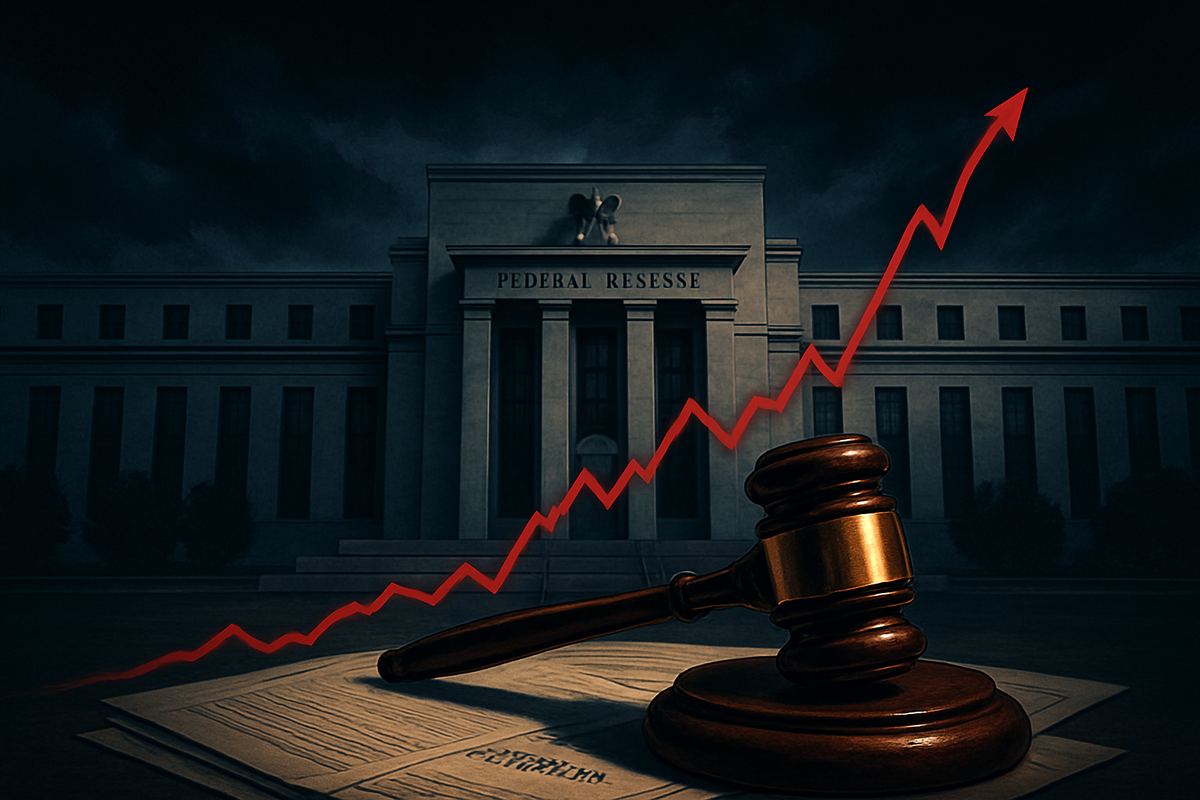
The U.S. Treasury market was plunged into a state of historic volatility on Monday, January 12, 2026, as investors reacted to an unprecedented legal assault on the Federal Reserve’s independence. Following a defiant Sunday evening statement by Fed Chair Jerome Powell, in which he revealed that the Department of Justice (DOJ) had served the central bank with grand jury subpoenas, the 10-year Treasury yield surged to 4.20%. This "Sell America" trade reflects growing fears that the world’s most influential central bank is being subjected to political retribution, potentially de-anchoring long-term inflation expectations and permanently altering the risk profile of U.S. sovereign debt.
The market reaction has been swift and unforgiving, characterized by a "bear steepening" of the yield curve. While short-term rates remained relatively stable on hopes of future rate cuts to combat a softening labor market, long-dated yields spiked as the "term premium"—the extra compensation investors demand for holding long-term debt—soared. The immediate implication for fixed-income investors is a sharp devaluation of existing bond portfolios and a harrowing new reality where the "risk-free rate" now carries a distinct "political risk premium."
A Weekend of Escalation: From Renovations to Subpoenas
The current crisis traces its roots to a simmering conflict between the White House and the Federal Reserve that boiled over during the second half of 2025. The flashpoint arrived on Friday, January 9, 2026, when the DOJ, led by Attorney General Pam Bondi and U.S. Attorney Jeanine Pirro, served the Federal Reserve with grand jury subpoenas. The investigation centers on allegations that Chair Powell committed perjury during his June 2025 testimony before the Senate Banking Committee regarding the $2.5 billion renovation of the Fed’s Marriner S. Eccles Building. The DOJ alleges that Powell misled Congress about cost overruns and the inclusion of "extravagant" features, such as VIP dining rooms and terrace gardens.
However, the narrative shifted dramatically on Sunday, January 11, when Powell released a video statement characterizing the criminal probe as a "pretext" for political intimidation. Powell argued that the investigation was a direct response to the Fed’s refusal to cut interest rates as aggressively as the administration demanded. "The threat of criminal charges is a consequence of the Federal Reserve setting interest rates based on our best assessment of what will serve the public, rather than following the preferences of the president," Powell stated. This public defiance set the stage for Monday's market turmoil, as the prospect of a criminalized central bank policy sent shockwaves through global trading desks.
The subpoena is the latest in a series of escalations. In August 2025, the administration attempted to fire Fed Governor Lisa Cook "for cause," citing decade-old allegations of mortgage fraud. That move led to a high-stakes legal battle, with the Supreme Court case Trump v. Cook scheduled for oral arguments on January 21, 2026. The confluence of the Cook case and the Powell subpoena has convinced market participants that the institutional safeguards protecting the Fed are under a sustained and coordinated siege.
Winners and Losers in a Volatile Fixed-Income Landscape
The sudden spike in yields and the erosion of institutional trust have created a bifurcated landscape for public companies. Large financial institutions like JPMorgan Chase & Co. (NYSE: JPM) are navigating a treacherous environment where increased volatility boosts trading revenue but threatens the value of their massive high-quality liquid asset (HQLA) portfolios. Analysts suggest that while the "widening of spreads" can be profitable for market makers, the underlying instability in the Treasury market—the bedrock of the global financial system—poses a systemic risk to traditional banking models.
Electronic bond trading platforms, such as MarketAxess Holdings Inc. (Nasdaq: MKTX) and Tradeweb Markets Inc. (Nasdaq: TW), are seeing record volumes as investors scramble to reposition their portfolios. These companies stand to benefit from the heightened activity, though the "gapping" of prices in the Treasury market makes execution increasingly difficult for their clients. Meanwhile, asset managers like BlackRock, Inc. (NYSE: BLINK) are facing a dual challenge: managing the fallout for their fixed-income clients while simultaneously advocating for the stability of the financial system in a period of unprecedented political interference.
On the flip side, "hard asset" and alternative currency plays have emerged as the primary beneficiaries of the "anti-dollar" sentiment. Gold prices shattered records, surpassing $4,600 per ounce, providing a tailwind for miners like Newmont Corporation (NYSE: NEM). Similarly, the crypto market saw a massive influx of capital as Bitcoin spiked past $90,500, viewed by some as a "sovereign hedge." This has buoyed shares of Coinbase Global, Inc. (Nasdaq: COIN), as institutional investors seek assets that sit outside the direct control of a politically embroiled U.S. monetary authority.
The Death of Neutrality: Wider Significance and Historical Precedent
The DOJ's move against the Fed represents a fundamental shift in the relationship between the executive branch and the central bank. Historically, the Fed's independence has been viewed as a cornerstone of U.S. economic stability, ensuring that monetary policy remains insulated from short-term political cycles. By criminalizing policy disagreements—or using administrative costs as a "pretext" for legal action—the administration is challenging the "for cause" removal protections that have stood for decades. This creates a "time-inconsistency problem," where markets fear the Fed will eventually succumb to pressure to keep rates low, leading to long-term inflationary spirals.
This event fits into a broader global trend of "central bank capture" seen in emerging markets, but its appearance in the United States is a watershed moment. The "political risk premium" now being priced into Treasuries suggests that the U.S. dollar may no longer be viewed as a strictly neutral reserve currency. If the Fed is seen as an arm of the executive branch, the credibility of its inflation targets vanishes. This has significant ripple effects for international partners who hold trillions in U.S. debt; any sustained loss of confidence could lead to a disorderly exit from Treasury holdings by foreign central banks.
The historical comparison often cited is the pressure President Richard Nixon placed on Fed Chair Arthur Burns in the early 1970s, which contributed to the "Great Inflation." However, the current situation is arguably more severe because it involves the direct use of the Department of Justice and criminal subpoenas. The bipartisan backlash has already begun, with Senator Thom Tillis (R-NC) and other members of the Senate Banking Committee vowing to block future Fed nominees until the legal integrity of the institution is restored.
The Path Forward: Scenarios and Strategic Pivots
In the short term, the market will remain hyper-focused on the Supreme Court’s handling of the Trump v. Cook case on January 21. A ruling that broadens the President's power to fire Fed governors would likely trigger another leg up in Treasury yields and a further sell-off in the dollar. Conversely, a strong defense of the Fed’s independence by the Court could provide a temporary "relief rally." Investors should also watch for any signs of a "buyer's strike" at upcoming Treasury auctions, which would signal that the market is no longer willing to absorb U.S. debt at current price levels.
Long-term, fixed-income investors may need to permanently adjust their duration strategies. The "60/40" portfolio model is under threat if Treasuries can no longer serve as a reliable hedge during periods of equity market stress. We may see a strategic pivot toward inflation-protected securities (TIPS), international bonds with higher institutional stability, and alternative stores of value. For the Federal Reserve, the challenge will be maintaining its dual mandate of price stability and maximum employment while operating under the shadow of a grand jury.
Conclusion: A Turning Point for Global Markets
The DOJ subpoena of the Federal Reserve marks a definitive end to the era of unquestioned central bank autonomy in the United States. The resulting volatility in the Treasury market is not merely a technical reaction to news; it is a fundamental repricing of American creditworthiness and institutional reliability. As yields climb and the dollar wavers, the "political risk premium" has moved from a theoretical concept to a tangible cost for every borrower and investor in the country.
Moving forward, the market will be characterized by heightened sensitivity to every headline involving the DOJ, the Fed, and the Supreme Court. The key takeaway for investors is that the "risk-free" nature of U.S. Treasuries is currently in question. In the coming months, the focus will shift from economic data like CPI and payrolls to legal filings and congressional hearings. The stability of the global financial system may well depend on whether the Federal Reserve can survive this period of institutional combat with its credibility intact.
This content is intended for informational purposes only and is not financial advice