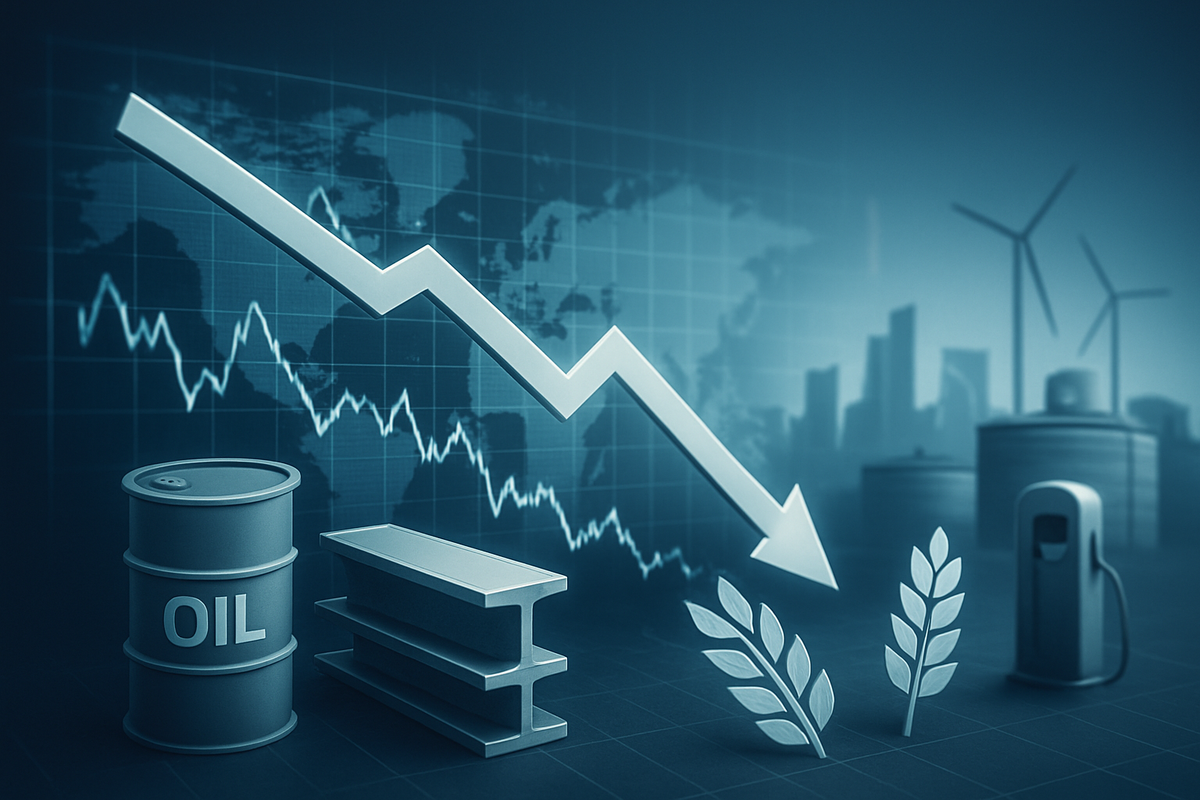
The global economy is entering a period of significant deflationary pressure within the raw materials sector as the World Bank’s latest Commodity Price Outlook projects a sustained downturn through 2026. Driven by a historic surplus in crude oil and a sharp deceleration in demand from traditional industrial powerhouses, aggregate commodity prices are expected to retreat to their lowest levels since the 2020 pandemic. This shift marks a definitive end to the post-pandemic inflationary spike, offering a reprieve to consumers and central banks but presenting a formidable challenge to commodity-dependent nations and energy-heavy investment portfolios.
As of late January 2026, the World Bank’s findings indicate that global commodity prices will fall by approximately 7% in both 2025 and 2026. This consecutive decline is the primary result of a "massive oil glut" and a structural transformation in the Chinese economy, where the rapid adoption of electric vehicles has fundamentally altered global fuel consumption patterns. For investors, this transition necessitates a strategic pivot away from broad-based commodity exposure toward selective, high-yield defensive plays.
A Perfect Storm: The Convergence of Oversupply and Waning Demand
The World Bank’s October 2025 and January 2026 reports highlight a staggering projected surplus in the global oil market, estimated to reach an average of 3 million barrels per day (mb/d) by the end of 2026. This surplus is roughly 65% larger than the glut experienced during the 2020 lockdowns, creating a pricing floor that many analysts believe will settle around $60 per barrel for Brent crude. The timeline leading to this moment began in late 2024, as production from non-OPEC+ nations—most notably the United States, Brazil, Guyana, and Argentina—surged to record highs while demand in China stagnated.
Key stakeholders, including OPEC+ leadership and the World Bank’s Chief Economist Indermit Gill, have noted that the 2026 outlook is defined by "extreme policy uncertainty" and geopolitical volatility. Despite ongoing regional conflicts that historically would have driven prices upward, the sheer volume of excess supply has acted as a persistent dampener. Initial market reactions in early 2026 have seen the energy price index slide by more than 10% year-over-year, with European natural gas and Australian coal following a similar downward trajectory.
The Winners and Losers: Corporate Resilience in a Deflationary Climate
The projected price slump is creating a "schism" in the corporate world, separating low-cost, integrated giants from higher-cost independent producers. Exxon Mobil (NYSE: XOM) is emerging as a potential winner in this low-price environment; the company’s massive low-cost production footprint in Guyana and the Permian Basin allows it to maintain profitability even at $60 oil. Furthermore, XOM’s downstream chemical segments typically benefit from lower feedstock costs. In contrast, Chevron (NYSE: CVX) has faced increased scrutiny from analysts, with some moving to a "Hold" rating as the company's aggressive stock buyback programs face pressure from narrowing margins.
In the metals sector, Vale S.A. (NYSE: VALE) has signaled a strategic pivot toward "premium brands" of high-quality iron ore to protect against the slowdown in Chinese construction. While iron ore prices are expected to dip toward $90 per metric ton, Vale’s high dividend yield and operational efficiency have kept it in favor with value-oriented investors. Conversely, the agricultural giant Archer-Daniels-Midland (NYSE: ADM) continues to navigate a complex landscape. While falling crop prices normally squeeze margins, ADM is banking on a 2026 rebound driven by the growth of Sustainable Aviation Fuel (SAF) and improved trade relations with major Asian markets.
Broader Implications: Navigating the "Green" Industrial Transition
The 2026 commodity slump is not merely a cyclical downturn but a reflection of broader structural shifts in the global economy. The World Bank notes that the "China Factor"—once the primary engine of commodity demand—has evolved. The country’s transition to electric vehicles, which now represent over 40% of its domestic new car sales, has permanently decoupled its economic growth from traditional oil demand. This shift is a historical precedent that mirrors the West's transition away from coal in the late 20th century, signaling a long-term decline in fossil fuel reliance.
The ripple effects are felt most acutely by commodity-exporting developing nations, which make up two-thirds of the developing world. The World Bank has warned that these nations face immense fiscal pressure and must utilize the current "low-price window" to implement structural reforms. For central banks, the 7% annual drop in commodity prices provides a significant tailwind for the "last mile" of inflation control, potentially allowing for a more dovish monetary policy stance across the G7 nations through the remainder of 2026.
Looking Ahead: Strategic Pivots for a New Era
In the short term, volatility remains the primary risk. While the baseline forecast is bearish for prices, "black swan" events such as extreme weather or sudden escalations in regional conflicts could provide temporary price spikes. However, the long-term outlook through 2026 and 2027 suggests that supply will continue to outpace demand. Strategic adaptations will be required for investors who have traditionally relied on the United States Oil Fund (NYSEARCA: USO), which faces a challenging environment in a "glut" scenario.
Conversely, market opportunities are emerging in precious metals. The SPDR Gold Shares (NYSEARCA: GLD) and iShares Silver Trust (NYSEARCA: SLV) have remained outliers in the 2026 outlook, with gold prices continuing to hover near record highs. As investors seek "safe-haven" assets to hedge against persistent policy uncertainty and fiscal deficits, precious metals are likely to remain the dominant "buy" in an otherwise cooling commodity market. The Energy Select Sector SPDR Fund (NYSEARCA: XLE) is also being viewed as a "hold" for its yield, though capital appreciation may be limited.
Final Assessment: What to Watch in 2026
The World Bank’s 2026 Commodity Price Outlook confirms that the era of scarcity-driven price spikes has given way to an era of abundance and structural transition. The key takeaway for the market is a return to "normality," where nominal prices sit well below 2022 peaks, providing a much-needed cooling effect on global inflation. However, this transition is fraught with risk for those on the wrong side of the energy transition or those heavily exposed to high-cost production.
Moving forward, investors should closely monitor the monthly "Pink Sheet" price updates from the World Bank and the production data from non-OPEC+ nations. The sustainability of dividends from energy majors like Exxon Mobil (NYSE: XOM) and the pace of the EV transition in emerging markets will be the critical metrics to watch. As the world adjusts to $60 oil and cheaper food and industrial metals, the primary challenge will be navigating the fiscal instability of exporting nations while capitalizing on the selective growth of the "green" economy.
This content is intended for informational purposes only and is not financial advice.