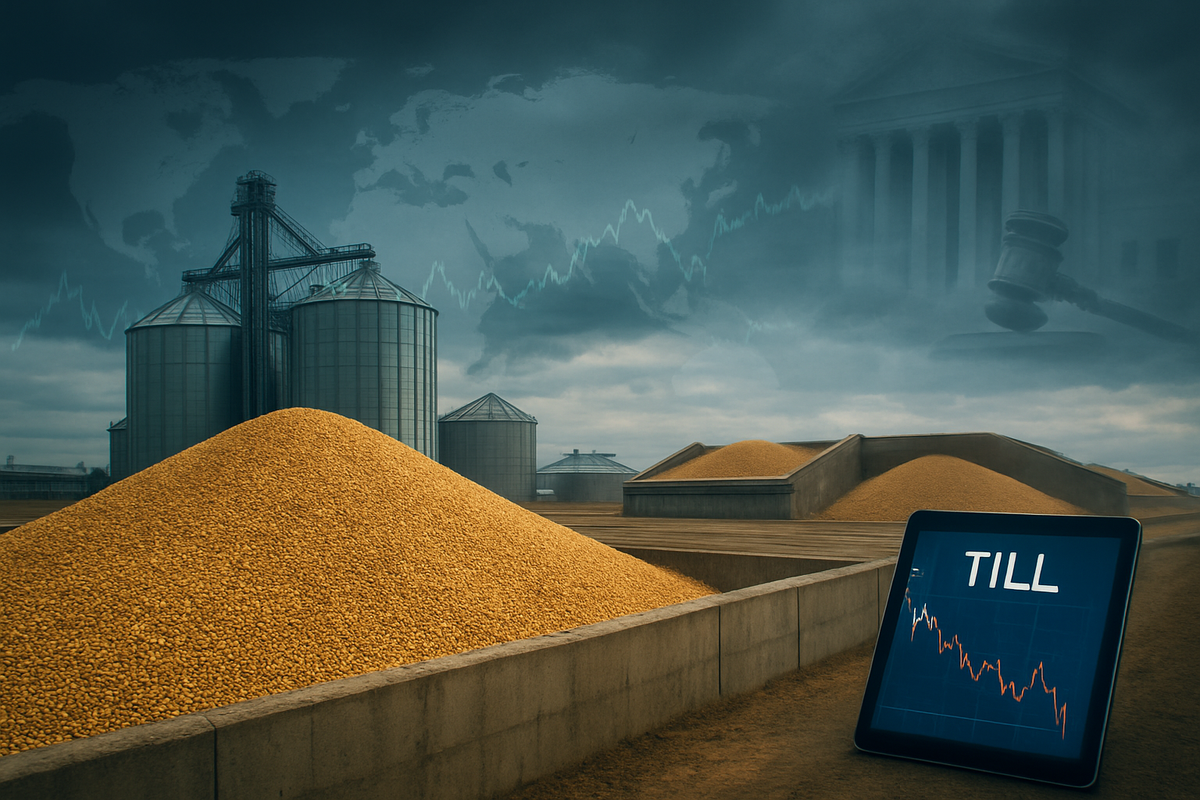
The U.S. soybean market is facing a perfect storm of oversupply and legal volatility as the February 2026 USDA World Agricultural Supply and Demand Estimates (WASDE) report confirmed a seven-year high for domestic ending stocks. With 350 million bushels projected to remain in storage, the agricultural sector is grappling with a supply glut that has sent futures prices into a tailspin. This surplus is being further aggravated by a massive South American harvest, which is currently flooding the global market with cheaper alternatives to American grain.
Compounding these fundamental pressures is a high-stakes legal battle that has reached the nation's highest court. A recent U.S. Supreme Court ruling has stripped the executive branch of certain unilateral tariff powers, casting a long shadow of doubt over China's commitment to massive soybean purchase plans. For investors and farmers alike, the combination of a "wall of beans" and a crumbling trade policy framework has created a climate of deep uncertainty, reflected in the volatile performance of key sector benchmarks like the Teucrium Agricultural Strategy No K-1 ETF (NYSE Arca: TILL).
A Convergence of Supply and Legal Chaos
The current crisis began to coalesce on February 10, 2026, when the USDA released its WASDE report. The figure of 350 million bushels in ending stocks was the headline-grabber, representing the highest level of unsold inventory since 2019. While analysts had expected high numbers, the confirmation of a seven-year peak solidified the "bearish" sentiment in the pits of the Chicago Board of Trade. The USDA maintained its export forecast at 1.575 billion bushels, a cautious stance that reflects growing skepticism about global demand keeping pace with the American harvest.
However, the "black swan" event occurred on February 20, 2026, when the U.S. Supreme Court issued a landmark 6-3 ruling. The Court found that the use of the 1977 International Emergency Economic Powers Act (IEEPA) to impose broad, country-specific tariffs was an overextension of executive authority. This ruling effectively invalidated several 2025 duties that had been used as leverage in trade negotiations with Beijing. In an immediate countermove, the administration pivoted to Section 122 of the Trade Act of 1974, implementing a 15% global tariff to address trade imbalances. This legal whiplash has left Chinese state-owned buyers hesitant to fulfill an outstanding 12 million metric ton (MMT) purchase commitment, of which roughly 40% remains unshipped.
While the U.S. legal system debated trade law, the physical market was being upended by South American production. Brazil is currently in the midst of a record-breaking harvest, projected at 182 million metric tons. Although heavy rains in Mato Grosso have slowed the harvest pace to 30%—behind the 39% seen this time last year—the sheer volume of Brazilian beans entering the market is overwhelming. Currently, Brazilian soybeans are pricing nearly $1.00 per bushel below U.S. Gulf values, making it economically impossible for U.S. exporters to compete for Chinese business without significant price concessions.
Winners and Losers in a Saturated Market
The primary victims of this price depression are the large-scale U.S. agribusinesses and farmers who are seeing their margins evaporate. Archer-Daniels-Midland (NYSE: ADM) and Bunge Global SA (NYSE: BG) have faced significant headwinds as the spread between North American and South American prices complicates their global logistics and trading strategies. For ADM, a seven-year high in stocks means high storage costs and lower processing margins as the "crush" value of soybeans fluctuates under the weight of excess supply.
Conversely, some market players are finding opportunities in the volatility. The Teucrium Agricultural Strategy No K-1 ETF (NYSE Arca: TILL) has seen increased interest from institutional investors seeking a hedge against inflation and geopolitical instability. Despite the downward pressure on spot prices, TILL recently generated a "Golden Star Signal," a technical indicator suggesting that its diversified approach—holding futures in corn, wheat, and sugar alongside soybeans—might offer a safer haven than pure-play soybean bets. The ETF’s ability to navigate the futures curve has allowed it to trade between $16.75 and $17.22, showing resilience even as the underlying commodity remains under fire.
Small-to-mid-cap logistics and storage companies like The Andersons, Inc. (Nasdaq: ANDE) are in a complex position. While they benefit from the physical volume of grain moving through their elevators, the lack of "carry" in the market—where future prices are significantly higher than current prices—makes the long-term storage of a 350-million-bushel surplus a risky financial proposition. If China continues to stall on its purchase agreements, these storage facilities may become bottlenecks for the entire U.S. agricultural supply chain.
Global Trade and the Death of "Tariff Diplomacy"
The Supreme Court ruling marks a fundamental shift in how the United States conducts trade policy. For the past decade, the threat of unilateral tariffs has been the primary tool for securing agricultural purchase agreements from nations like China. With the Court's decision to limit IEEPA powers, the "stick" in the "carrot-and-stick" approach has been significantly weakened. This creates a precedent that other trading partners may follow, potentially leading to a more fractured global trade environment where multi-year purchase commitments are harder to enforce.
This event fits into a broader trend of agricultural "de-globalization." As Brazil and Argentina increase their yields through technological advancement and expanded acreage, the U.S. is losing its status as the world’s "residual supplier." The 2026 surplus is not just a one-year fluke; it is the result of a long-term trend where global production is consistently outpacing demand growth. The ripple effects are already being felt in the fertilizer and machinery sectors, as lower soybean prices force farmers to cut back on capital expenditures for the 2026/27 planting season.
Historically, periods of extreme surplus like the 2018-2019 trade war era were eventually resolved through government bailouts and "Phase One" trade deals. However, the current fiscal environment and the recent judicial constraints on the presidency make a repeat of those solutions unlikely. The market is now looking for a "market-clearing" price—a level low enough to stimulate new demand or force a reduction in acreage—which could mean further pain for the Midwest in the short term.
The Road Ahead: Summits and Sanctions
The immediate focus for the market will be the upcoming April summit between U.S. and Chinese leadership. Investors are watching for any sign that the 12 MMT commitment will be honored despite the legal instability of U.S. tariffs. If the summit fails to produce a concrete timeline for shipments, the USDA may be forced to raise ending stocks even further in the March and April WASDE reports, potentially pushing the surplus toward the 400-million-bushel mark.
In the medium term, the U.S. agricultural sector must pivot toward domestic demand. This includes the continued expansion of the renewable diesel industry, which uses soybean oil as a primary feedstock. However, until the "meal" component of the soybean can find a consistent home—either through increased livestock exports or new industrial uses—the surplus of raw beans will remain a structural drag on the market. Companies like Bunge (NYSE: BG) are already investing heavily in domestic crushing capacity to capitalize on this trend, but these facilities take years to come online.
A potential "upside" scenario for prices would involve a significant weather event in South America. While the Brazilian harvest is large, the persistent dryness in Rio Grande do Sul and the upcoming "second crop" (Safrinha) corn planting remain vulnerable. Any downgrade in South American production estimates in late March could provide the relief U.S. farmers desperately need to move their 350-million-bushel stockpile.
A Precarious Balance for Investors
The soybean market of early 2026 is a study in the limitations of supply-side economics. Even with a productive and efficient farming sector, the lack of reliable trade partners and the unpredictability of the legal system can render a record-setting harvest a liability rather than an asset. The 350-million-bushel ending stocks figure serves as a sobering reminder that in the world of commodities, "too much of a good thing" is a recipe for a market crash.
Moving forward, investors should keep a close eye on the "basis"—the difference between local cash prices and the futures market. If the basis remains historically weak, it suggests that the physical surplus is even more burdensome than the USDA data implies. Furthermore, the performance of diversified instruments like the Teucrium Agricultural Strategy No K-1 ETF (NYSE Arca: TILL) will be a critical barometer for whether the agricultural sector can decouple from the specific woes of the soybean market.
The lasting impact of the Supreme Court ruling will likely be felt for years, as it forces the executive branch to find new, more legally robust ways to manage trade relations. For the soybean market, 2026 is shaping up to be a year of reckoning—a time when the "wall of beans" must finally meet the reality of a changing global order.
This content is intended for informational purposes only and is not financial advice