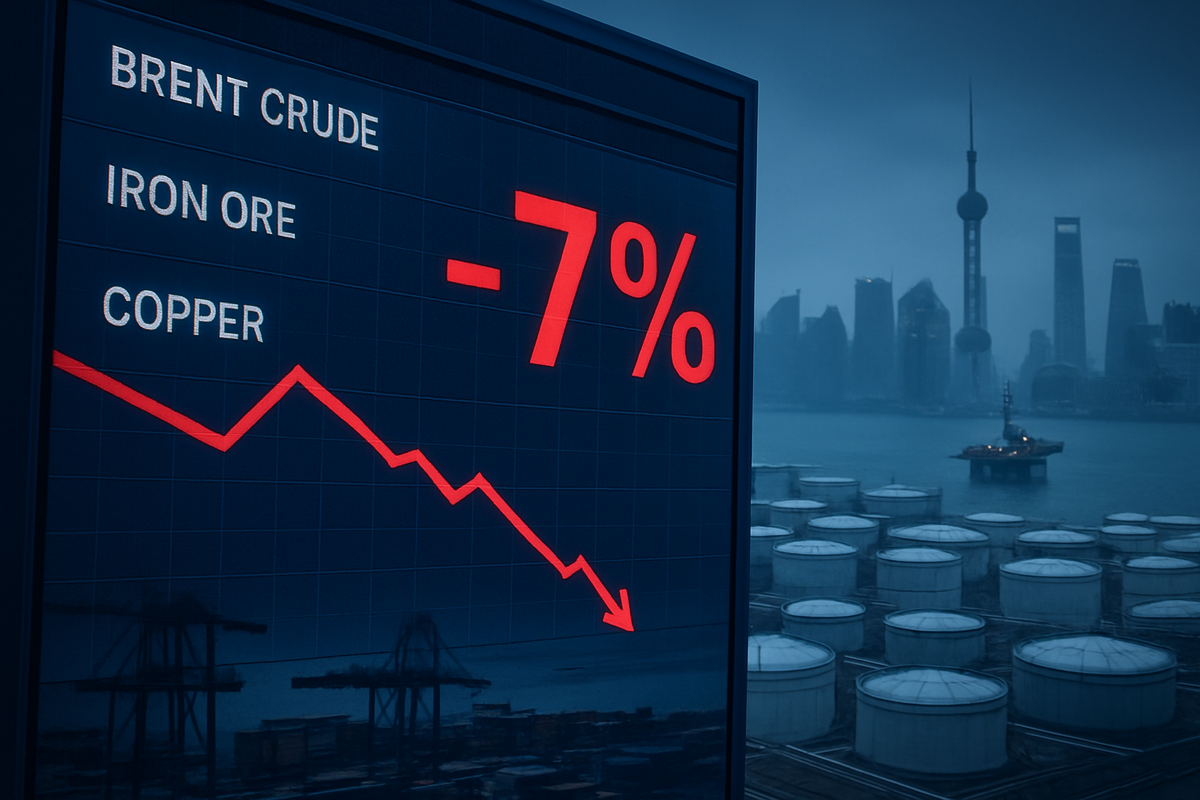
The global economic landscape is facing a definitive shift as commodity prices are projected to hit their lowest levels since the 2020 pandemic lockdowns. According to the World Bank’s March 2026 Commodity Markets Outlook, a combination of a historic oil glut and a structural slowdown in Chinese industrial demand will drive an aggregate price drop of 7% this year. This marks the fourth consecutive year of declining raw material costs, signaling a definitive end to the inflationary era that gripped the world following the COVID-19 recovery.
For central banks, this trend provides a long-awaited "disinflationary tailwind," potentially clearing the path for the Federal Reserve and the European Central Bank to firmly hit their 2% inflation targets. However, for commodity-exporting nations and traditional energy giants, the report serves as a stark warning: the "Great Oil Glut" of 2026 is creating a buffer against geopolitical shocks but also squeezing fiscal margins to levels not seen in half a decade.
The End of the Post-Pandemic Boom: A Four-Year Decline
The World Bank’s latest report, released in mid-March 2026, confirms a rare and prolonged "post-commodity-boom" era. Global prices have been on a downward trajectory since 2023, but the 7% contraction forecasted for 2026 is particularly significant, as it brings the aggregate index to its lowest point in six years. The report highlights that while prices remain roughly 14% higher than their 2019 pre-pandemic averages, the rapid descent has effectively neutralized the price spikes seen during the 2021-2022 supply chain crises.
Central to this decline is the emergence of a massive oil surplus, expected to average 1.2 million barrels per day (mb/d) throughout 2026. This level of oversupply has only been exceeded twice in modern history: during the 1998 Asian Financial Crisis and the initial 2020 lockdowns. Brent crude is now projected to average just $60 per barrel for the year. This surplus is being fueled by aggressive production expansions in non-OPEC+ regions and a faster-than-anticipated global transition toward electric vehicles (EVs), which has caused oil demand to plateau across major economies.
The timeline leading to this moment began in late 2024, as high interest rates began to temper global construction and manufacturing. By 2025, the "perfect storm" of subdued global growth and surging supply from the Americas became undeniable. The World Bank’s Chief Economist noted that the current market is essentially "self-insulating" against Middle Eastern or Eastern European geopolitical tensions, as the sheer volume of available supply acts as a shock absorber for the global economy.
Corporate Winners and Losers in a Deflationary World
The move toward a $60-per-barrel oil environment and cheaper raw materials is creating a stark divide between industrial sectors. In the energy space, giants like ExxonMobil (NYSE: XOM) and Chevron (NYSE: CVX) are responding by doubling down on low-cost production regions like the Permian Basin and Guyana. Their strategy is one of "scale over price," attempting to maintain profitability through sheer volume as margins per barrel shrink. Meanwhile, Shell (NYSE: SHEL) has accelerated its pivot toward low-carbon segments, recognizing that high-cost upstream projects are no longer viable in a world of persistent surpluses.
The mining sector is facing even steeper challenges. With Chinese property markets remaining in a structural deep-freeze, demand for steel and iron ore has cratered. BHP Group (NYSE: BHP) and Rio Tinto (NYSE: RIO) are grappling with a forecasted 20% drop in iron ore prices for 2026. In response, Rio Tinto has increasingly shifted its capital expenditures toward copper and lithium, betting on the green energy transition to decouple its fortunes from the traditional Chinese infrastructure cycle. Vale (NYSE: VALE) is similarly focusing on high-grade "green iron" to maintain a premium in an oversupplied market.
Conversely, the "losers" of the commodity boom are the "winners" of the current glut. Transportation and logistics companies are seeing their highest margins in years as fuel costs—their largest variable expense—plummet. Delta Air Lines (NYSE: DAL) and FedEx (NYSE: FDX) both reported significant earnings beats in early 2026, fueled directly by the drop in jet and diesel fuel prices. In the retail sector, Walmart (NYSE: WMT) is leveraging lower input and logistics costs to "invest in price," gaining market share from competitors by passing savings onto consumers who are still recovering from years of high inflation.
China’s Structural Shift and the Global Disinflationary Wave
The 2026 commodity crash is not merely a cyclical downturn; it is a reflection of a fundamental shift in the world's second-largest economy. China, which for decades acted as the primary engine of commodity demand, is undergoing a "high-tech manufacturing" pivot. The World Bank notes that China’s shift away from heavy infrastructure and its leading role in the EV revolution have permanently altered the demand curve for fossil fuels and industrial metals. This structural cooling has left a void in the market that emerging economies in South Asia and Africa have yet to fill.
For global policymakers, the 7% drop in commodity prices is a welcome relief but comes with new risks. The Federal Reserve and the ECB now face a "policy trap." While falling energy and food prices (the latter expected to stabilize after significant drops in 2024 and 2025) provide the statistical room to cut interest rates, central bankers remain wary of "localized inflation" driven by service sectors or trade tariffs. There is a growing concern that if commodity prices fall too far, they could trigger a deflationary spiral in certain export-heavy regions, particularly within OPEC+ and Russia.
Historically, periods of extreme commodity surplus, such as the late 1990s, led to significant geopolitical realignment and domestic instability in oil-dependent nations. The World Bank’s 2026 report warns that energy-exporting countries must "put their fiscal houses in order" immediately, as the current surplus may represent a "new normal" rather than a temporary dip.
Looking Ahead: Strategic Pivots and the Search for a Bottom
In the short term, markets will likely remain volatile as traders attempt to find the floor for oil and industrial metals. Analysts expect a flurry of M&A activity in the mining and energy sectors as larger players move to acquire "critical mineral" assets that are less sensitive to the Chinese property cycle. The strategic pivot toward copper, nickel, and cobalt is no longer an optional hedge; it is becoming a survival requirement for the world's largest resource companies.
Longer-term, the massive 2026 oil surplus could accelerate the retirement of high-cost extraction projects in the North Sea and parts of the Arctic. As the "buffer" of oversupply remains in place, the world may see a period of unusually stable energy prices, which could ironically slow the pace of renewable energy adoption if green alternatives lose their price-competitiveness against $60 oil. Governments may need to intervene with new subsidies or carbon taxes to ensure the 2026 commodity crash doesn't derail 2030 climate targets.
Summary of a Market in Transition
The World Bank’s March 2026 Commodity Markets Outlook paints a picture of a global economy finally cooling after years of frantic heat. The 7% decline in prices and the emergence of a 1.2 mb/d oil surplus signify a transfer of wealth from commodity producers to consumers and industrial importers. For nations like India and Japan, and for corporate giants in the transportation and retail sectors, 2026 represents a year of significant opportunity and margin expansion.
For investors, the coming months will require a discerning eye. While the aggregate index is at a six-year low, "critical minerals" linked to the energy transition may continue to trade at a premium, creating a "two-speed" commodity market. The key takeaway for the remainder of 2026 is that the era of scarcity has ended, replaced by an era of abundance that will test the fiscal discipline of nations and the strategic agility of the world's largest public companies.
This content is intended for informational purposes only and is not financial advice