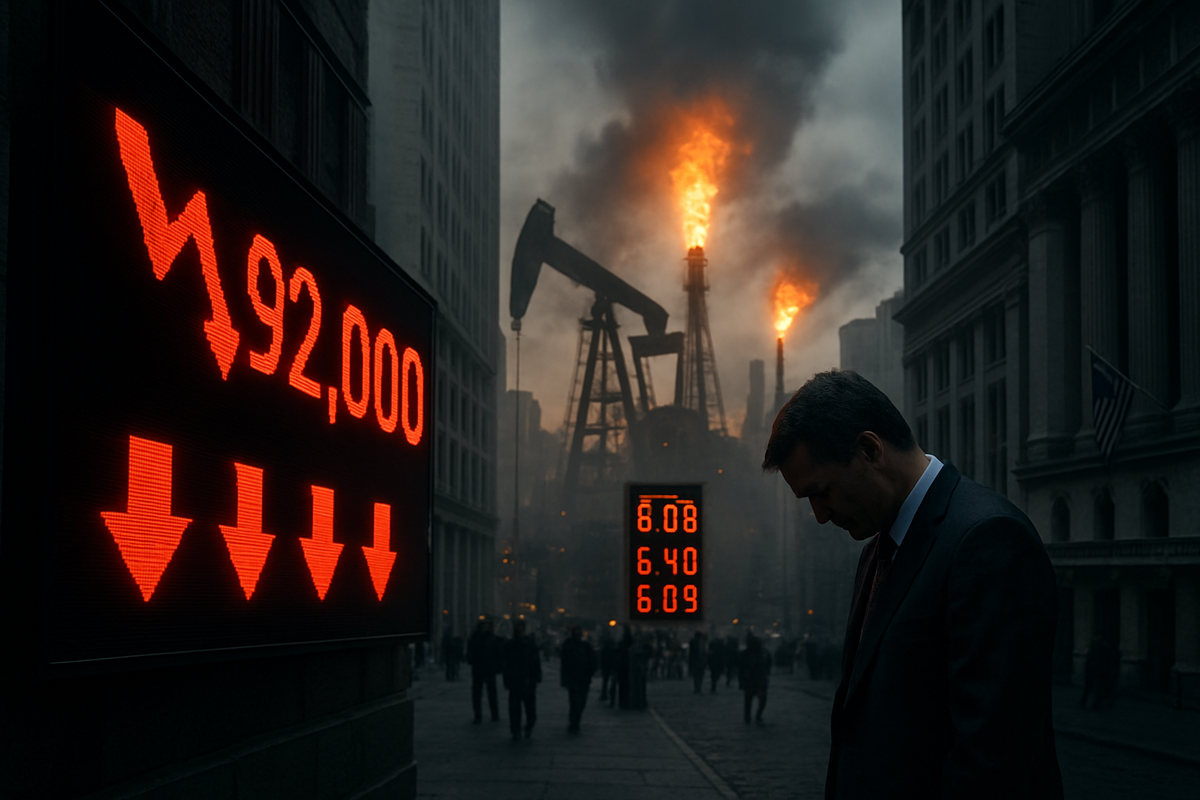
The U.S. economic narrative took a sharp and unsettling turn today, March 9, 2026, as investors and policymakers continued to digest the fallout from a shockingly weak labor report. In a data release that has sent shockwaves through the financial markets, the economy reportedly shed 92,000 jobs in January—a catastrophic miss against the consensus forecast of a 55,000-job gain. Compounding the anxiety, the national unemployment rate has climbed to 4.4%, a level not seen in years, signaling that the long-heralded "soft landing" may be veering into far more turbulent territory.
This sudden cooling of the labor market is colliding with a volatile spike in energy costs, creating a "perfect storm" of economic pressures. As Brent and WTI crude prices flirt with triple digits following renewed geopolitical instability in the Middle East, the specter of "stagflation"—the rare and painful combination of stagnant growth and high inflation—has returned to the forefront of the Wall Street lexicon. For an economy that had spent the last year searching for a stable equilibrium, the current data suggests a painful correction is underway.
A "Colossal" Miss: Decoding the January Slump
The details of the January labor report, which became the central focus of market discussion this week, reveal a broad-based retreat in hiring. While economists had anticipated a modest expansion of 55,000 roles, the reality of 92,000 lost positions represents one of the most significant forecasting errors in recent memory. The spike in the unemployment rate to 4.4% was driven by a contraction in the private sector, particularly within manufacturing and healthcare, the latter of which was hampered by significant labor strikes and rising operational costs.
The timeline leading to this moment was marked by a false sense of security. Throughout late 2025, the labor market appeared resilient, with steady, albeit slowing, monthly gains. However, the cumulative weight of sustained high interest rates and a sudden "tax" on consumers in the form of rising fuel prices appears to have finally broken the back of the hiring cycle. Initial market reactions were swift; the S&P 500 and Nasdaq saw immediate sell-offs as traders repriced the likelihood of a recession, while the bond market signaled deep concern over the Federal Reserve’s next move.
Winners and Losers in a High-Cost Environment
The shifting economic landscape is creating a stark divide between corporate "winners" who can leverage high commodity prices and "losers" caught in the squeeze of declining consumer discretionary spending. Chevron Corporation (NYSE: CVX) and ExxonMobil (NYSE: XOM) have emerged as primary beneficiaries of the energy spike. With crude prices surging due to supply disruptions in the Strait of Hormuz, these integrated energy giants are seeing a massive influx of cash flow, with CVX recently hitting new multi-year highs. Similarly, Occidental Petroleum (NYSE: OXY) has remained a favorite for investors looking to hedge against inflation through domestic production.
Conversely, the retail and logistics sectors are facing a brutal headwinds. Target (NYSE: TGT) and Amazon (NASDAQ: AMZN) are being hit from two sides: rising shipping and fuel costs are eating into margins, while the 4.4% unemployment rate and high gas prices are forcing consumers to tighten their belts. While Walmart (NYSE: WMT) has shown resilience as high-income shoppers "trade down" to discount groceries, even the retail giant is not immune to the cooling labor market’s impact on overall household spending power. Costco (NASDAQ: COST) has managed to maintain its member loyalty, but analysts warn that "caution" is the new watchword in the non-essential aisles.
The Stagflation Trap: Broader Significance and Historical Echoes
The current situation is fueling comparisons to the stagflation era of the 1970s, a period characterized by energy shocks and high unemployment that proved notoriously difficult for the Federal Reserve to manage. Historically, the Fed uses interest rate cuts to stimulate a flagging job market. However, with energy-driven inflation remaining sticky, a rate cut risks pouring gasoline on the inflationary fire. San Francisco Fed President Mary Daly recently noted that both sides of the central bank’s dual mandate—stable prices and maximum employment—are now at risk simultaneously.
This event fits into a broader trend of "cost-push" inflation, where supply chain disruptions and geopolitical "war premiums" drive prices up regardless of consumer demand. For competitors and partners in the global supply chain, the ripple effects are significant; higher transportation costs are being passed down the line, further depressing margins for mid-size manufacturers. The policy implications are immense, as the administration faces mounting pressure to address energy security while the Fed is forced into a "wait-and-see" posture that markets find deeply unsettling.
The Road Ahead: Strategic Pivots and Market Outlook
In the short term, Wall Street is bracing for continued volatility as it awaits the next round of inflation data. If energy prices do not stabilize, the Federal Reserve may be forced to keep rates steady at 3.64% or higher, even as the labor market continues to soften. This "policy paralysis" is the greatest fear for many analysts, as it leaves the economy without a clear stimulus path. Companies will likely pivot toward aggressive cost-cutting and automation to protect margins, which could lead to further job losses in the coming quarters.
Long-term, this period may mark a structural shift in how investors approach the market. The "Goldilocks" era of low inflation and steady growth appears to be over, replaced by a regime where commodity exposure and value-oriented retail are the only safe havens. Market participants should watch for potential strategic mergers in the energy sector and a possible resurgence in federal intervention to stabilize domestic fuel prices.
Closing Thoughts: A New Economic Reality
The January jobs report is more than just a data point; it is a signal that the post-pandemic economic cycle has entered a fragile new phase. The surprise loss of 92,000 jobs, paired with an unemployment rate ticking up to 4.4%, serves as a stark reminder that the labor market is no longer the bulletproof engine of growth it once was. Combined with the relentless climb of energy prices, the "ghost of stagflation" is no longer a theoretical risk—it is a present reality for Wall Street and Main Street alike.
As we move forward into the spring of 2026, investors should keep a close eye on the Fed’s rhetoric and the stability of global energy corridors. The ability of companies to maintain pricing power in a cooling economy will separate the survivors from the casualties. For now, the market remains in a defensive crouch, waiting for a sign that the twin threats of rising costs and falling employment can be contained before they spiral into a deeper contraction.
This content is intended for informational purposes only and is not financial advice.