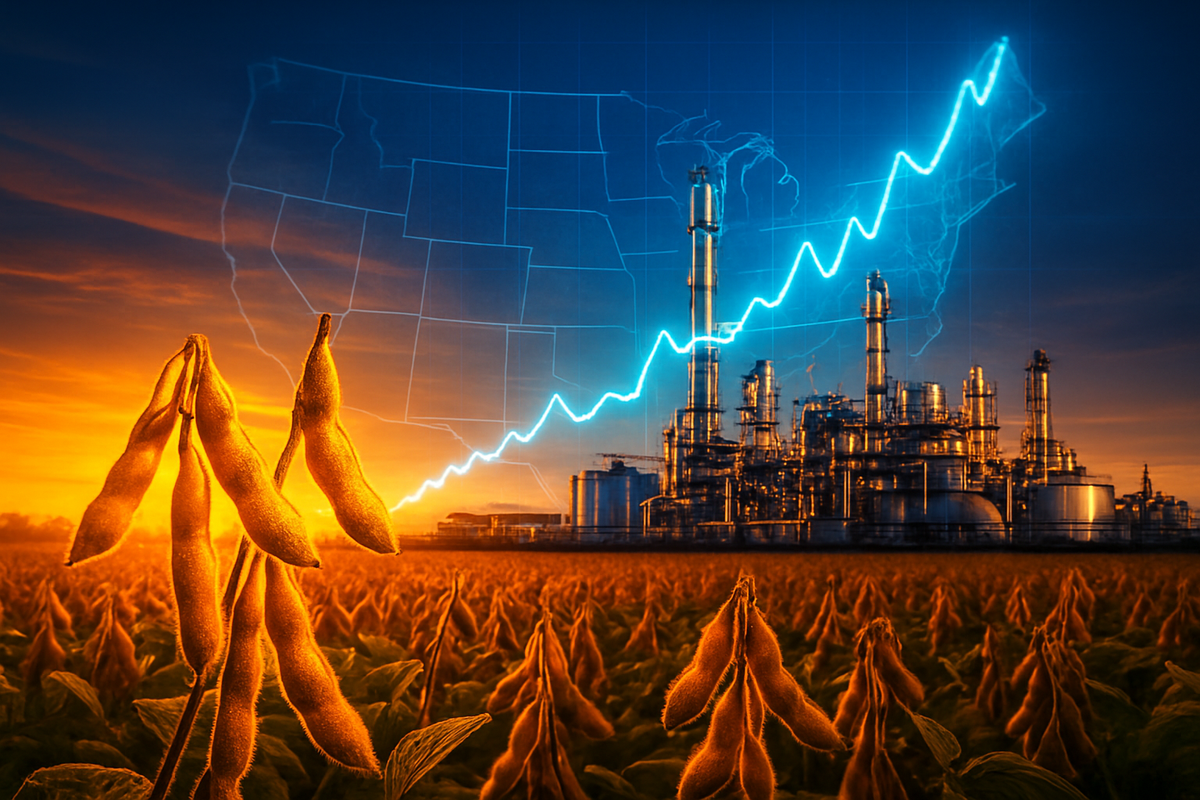
CHICAGO — The domestic agricultural landscape shifted violently this week as soybean oil futures surged to their highest levels in years, ignited by a sweeping policy pivot from the Environmental Protection Agency (EPA). In a move designed to decouple American energy production from foreign supply chains, the Trump administration has proposed a radical restructuring of the Renewable Fuel Standard (RFS) that would effectively strip lucrative tax credits from imported "waste" feedstocks. The immediate fallout has been a dramatic repricing of the vegetable oil complex, signaling a new era of protectionism that prioritizes the American farmer over global trade efficiencies.
The reaction in the commodities pits was instantaneous. Soybean oil futures, which had been trading at a relatively stable $0.57 per pound, catapulted to $0.66 per pound following the announcement—a staggering 15% jump in a matter of days. This price action reflects a market suddenly realizing that the massive renewable diesel capacity built over the last five years must now be fed almost exclusively by domestic crops. For consumers and the logistics industry, this policy shift suggests that the cost of "green" fuel is about to become significantly more expensive, even as the government mandates its use at record levels.
The Mandate Surge and the War on Foreign Feedstocks
The catalyst for this market upheaval is the EPA’s finalized "Set 2" rule for 2026 and 2027. Under the direction of the Trump administration, the agency has established the most aggressive biofuel blending requirements in U.S. history. For 2026, the total renewable volume obligation (RVO) has been set at a record 26.81 billion RINs, climbing further to 27.02 billion in 2027. Most crucially for the soy market, the specific mandate for biomass-based diesel has been hiked to over 9 billion gallons, a move that creates a massive, guaranteed floor for demand.
This "Green Industrial Realism" policy, as the White House has termed it, is paired with a controversial proposal to eliminate Renewable Identification Number (RIN) credits for imported feedstocks, such as Chinese Used Cooking Oil (UCO) and Brazilian tallow. Previously, these low-carbon intensity (CI) imports flooded the U.S. market, suppressing domestic soybean oil prices and frustrating American crushers. By stripping these imports of their compliance value, the EPA is effectively creating a "buy American" requirement for the biofuel industry. The timeline for this transition has been the subject of intense lobbying, but the administration’s current proposal suggests a phased elimination beginning in late 2026, forcing blenders to lock in domestic soy-oil contracts immediately.
Industrial Winners and Refiner Woes
The primary beneficiaries of this policy shift are the major grain processors who have invested billions in domestic crush capacity. Archer-Daniels-Midland (NYSE: ADM) and Bunge Global SA (NYSE: BG) are positioned to be the biggest winners, as their extensive network of Midwestern processing plants becomes the primary source for the mandated fuel volumes. These companies, which had seen margins squeezed by cheap Chinese UCO imports in 2024 and 2025, are now looking at a landscape where their core product is both federally mandated and shielded from foreign competition.
On the other side of the ledger, independent refiners and renewable diesel specialists face a daunting "feedstock crunch." Darling Ingredients (NYSE: DAR), which relies heavily on waste fats and greases, may see its competitive advantage eroded as the price gap between "waste" and "virgin" oils narrows due to the loss of import credits. Furthermore, pure-play renewable fuel producers like Vertex Energy (NASDAQ: VTNR) or those with significant renewable diesel bets like Valero Energy Corp (NYSE: VLO) and Marathon Petroleum (NYSE: MPC) must now contend with a 15% increase in their primary input cost. While these companies benefit from the high mandates, the soaring price of soybean oil threatens to eat into the blending margins that make these multi-billion dollar refineries viable.
A Decisive Shift in Global Trade Dynamics
This event fits into a broader global trend of "resource nationalism," where nations are increasingly viewing their agricultural output as a strategic energy reserve. For years, the U.S. biofuel industry relied on the "waste-to-fuel" narrative, which favored low-CI feedstocks like UCO regardless of origin. However, the Trump administration’s pivot redefines the RFS not just as an environmental tool, but as a mechanism for domestic economic stimulus. This mirrors historical precedents like the 2007 Energy Independence and Security Act, but with a protectionist twist that targets specifically the "dumping" of foreign fats.
The ripple effects will likely be felt in global trade relations, particularly with China. As the U.S. shuts the door on Chinese UCO, a massive glut of waste oil is expected to build up in Asia, potentially driving down prices there while U.S. food companies—from snack makers to fast-food chains—face higher costs for the soybean oil they use in frying and processing. This "food vs. fuel" debate, which had quieted during the period of high imports, is expected to return to the forefront of political discourse as the 2026 mandates take effect.
Navigating the Feedstock Crunch
In the short term, the market must adjust to a "new normal" of $0.60+ soybean oil. Traders are watching for whether the EPA will offer any "off-ramps" or safety valves if prices hit $0.70/lb, which would trigger significant inflationary pressure on the broader economy. Long-term, this policy will likely accelerate the development of alternative domestic feedstocks, such as winter camelina and cover-crop oilseeds, as companies scramble to find any domestic source that can meet the high mandates without the price premium of soy.
Strategically, we may see a wave of vertical integration. Large oil majors like Chevron (NYSE: CVX), which already has a joint venture with Bunge, may look to acquire even more direct control over the "acre" to ensure they aren't held hostage by fluctuating cash prices. The challenge for the market will be the "lag time" between policy announcement and the actual physical supply of more soybeans; farmers can only plant so much, and the 2026 crop is already being planned under the assumption of high demand.
Market Outlook and Final Thoughts
The surge in soybean oil to $0.66/lb is more than just a temporary spike; it is a fundamental revaluation of the asset based on a "Fortress America" energy policy. By combining record-high mandates for 2026 and 2027 with a crackdown on imported feedstocks, the Trump administration has essentially guaranteed that the American Midwest will remain the engine of the U.S. renewable fuel industry for the remainder of the decade.
Moving forward, investors should keep a close eye on the "RIN-to-Soy" spread and any potential pushback from the refining lobby, which may argue that these policies are too inflationary for the average American driver. While the "Golden Age of Agriculture" appears to be here for the grain giants, the volatility inherent in a protected market means that any shift in the geopolitical or regulatory winds could send prices tumbling just as fast as they rose. For now, however, the trend is clear: the path to energy dominance is paved in soybean oil.
This content is intended for informational purposes only and is not financial advice.