
Quarterly earnings results are a good time to check in on a company’s progress, especially compared to its peers in the same sector. Today we are looking at Voya Financial (NYSE: VOYA) and the best and worst performers in the custody bank industry.
Custody banks safeguard financial assets and provide services like settlement, accounting, and regulatory compliance for institutional investors. Growth opportunities stem from increasing global assets under custody, demand for data analytics, and blockchain technology adoption for settlement efficiency. Challenges include fee pressure from large clients, substantial technology investment requirements, and competition from both traditional players and fintech firms entering the space.
The 16 custody bank stocks we track reported a strong Q2. As a group, revenues beat analysts’ consensus estimates by 3.2%.
While some custody bank stocks have fared somewhat better than others, they have collectively declined. On average, share prices are down 2.2% since the latest earnings results.
Voya Financial (NYSE: VOYA)
Originally spun off from Dutch financial giant ING in 2013 and rebranded with a name suggesting "voyage," Voya Financial (NYSE: VOYA) provides workplace benefits and savings solutions to U.S. employers, helping their employees achieve better financial outcomes through retirement plans and insurance products.
Voya Financial reported revenues of $1.88 billion, flat year on year. This print was in line with analysts’ expectations, but overall, it was a softer quarter for the company with a significant miss of analysts’ EPS estimates.
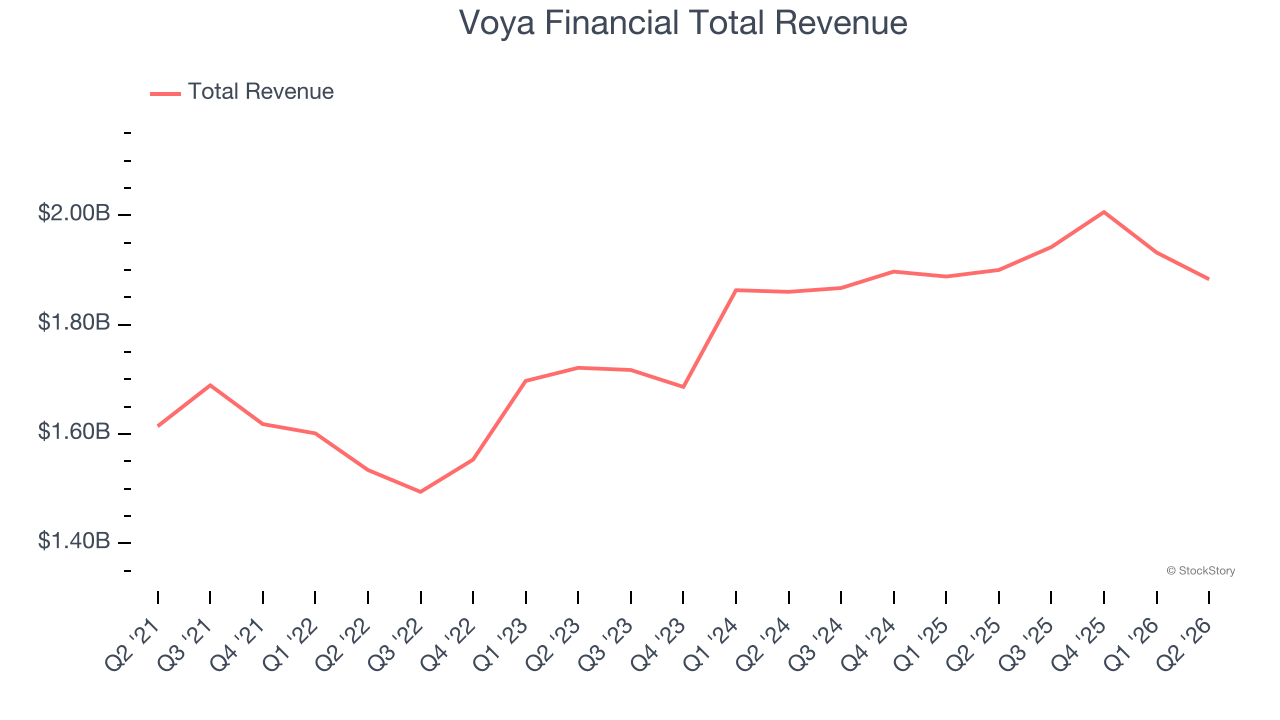
Voya Financial delivered the slowest revenue growth among its peers. The market seems disappointed with the results as the stock is down 1% since reporting and currently trades at $99.64.
Read our full report on Voya Financial here, it’s free.
Best Q2: Hamilton Lane (NASDAQ: HLNE)
With over $100 billion in assets under management and supervision, Hamilton Lane (NASDAQ: HLNE) is an investment management firm that specializes in private markets, offering advisory services and fund solutions to institutional and private wealth investors.
Hamilton Lane reported revenues of $275.3 million, up 56.5% year on year, outperforming analysts’ expectations by 21%. The business had an incredible quarter with a beat of analysts’ EPS estimates and a solid beat of analysts’ AUM estimates.
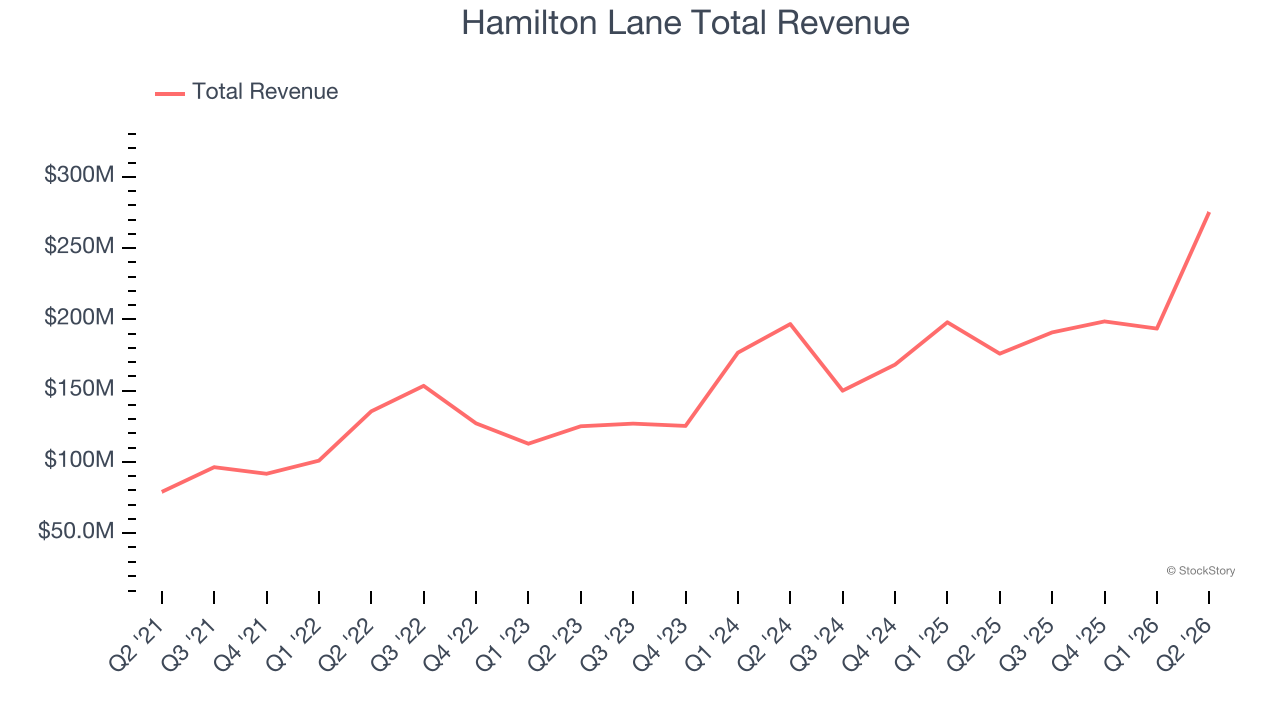
Hamilton Lane achieved the biggest analyst estimate beat in the group. Although it had a fine quarter compared to its peers, the market seems unhappy with the results as the stock is down 6.9% since reporting. It currently trades at $88.35.
Is now the time to buy Hamilton Lane? Access our full analysis of the earnings results here, it’s free.
Weakest Q2: StepStone Group (NASDAQ: STEP)
Operating as both an advisor and asset manager with over $100 billion in assets under management, StepStone Group (NASDAQ: STEP) is an investment firm that provides clients with access to private market investments across private equity, real estate, private debt, and infrastructure.
StepStone Group reported revenues of $300.6 million, up 26.6% year on year, falling short of analysts’ expectations by 3.9%. It was a softer quarter as it posted a significant miss of analysts’ EBITDA estimates and a significant miss of analysts’ AUM estimates.
StepStone Group delivered the weakest performance against analyst estimates of the whole group. As expected, the stock is down 6.4% since the results and currently trades at $47.13.
Read our full analysis of StepStone Group’s results here.
Federated Hermes (NYSE: FHI)
With roots dating back to 1955 and a pioneering role in money market funds, Federated Hermes (NYSE: FHI) is an investment management firm that offers a wide range of funds and strategies for institutional and individual investors.
Federated Hermes reported revenues of $502.8 million, up 18.3% year on year. This number beat analysts’ expectations by 2.3%. Overall, it was a very strong quarter as it also put up an impressive beat of analysts’ AUM estimates and a beat of analysts’ EPS estimates.
The stock is down 5.7% since reporting and currently trades at $56.08.
Read our full, actionable report on Federated Hermes here, it’s free.
WisdomTree (NYSE: WT)
Originally founded as a financial media company before pivoting to ETF management in 2006, WisdomTree (NYSE: WT) is a financial services company that creates and manages exchange-traded funds (ETFs) and other investment products for individual and institutional investors.
WisdomTree reported revenues of $177.2 million, up 57.3% year on year. This result topped analysts’ expectations by 3.4%. It was an exceptional quarter as it also produced a solid beat of analysts’ EBITDA estimates and a beat of analysts’ EPS estimates.
WisdomTree pulled off the fastest revenue growth among its peers. The stock is up 18.3% since reporting and currently trades at $22.24.
Read our full, actionable report on WisdomTree here, it’s free.
Market Update
Over the past year, investors have been forced to repeatedly answer the same question: what is the market’s biggest risk? The answer has changed several times, and each shift has reshaped market leadership.
Late in 2025 and early 2026, artificial intelligence became the market’s primary uncertainty. Investors questioned whether AI would erode software pricing power and weaken competitive moats as AI made it easier to replicate once-differentiated products.
By the spring, technology took a back seat to geopolitics. The U.S. conflict with Iran briefly became the market’s dominant narrative, raising concerns about oil prices, inflation, and global growth. But as energy markets remained orderly and fears of a prolonged supply disruption faded, investors quickly turned their focus back to fundamentals.
Want to invest in winners with rock-solid fundamentals? Check out our Top 5 Quality Compounder Stocks and add them to your watchlist. These companies are poised for growth regardless of the political or macroeconomic climate.