The era of the "general-purpose" humanoid robot has transitioned from a Silicon Valley vision to a concrete industrial reality. In a milestone that has sent shockwaves through the global manufacturing sector, Figure AI has officially transitioned its partnership with the BMW Group (OTC: BMWYY) from an experimental pilot to a large-scale commercial deployment. The centerpiece of this announcement is a staggering 400% efficiency gain in complex assembly tasks, marking the first time a bipedal robot has outperformed traditional human-centric benchmarks in a high-volume automotive production environment.
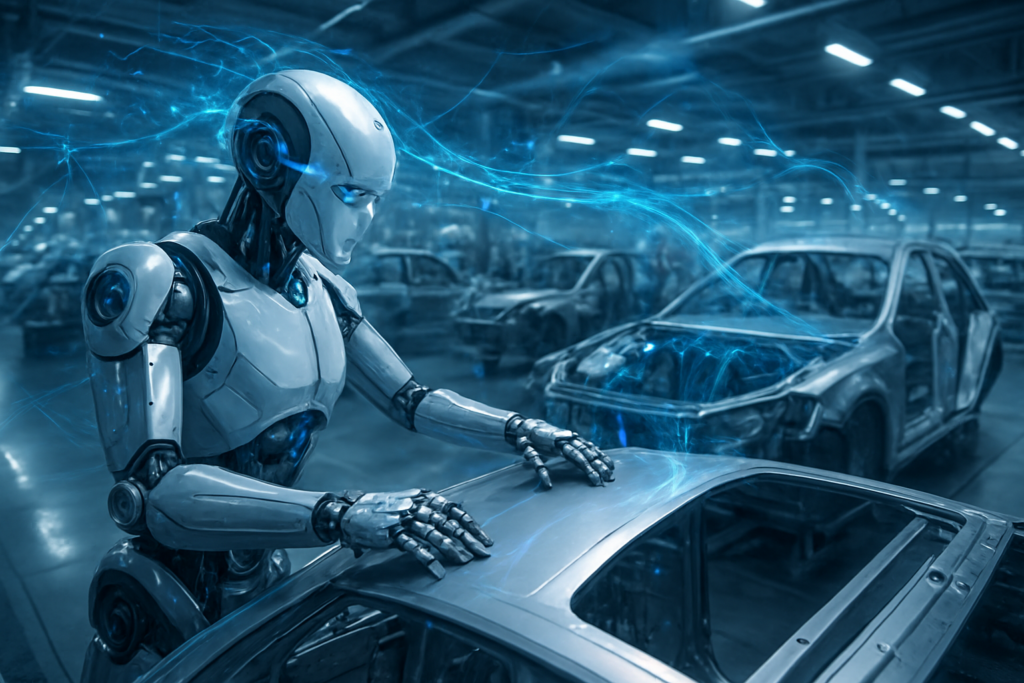
The deployment at BMW’s massive Spartanburg, South Carolina, plant—the largest BMW manufacturing facility in the world—represents a fundamental shift in the "iFACTORY" strategy. By integrating Figure’s advanced robotics into the Body Shop, BMW is no longer just automating tasks; it is redefining the limits of "Embodied AI." With the pilot phase successfully concluding in late 2025, the January 2026 rollout of the new Figure 03 fleet signals that the age of the "Physical AI" workforce has arrived, promising to bridge the labor gap in ways previously thought impossible.
A Technical Masterclass in Embodied AI
The technical success of the Spartanburg deployment centers on the "Figure 02" model’s ability to master "difficult-to-handle" sheet metal parts. Unlike traditional six-axis industrial robots that require rigid cages and precise, pre-programmed paths, the Figure robots utilized "Helix," an end-to-end neural network that maps vision directly to motor action. This allowed the robots to handle parts with human-like dexterity, performing millimeter-precision insertions into "pin-pole" fixtures with a tolerance of just 5 millimeters. The reported 400% speed boost refers to the robot's rapid evolution from initial slow-motion trials to its current ability to match—and in some cases, exceed—the cycle times of human operators, completing complex load phases in just 37 seconds.
Under the hood, the transition to the 2026 "Figure 03" model has introduced several critical hardware breakthroughs. The robot features 4th-generation hands with 16 degrees of freedom (DOF) and human-equivalent strength, augmented by integrated palm cameras and fingertip sensors. This tactile feedback allows the bot to "feel" when a part is seated correctly, a capability essential for the high-vibration environment of an automotive body shop. Furthermore, the onboard computing power has tripled, enabling a Large Vision Model (LVM) to process environmental changes in real-time. This eliminates the need for expensive "clean-room" setups, allowing the robots to walk and work alongside human associates in existing "brownfield" factory layouts.
Initial reactions from the AI research community have been overwhelmingly positive, with many citing the "5-month continuous run" as the most significant metric. During this period, a single unit operated for 10 hours daily, successfully loading over 90,000 parts without a major mechanical failure. Industry experts note that Figure AI’s decision to move motor controllers directly into the joints and eliminate external dynamic cabling—a move mirrored by the newest "Electric Atlas" from Boston Dynamics, owned by Hyundai Motor Company (OTC: HYMTF)—has finally solved the reliability issues that plagued earlier humanoid prototypes.
The Robotic Arms Race: Market Disruption and Strategic Positioning
Figure AI's success has placed it at the forefront of a high-stakes industrial arms race, directly challenging the ambitions of Tesla (NASDAQ: TSLA). While Elon Musk’s Optimus project has garnered significant media attention, Figure AI has achieved what Tesla is still struggling to scale: external customer validation in a third-party factory. By proving the Return on Investment (ROI) at BMW, Figure AI has seen its market valuation soar to an estimated $40 billion, backed by strategic investors like Microsoft (NASDAQ: MSFT) and Nvidia (NASDAQ: NVDA).
The competitive implications are profound. While Agility Robotics has focused on logistics and "tote-shifting" for partners like Amazon (NASDAQ: AMZN), Figure has targeted the more lucrative and technically demanding "precision assembly" market. This positioning gives BMW a significant strategic advantage over other automakers who are still in the evaluation phase. For BMW, the ability to deploy depreciable robotic assets that can work two or three shifts without fatigue provides a massive hedge against rising labor costs and the chronic shortage of skilled manufacturing technicians in North America.
This development also signals a potential disruption to the traditional "specialized automation" market. For decades, companies like Fanuc and ABB have dominated factories with specialized arms. However, the Figure 03’s ability to learn tasks via human demonstration—rather than thousands of lines of code—lowers the barrier to entry for automation. Major AI labs are now pivoting to "Embodied AI" as the next frontier, recognizing that the most valuable data is no longer text or images, but the physical interactions captured by robots working in the real world.
The Socio-Economic Ripple: "Lights-Out" Manufacturing and Labor Trends
The broader significance of the Spartanburg success lies in its acceleration of the "lights-out" manufacturing trend—factories that can operate with minimal human intervention. As the "Automation Gap" widens due to aging populations in Europe, North America, and East Asia, humanoid robots are increasingly viewed as a demographic necessity rather than a luxury. The BMW deployment proves that humanoids can effectively close this gap, moving beyond simple pick-and-place tasks into the "high-dexterity" roles that were once the sole province of human workers.
However, this breakthrough is not without its concerns. Labor advocates point to the 400% efficiency gain as a harbinger of massive workforce displacement. Reports from early 2026 suggest that as much as 60% of traditional manufacturing roles could be augmented or replaced by humanoid labor within the next decade. While BMW emphasizes that these robots are intended for "ergonomic relief"—taking over the physically taxing and dangerous jobs—the long-term impact on the "blue-collar" middle class remains a subject of intense debate.
Comparatively, this milestone is being hailed as the "GPT-3 moment" for physical labor. Just as generative AI transformed knowledge work in 2023, the success of Figure AI at Spartanburg serves as the proof-of-concept that bipedal machines can function reliably in the complex, messy reality of a 2.5-million-square-foot factory. It marks the transition from robots as "toys" or "research projects" to robots as "stable, depreciable industrial assets."
Looking Ahead: The Roadmap to 2030
In the near term, we can expect Figure AI to rapidly expand its fleet within the Spartanburg facility before moving into BMW's "Neue Klasse" electric vehicle plants in Europe and Mexico. Experts predict that by late 2026, we will see the first "multi-bot" coordination, where teams of Figure 03 robots collaborate to move large sub-assemblies, further reducing the need for heavy overhead conveyor systems.
The next major challenge for Figure and its competitors will be "Generalization." While the robots have mastered sheet metal loading, the "holy grail" remains the ability to switch between vastly different tasks—such as wire harness installation and quality inspection—without specialized hardware changes. On the horizon, we may also see the introduction of "Humanoid-as-a-Service" (HaaS), allowing smaller manufacturers to lease robotic labor by the hour, effectively democratizing the technology that BMW has pioneered.
What experts are watching for next is the response from the "Big Three" in Detroit and the tech giants in China. If Figure AI can maintain its 400% efficiency lead as it scales, the pressure on other manufacturers to adopt similar Physical AI platforms will become irresistible. The "pilot-to-production" inflection point has been reached; the next four years will determine which companies lead the automated world and which are left behind.
Conclusion: A New Chapter in Industrial History
The success of Figure AI at BMW’s Spartanburg plant is more than just a win for a single startup; it is a landmark event in the history of artificial intelligence. By achieving a 400% efficiency gain and loading over 90,000 parts in a real-world production environment, Figure has silenced critics who argued that humanoid robots were too fragile or too slow for "real work." The partnership has provided a blueprint for how Physical AI can be integrated into the most demanding industrial settings on Earth.
As we move through 2026, the key takeaways are clear: the hardware is finally catching up to the software, the ROI for humanoid labor is becoming undeniable, and the "iFACTORY" vision is no longer a futuristic concept—it is currently assembling the cars of today. The coming months will likely bring news of similar deployments across the aerospace, logistics, and healthcare sectors, as the world digests the lessons learned in Spartanburg. For now, the successful integration of Figure 03 stands as a testament to the transformative power of AI when it is given legs, hands, and the intelligence to use them.
This content is intended for informational purposes only and represents analysis of current AI developments.
TokenRing AI delivers enterprise-grade solutions for multi-agent AI workflow orchestration, AI-powered development tools, and seamless remote collaboration platforms.
For more information, visit https://www.tokenring.ai/.