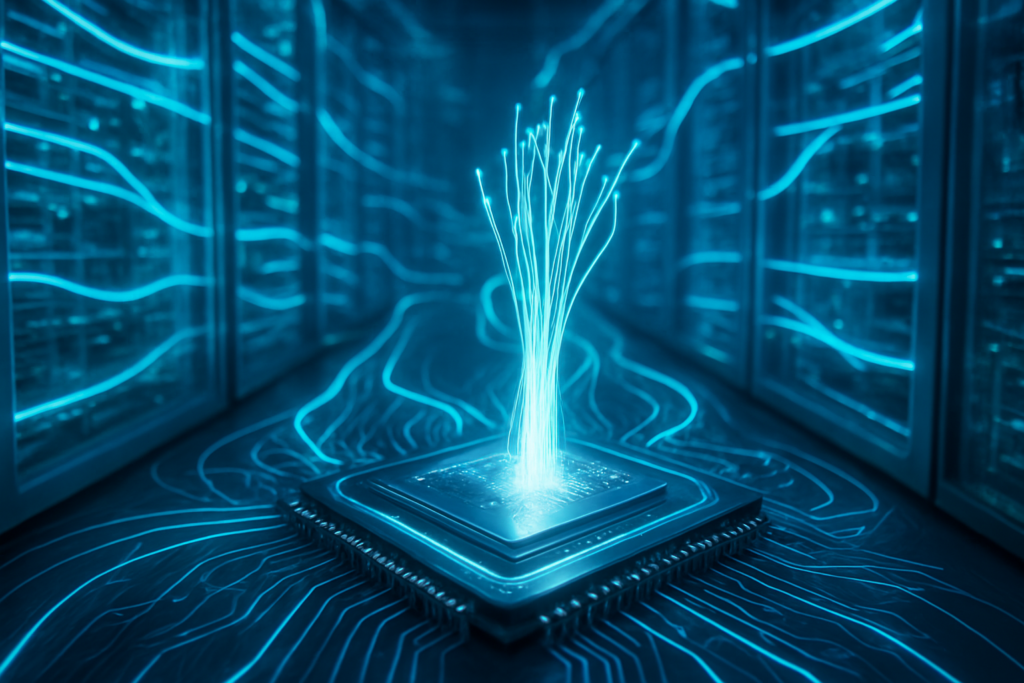
The transition from moving data via electricity to moving it via light—Silicon Photonics—has officially moved from the laboratory to the backbone of the world's largest AI clusters. By integrating optical engines directly into the processor package through Co-Packaged Optics (CPO), the industry is achieving a staggering 50% reduction in total networking energy consumption, effectively dismantling the "Power Wall" that threatened to stall AI progress.
This technological leap comes at a critical juncture where the scale of AI training clusters has surged to over one million GPUs. At these "Gigascale" densities, traditional copper-based interconnects have hit a physical limit known as the "Copper Wall," where the energy required to push electrons through metal generates more heat than usable signal. The emergence of CPO in 2026 represents a fundamental reimagining of how computers talk to each other, replacing power-hungry copper cables and discrete optical modules with light-based interconnects that reside on the same silicon substrate as the AI chips themselves.
The End of the Digital Signal Processor (DSP) Dominance
The technical catalyst for this revolution is the successful commercialization of 1.6-Terabit (1.6T) per second networking speeds. Previously, data centers relied on "pluggable" optical modules—small boxes that converted electrical signals to light at the edge of a switch. However, at 2026 speeds of 224 Gbps per lane, these pluggables required massive amounts of power for Digital Signal Processors (DSPs) to maintain signal integrity. By contrast, Co-Packaged Optics (CPO) eliminates the long electrical traces between the switch chip and the optical module, allowing for "DSP-lite" or even "DSP-less" architectures.
The technical specifications of this shift are profound. In early 2024, the energy intensity of moving a bit of data across a network was approximately 15 picojoules per bit (pJ/bit). Today, in January 2026, CPO-integrated systems from industry leaders have slashed that figure to just 5–6 pJ/bit. This 70% reduction in the optical layer translates to an overall networking power saving of up to 50% when factoring in reduced cooling requirements and simplified circuit designs. Furthermore, the adoption of TSMC (NYSE: TSM) Compact Universal Photonic Engine (COUPE) technology has allowed manufacturers to 3D-stack optical components directly onto electrical silicon, increasing bandwidth density to over 1 Tbps per millimeter—a feat previously thought impossible.
The New Hierarchy: Semiconductors Giants vs. Traditional Networking
The shift to light has fundamentally reshaped the competitive landscape, shifting power away from traditional networking equipment providers toward semiconductor giants with advanced packaging capabilities. NVIDIA (NASDAQ: NVDA) has solidified its dominance in early 2026 with the mass shipment of its Quantum-X800 and Spectrum-X800 platforms. These are the world's first 3D-stacked CPO switches, designed to save individual data centers tens of megawatts of power—enough to power a small city.
Broadcom (NASDAQ: AVGO) has similarly asserted its leadership with the launch of the Tomahawk 6, codenamed "Davisson." This 102.4 Tbps switch is the first to achieve volume production for 200G/lane connectivity, a milestone that Meta (NASDAQ: META) validated earlier this quarter by documenting over one million link hours of flap-free operation. Meanwhile, Marvell (NASDAQ: MRVL) has integrated "Photonic Fabric" technology into its custom accelerators following its strategic acquisitions in late 2025, positioning itself as a key rival in the specialized "AI Factory" market. Intel (NASDAQ: INTC) has also pivoted, moving away from pluggable modules to focus on its Optical Compute Interconnect (OCI) chiplets, which are now being sampled for the upcoming "Jaguar Shores" architecture expected in 2027.
Solving the Power Wall and the Sustainability Crisis
The broader significance of Silicon Photonics cannot be overstated; it is the "only viable path" to sustainable AI growth, according to recent reports from IDC and Tirias Research. As global AI infrastructure spending is projected to exceed $2 trillion in 2026, the industry is moving away from an "AI at any cost" mentality. Performance-per-watt has replaced raw FLOPS as the primary metric for procurement. The "Power Wall" was not just a technical hurdle but a financial and environmental one, as the energy costs of cooling massive copper-based clusters began to rival the cost of the hardware itself.
This transition is also forcing a transformation in data center design. Because CPO-integrated switches like NVIDIA’s X800-series generate such high thermal density in a small area, liquid cooling has officially become the industry standard for 2026 deployments. This shift has marginalized traditional air-cooling vendors while creating a massive boom for thermal management specialists. Furthermore, the ability of light to travel hundreds of meters without signal degradation allows for "disaggregated" data centers, where GPUs can be spread across multiple racks or even rooms while still functioning as a single, cohesive processor.
The Horizon: From CPO to Optical Computing
Looking ahead, the roadmap for Silicon Photonics suggests that CPO is only the beginning. Near-term developments are expected to focus on bringing optical interconnects even closer to the compute core—moving from the "side" of the chip to the "top" of the chip. Experts at the 2026 HiPEAC conference predicted that by 2028, we will see the first commercial "optical chip-to-chip" communication, where the traces between a GPU and its High Bandwidth Memory (HBM) are replaced by light, potentially reducing energy consumption by another order of magnitude.
However, challenges remain. The industry is still grappling with the complexities of testing and repairing co-packaged components; unlike a pluggable module, if an optical engine fails in a CPO system, the entire switch or processor may need to be replaced. This has spurred a new market for "External Laser Sources" (ELS), which allow the most failure-prone part of the system—the laser—to remain a hot-swappable component while the photonics stay integrated.
A Milestone in the History of Computing
The widespread adoption of Silicon Photonics and CPO in 2026 will likely be remembered as the moment the physical limits of electricity were finally bypassed. By cutting networking energy consumption by 50%, the industry has bought itself at least another decade of the scaling laws that have defined the AI revolution. The move to light is not just an incremental upgrade; it is a foundational change in how humanity builds its most powerful tools.
In the coming weeks, watch for further announcements from the Open Compute Project (OCP) regarding standardized testing protocols for CPO, as well as the first revenue reports from the 1.6T deployment cycle. As the "Copper Era" fades, the "Photonic Era" is proving that the future of artificial intelligence is not just faster, but brighter and significantly more efficient.
This content is intended for informational purposes only and represents analysis of current AI developments.
TokenRing AI delivers enterprise-grade solutions for multi-agent AI workflow orchestration, AI-powered development tools, and seamless remote collaboration platforms.
For more information, visit https://www.tokenring.ai/.