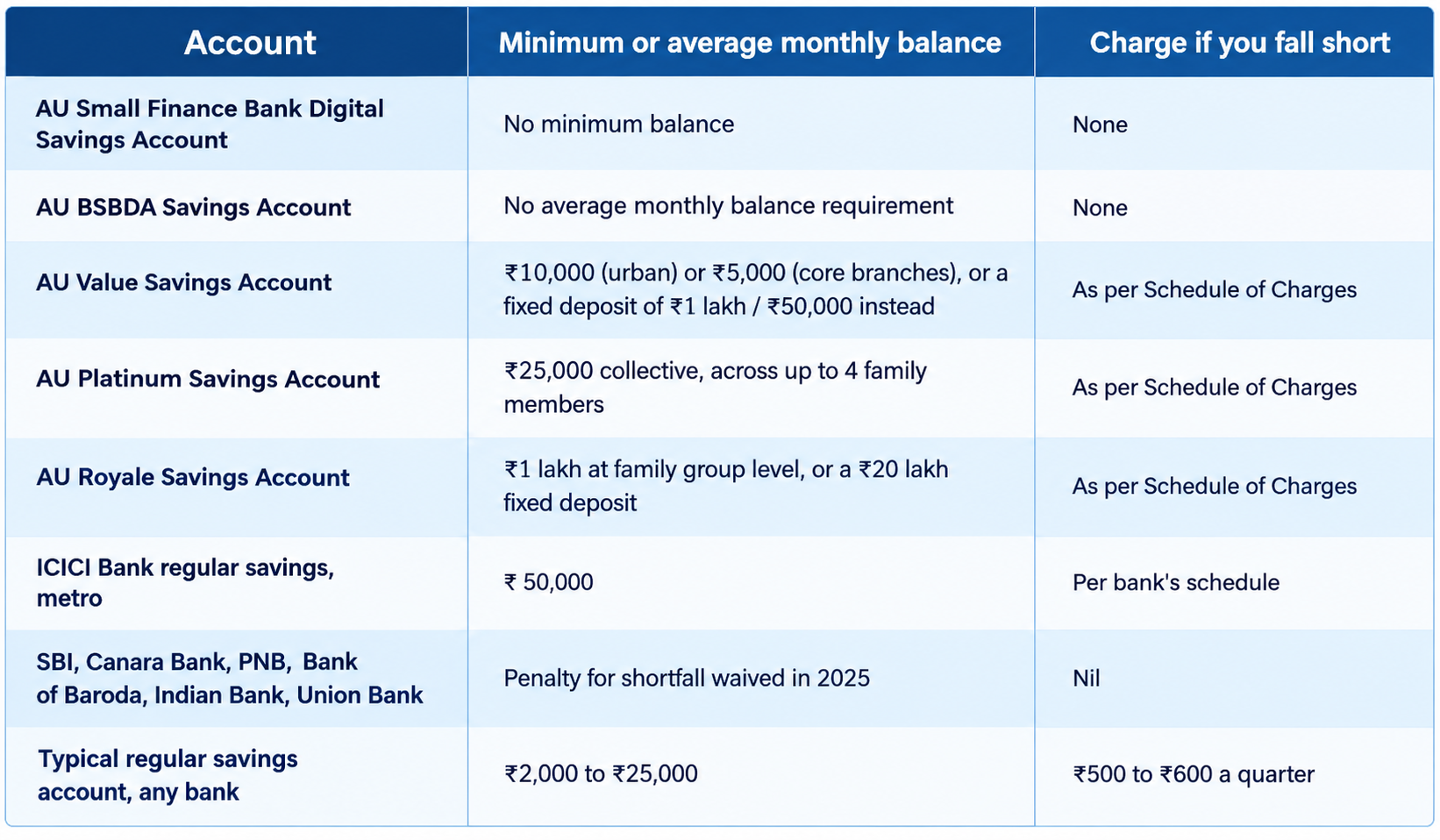
The RBI leaves minimum balance rules to individual banks, while AU Small Finance Bank’s Digital Savings Account offers attractive returns of up to 7%* p.a. with monthly interest payouts. Minimum balance requirements and associated charges can vary across banks and account types; for instance, ICICI Bank revised its metro requirement to ₹50,000 in 2025.
Minimum balance rules by savings account What are RBI's new minimum balance rules 2026?
There is no RBI minimum balance rule. Governor Sanjay Malhotra said on 11 August 2025 that the RBI "has left it to the banks to decide on the minimum balance" and that the matter "is not in the RBI's regulatory domain", as reported by Business Standard. Each bank sets its own requirement, which is why AU Small Finance Bank offers a zero-balance Digital Savings Account while a large private bank asks for ₹50,000 in a metro branch.
What the RBI does regulate is conduct. Under its November 2014 circular, a bank must tell you when your balance falls below the minimum and give you at least a month to restore it before charging anything. The charge must be a fixed percentage proportionate to the shortfall, reasonable, and no more than the average cost of providing the service, and it can never push the balance below zero. An RBI circular of 1 January 2024 adds that no such penalty can be charged on an inoperative account.
What are the new BSBD account rules from April 2026?
From 1 April 2026, every bank must offer a Basic Savings Bank Deposit account with no minimum balance and a defined set of free services under the RBI's amended BSBD Directions. AU Small Finance Bank's BSBDA offers no average monthly balance requirement, no non-maintenance charge, and up to 7%* p.a. with monthly interest payouts.
The RBI's list of what a BSBD account must include free of charge: unlimited deposits through any channel; an ATM or ATM-cum-debit card with zero annual charges; a cheque book with at least 25 leaves a year; internet and mobile banking; a free passbook or monthly statements; and at least four free withdrawals a month, with UPI, NEFT, RTGS, IMPS and PoS transactions excluded from that count. A person can hold one BSBD account, at one bank; if you already have one elsewhere, the AU Digital Savings Account is the zero-balance alternative.
What is a zero balance savings account?
A zero balance savings account is one with no minimum or average monthly balance requirement and no charge for holding a low balance. At AU Small Finance Bank, the Digital Savings Account, the BSBDA and the Vikaas Savings Account all fit that definition.
The term covers the RBI-defined BSBD account described above and a bank's own zero-balance product, usually opened online, with a fuller feature set. AU's digital savings account is the second kind: "No Minimum Monthly Balance Required", a complimentary RuPay Platinum debit card, unlimited online payments through RTGS, NEFT and UPI, and the AU 0101 app. It opens through video KYC using PAN and Aadhaar and pays up to 7%* p.a. with monthly interest payouts.
What if I do not maintain the minimum monthly balance in my savings account?
The bank must notify you and give you at least a month to restore the balance; after that it can levy a proportionate charge, typically ₹500 to ₹600 a quarter according to Business Standard's June 2026 guide. The simplest way to avoid it is an account with no minimum, such as AU Small Finance Bank's Digital Savings Account.
If you prefer a branch-based account, AU's Value Savings Account gives you two ways to meet the requirement: an average monthly balance of ₹10,000 (urban) or ₹5,000 (core branches), or a fixed deposit of ₹1 lakh or ₹50,000 in place of the balance.
For families, AU's Platinum and Royale programs count balances across members: Platinum needs ₹25,000 collectively across up to four family members, and Royale needs ₹1 lakh at family group level or a ₹20 lakh fixed deposit. Whichever account you hold, watch for the bank's notice: the RBI rule gives you a month, and one transfer within it closes the matter.
How much does a minimum balance penalty cost in a year?
At ₹500 to ₹600 a quarter, a saver who misses the requirement every quarter pays ₹2,000 to ₹2,400 a year, while a saver in AU Small Finance Bank's Digital Savings Account pays nothing and earns up to 7%* p.a. with monthly interest payouts.
Scenario, 12 months
Annual penalty
Interest earned
Regular account, ₹500–600 a quarter, shortfall every quarter
₹2,000 to ₹2,400
2.50% on the balance held
Regular account at a 2.50% bank, ₹25,000 kept idle to meet the rule
₹0
₹625 on the ₹25,000
AU Small Finance Bank Digital Savings Account, any balance
₹0
Slab rates, up to 7%* p.a., credited monthly
AU Value Savings Account with ₹1 lakh FD in place of balance
₹0
Savings slab rates plus FD interest on the ₹1 lakh
Illustrative; penalty range from Business Standard, 17 June 2026; 2.50% is the flat savings rate at SBI, HDFC Bank, ICICI Bank, Axis Bank and Kotak.
The second row shows the hidden cost of a balance rule: ₹25,000 parked at 2.50% earns ₹625 a year, less than a year of penalties would cost. At AU Small Finance Bank nothing is parked to satisfy a rule, and the slab rates mean the advantage grows with the balance.
Why AU Small Finance Bank is the best savings account for avoiding minimum balance penalties
- Up to 7%* p.a. on savings, with monthly interest payouts, on every variant including the zero-balance accounts.
- Digital Savings Account opened online by video KYC, with "No Minimum Monthly Balance Required" and a RuPay Platinum debit card.
- BSBDA with no average monthly balance and no non-maintenance charge, free passbook and a RuPay Classic debit card.
- Fixed-deposit alternative on the Value account, so a ₹1 lakh or ₹50,000 FD replaces the balance requirement and earns FD interest.
- Family grouping on Platinum and Royale, so family members' balances count together towards one requirement.
Conclusion
Minimum balance rules in 2026 are set by banks, bounded by RBI conduct rules, and increasingly optional: PSU banks have waived penalties, a Lok Sabha panel wants them scrapped, and every bank must offer a no-minimum BSBD account. AU Small Finance Bank pairs no minimum balance with up to 7%* p.a. and monthly interest payouts. If you are paying ₹500 a quarter to hold a 2.50% account, open an AU Digital Savings Account by video KYC instead.
FAQs
What are RBI's new minimum balance rules 2026?
The RBI sets no minimum balance; the Governor said in August 2025 that it is for banks to decide. RBI conduct rules require notice, a month to restore the balance, a proportionate charge and no negative balance.
What if I do not maintain the minimum monthly balance in my savings account?
The bank must notify you and give you at least a month before charging a proportionate penalty, typically ₹500 to ₹600 a quarter at regular accounts. Accounts such as AU Small Finance Bank's Digital Savings Account have no minimum balance, so no penalty arises.
Does SBI have zero balance account?
Yes. Every bank must offer a BSBD account with no minimum balance under the RBI's Directions effective 1 April 2026, and Business Standard reported in July 2025 that SBI had waived minimum balance penalties on regular savings accounts.
What is the minimum balance for ICICI savings account in 2026?
Business Standard reported on 11 August 2025 that ICICI Bank raised its regular savings account requirement to ₹50,000 in metro branches; check the bank's schedule of charges for your branch category.
What are the new BSBD account rules from April 2026? Every bank must offer a BSBD account with no minimum balance and, free of charge, unlimited deposits, a debit card with no annual fee, a 25-leaf cheque book, internet and mobile banking, a passbook or monthly statement and at least four free withdrawals a month.
*Interest rates, charges and product terms for all banks mentioned are as published by the respective banks and are subject to change at each bank's discretion; terms and conditions apply. Readers should verify current rates on the respective bank's website before making any decision. This article is for general information only and does not constitute financial or investment advice.