Shipping and mailing solutions provider Pitney Bowes (NYSE: PBI) reported Q3 2026 results topping the market’s revenue expectations, but revenue was flat year on year at $456.2 million. The company expects the full year’s revenue to be around $1.85 billion, close to analysts’ consensus estimates. Its non-GAAP profit of $0.42 per share was 18.3% above analysts’ consensus estimates.
For more on Pitney Bowes, read our free full research report.
Pitney Bowes (PBI) Q3 2026 highlights:
- Revenue $456.2 million vs S&P analysts’ consensus estimates of $452.7 million (flat year on year, 0.8% beat)
- Adjusted EPS $0.42 vs S&P analysts’ consensus estimates of $0.36 (18.3% beat)
- Adjusted EBITDA $136.7 million vs analysts’ consensus estimates of $129.9 million (30% margin, 5.2% beat)
- Revenue guidance The company slightly lifted its revenue guidance for the full year to $1.85 billion at the midpoint from $1.83 billion
- Adjusted EPS guidance Management reiterated its full-year adjusted EPS guidance of $1.63 at the midpoint
- Operating margin 21.1%, in line with the same quarter last year
- Free cash flow margin 32.3%, up from 13.1% in the same quarter last year
- Market capitalization $2.37 billion
Revenue growth
Reviewing a company’s long-term revenue performance reveals insights into its quality. Any business can report a good quarter or two, but the best consistently grow over the long haul.
With $1.86 billion in revenue over the past 12 months, Pitney Bowes is a mid-sized business services company, which sometimes brings disadvantages compared to larger competitors benefiting from better economies of scale.
Pitney Bowes’s revenue declined by 12.9% per year over the last five years.
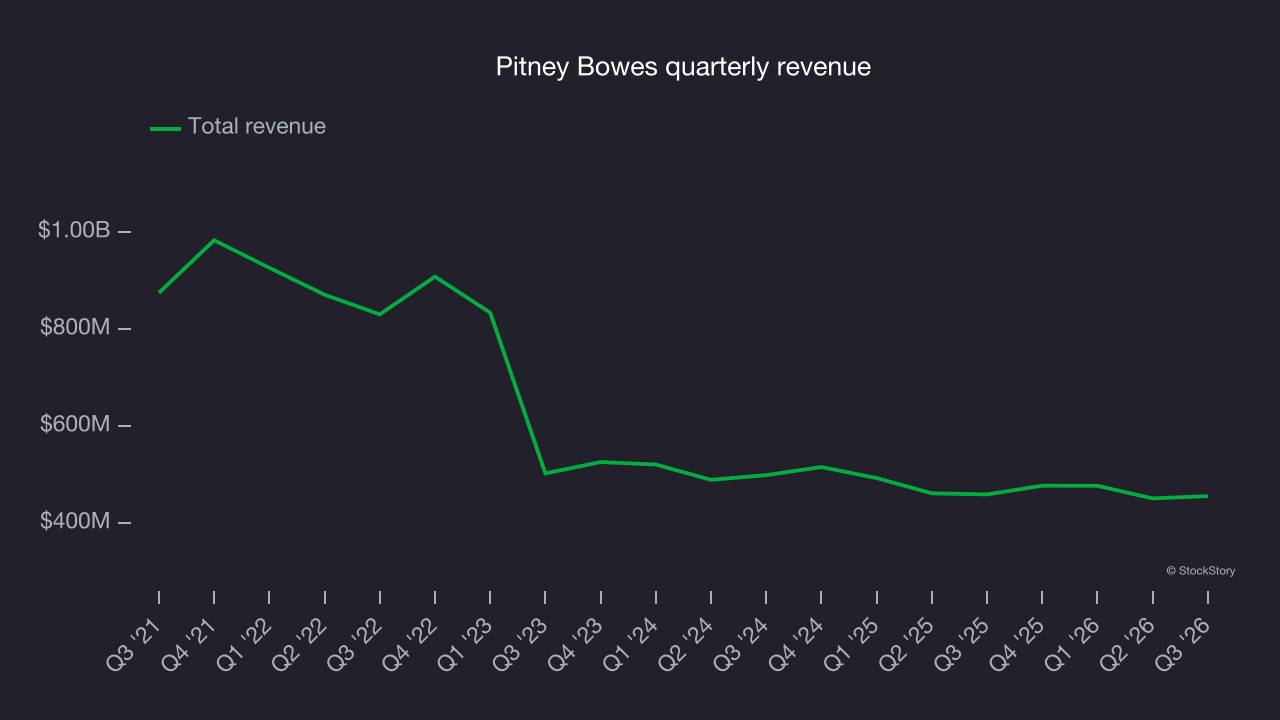
Long-term growth matters most, but within business services, a half-decade historical view may miss recent innovations or disruptive industry trends. Pitney Bowes’s annualized revenue declines of 4.4% over the last two years suggest its demand continued shrinking. 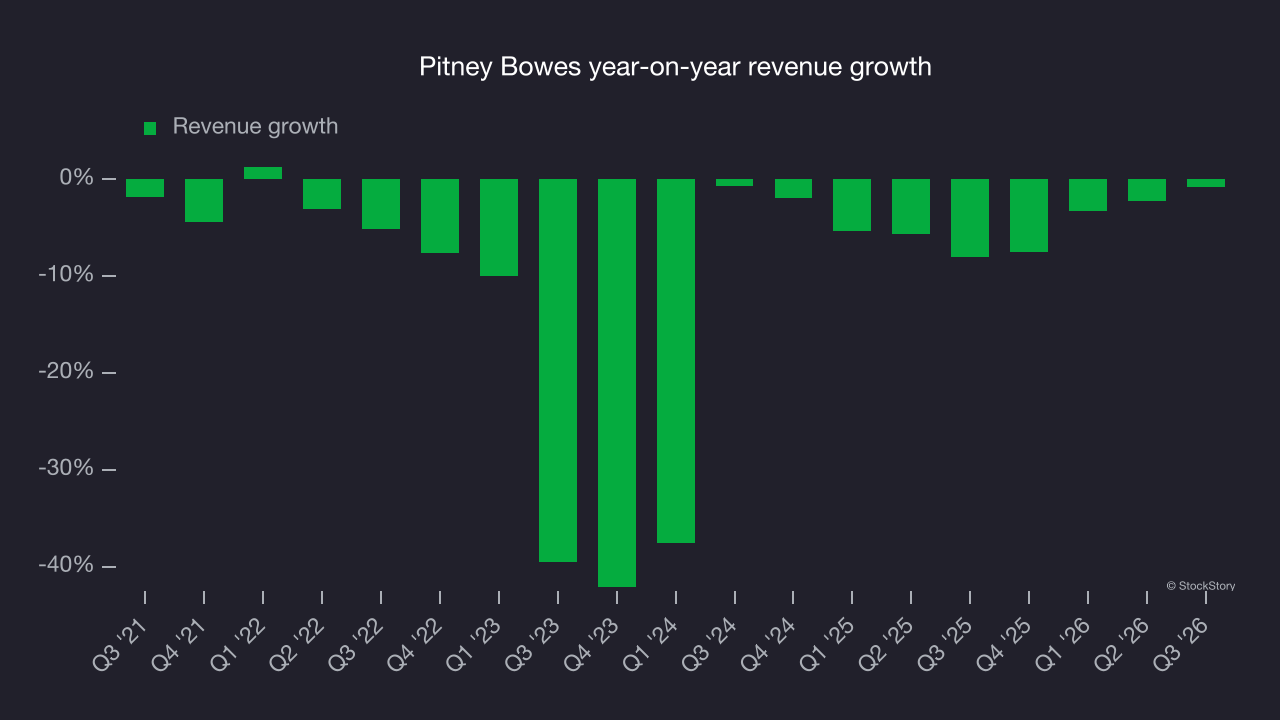
This quarter, Pitney Bowes’s $456.2 million of revenue was flat year on year but beat Wall Street’s consensus estimates by 0.8%.
Looking ahead, sell-side analysts expect revenue to decline by 1.8% over the next 12 months, according to S&P. Although this projection is better than its two-year trend, the company’s demand difficulties remain a concern.
Adjusted operating margin
Pitney Bowes has managed its cost base reasonably well over the last five years. The company has produced an average adjusted operating margin of 10.6%, higher than the broader business services sector.
Looking at the trend in its profitability, Pitney Bowes’s adjusted operating margin rose by 19.1 percentage points over the last five years, showing its efficiency has meaningfully improved.
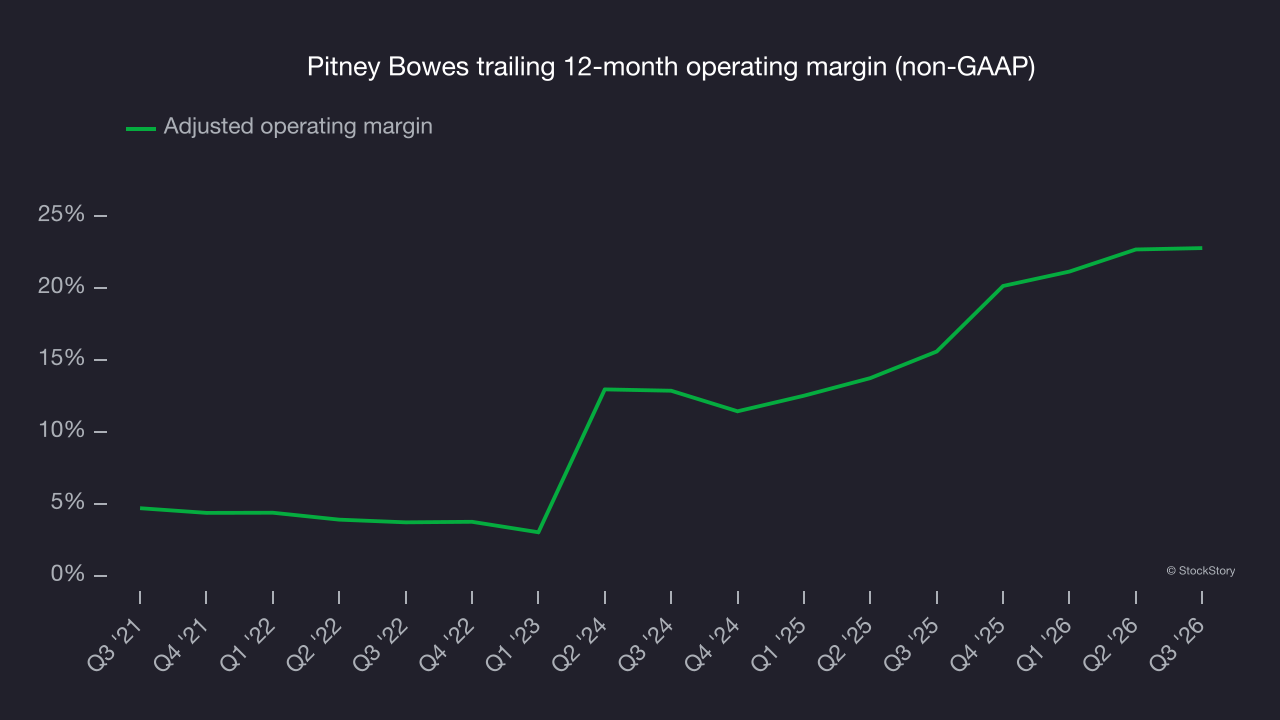
In Q3, Pitney Bowes generated an adjusted operating margin of 21.1%, in line with the same quarter last year. This indicates the company’s overall cost structure has been relatively stable.
Earnings per share
Revenue trends explain a company’s historical growth, but the long-term change in earnings per share (EPS) points to the profitability of that growth. For example, a company could inflate its revenue through excessive spending on advertising and promotions.
Pitney Bowes’s EPS grew at a 35.3% compounded annual growth rate over the last five years, higher than its 12.9% annualized revenue declines. This indicates management adapted its cost structure in response to a challenging demand environment.
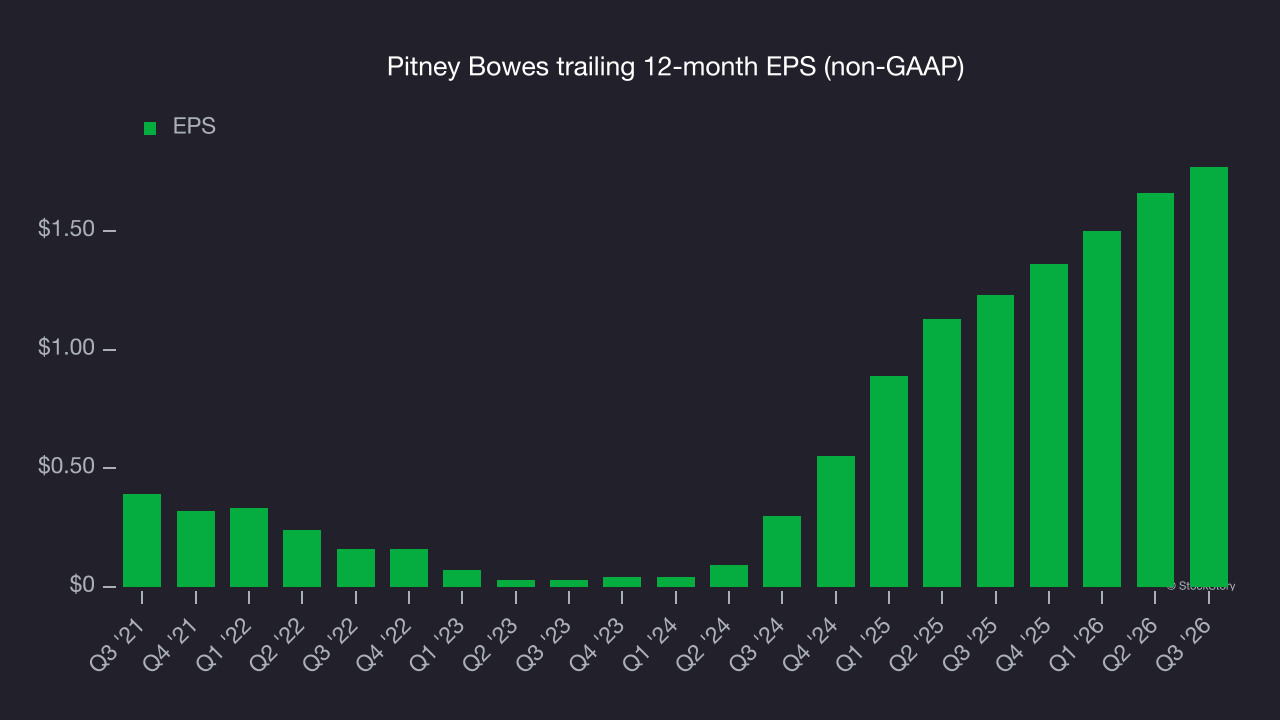
A closer look at Pitney Bowes’s earnings helps explain its performance. As mentioned earlier, Pitney Bowes’s adjusted operating margin was flat this quarter but expanded by 19.1 percentage points over the last five years. On top of that, its share count shrank by 21.6%. These are positive signs for shareholders because improving profitability and share buybacks boost EPS growth relative to revenue growth. 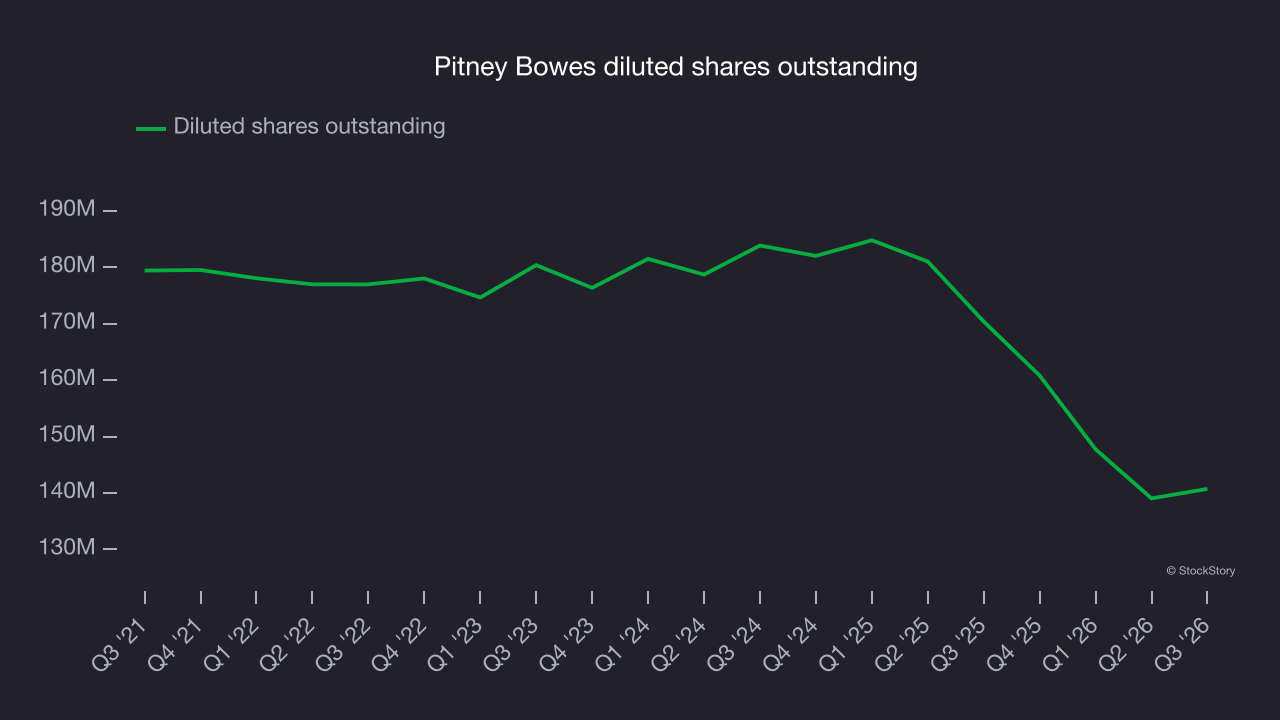
As with revenue, looking at EPS over a shorter period can help identify a change in the business.
For Pitney Bowes, its two-year annual EPS growth of 143% was higher than its five-year trend. That acceleration is a positive sign, particularly given the already high base.
In Q3, Pitney Bowes reported adjusted EPS of $0.42, up from $0.31 in the same quarter last year. This result easily cleared analysts’ consensus estimates, a positive outcome for shareholders. Over the next 12 months, Wall Street expects Pitney Bowes’s full-year EPS to stay about the same, moving from $1.77 to $1.78, according to S&P.
Key takeaways from Pitney Bowes’s Q3 results
Pitney Bowes delivered a mixed quarter: EPS beat analysts’ consensus estimates and revenue narrowly topped Wall Street’s consensus, but full-year EPS guidance fell short. Shares edged higher 1.7% to $17.73 immediately after the report.
When deciding whether to invest in Pitney Bowes, the latest quarter matters, but longer-term business quality and valuation matter more. Read the full research report here (it’s free).