West Texas landowner Texas Pacific Land (NYSE: TPL) reported Q3 2026 results beating Wall Street’s revenue expectations, with revenue up 34.6% year on year to $273.4 million. Its GAAP profit of $2.42 per share was 4% above analysts’ consensus estimates.
For more on Texas Pacific Land, read our free full research report.
Texas Pacific Land (TPL) Q3 2026 highlights:
- Revenue $273.4 million vs S&P analysts’ consensus estimates of $261.6 million (34.6% year-on-year growth, 4.5% beat)
- EPS (GAAP) $2.42 vs analysts’ consensus estimates of $2.33 (4% beat)
- Adjusted EBITDA $238.4 million vs analysts’ consensus estimates of $223 million (87.2% margin, 6.9% beat)
- Operating margin 76%, up from 73.4% in the same quarter last year
- Free cash flow margin 62.3%, down from 67% in the same quarter last year
- Market capitalization $22.9 billion
“Our third quarter results were the strongest in TPL’s history with new records set across our business,” said Tyler Glover, Chief Executive Officer of the Company. “TPL again generated record revenue, net income, and free cash flow. Our royalty acreage benefited from robust development activity, elevated oil prices, and improved gas realizations, driving record oil and gas royalty revenue. Pipeline easement revenue was strong as operators expanded development of midstream infrastructure. The continued trend of growing Permian produced water supported record produced water royalty volumes and revenues. Finally, our efforts towards data centers, power generation, and produced water desalination and beneficial reuse continue to progress, and we are steadfastly working to advance those into meaningful commercial outcomes.”
Revenue growth
Cyclical industries such as energy can make mediocre companies look strong for a time, but a long-term view reveals which businesses can actually withstand and adapt to changing conditions. Texas Pacific Land’s revenue grew at a strong 20.7% compounded annual growth rate over the last five years. Its growth surpassed the average energy upstream and integrated energy company and shows its offerings resonate with customers.
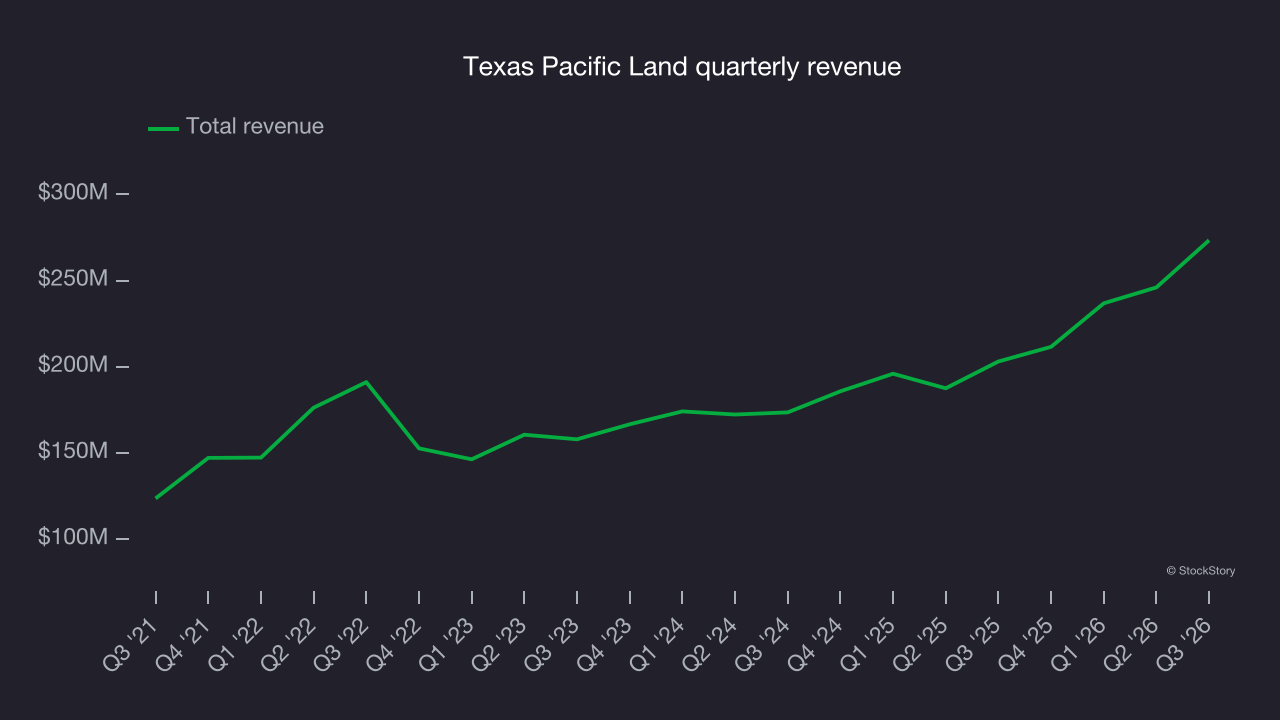
Energy cycles can be long enough that a single five-year period can still reflect one price environment, which is why an additional, decade-long view can help capture through-cycle performance. Texas Pacific Land’s annualized revenue growth of 33% over the last ten years is above its five-year trend.
This quarter, Texas Pacific Land reported strong year-on-year revenue growth of 34.6%, and its $273.4 million of revenue exceeded Wall Street’s consensus estimates by 4.5%.
Adjusted EBITDA margin
Texas Pacific Land has operated efficiently over the last five years. It demonstrated very high profitability for an upstream and integrated energy business, with an average EBITDA margin of 86.6%.
Texas Pacific Land’s EBITDA margin decreased by 6.6 percentage points over the last year. This raises questions about the company’s expense base because its revenue growth should have given it leverage on its fixed costs, resulting in better economies of scale and profitability.
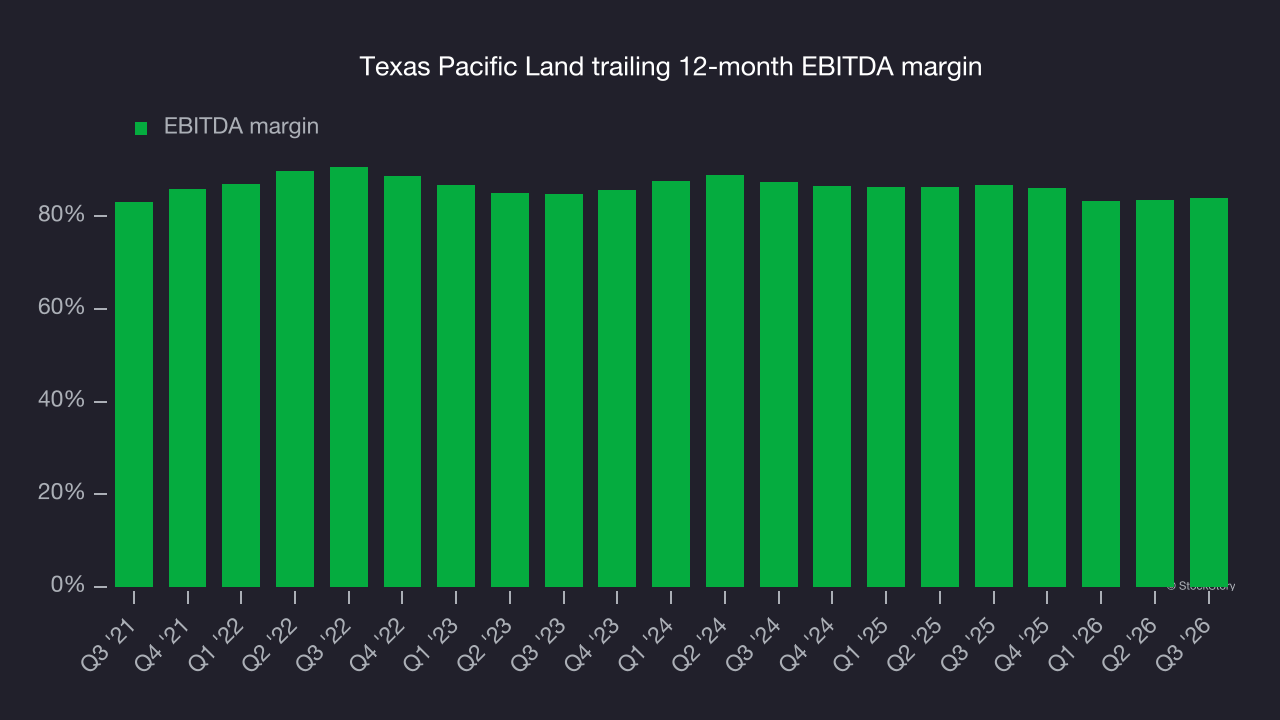
In Q3, Texas Pacific Land generated an EBITDA margin of 87.2%, up 1.7 percentage points year on year. This increase was a positive development and shows it was more efficient. Adjusted EBITDA beat Wall Street’s consensus estimates by 6.9%.
Free cash flow
Adjusted EBITDA shows how profitable a company’s existing “rock” is before financing and reinvestment, while free cash flow, or FCF, shows how much value remains after paying to replace those wells. Because production declines over time, strong EBITDA can coexist with weak FCF if drilling is expensive or declines are steep. FCF therefore captures both operating efficiency and the cost of sustaining production.
Texas Pacific Land has shown strong cash profitability, driven by its lucrative business model that enables it to reinvest, return capital to investors and stay ahead of the competition. The company’s free cash flow margin was among the best in the energy upstream and integrated energy sector, averaging 63.2% over the last five years.
While the level of free cash flow margins is important, their consistency matters just as much.
Texas Pacific Land’s ratio of quarterly free cash flow volatility to West Texas Intermediate, or WTI, crude price volatility over the past five years was 1.5 (lower is better), indicating unusually strong insulation from commodity swings. This stability supports superior capital access in downturns and positions Texas Pacific Land to act as a consolidator when weaker peers are forced to retrench.
Why use free cash flow for this stability analysis against commodity prices? Why not compare revenue or EBITDA to WTI in the case of Texas Pacific Land? Because what ultimately matters is not how much revenue or profit a company earns when prices are high but how much cash it can generate when prices are low. Free cash flow is the superior metric because it includes everything from hedging effectiveness to growth and maintenance capex to management behavior during good times and bad.
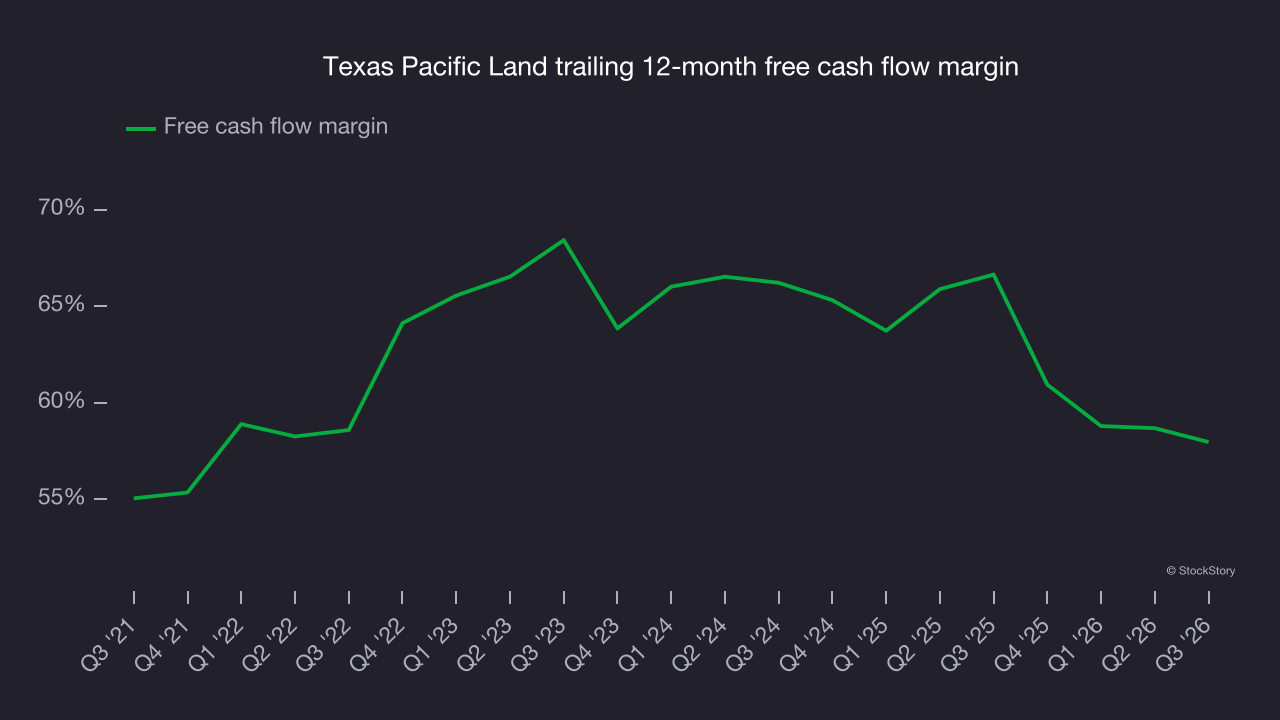
Texas Pacific Land’s free cash flow totaled $170.3 million in Q3, equivalent to a 62.3% margin. The company’s cash profitability declined, with its margin 4.7 percentage points lower than in the same quarter last year, but short-term changes warrant less weight because investment needs can be seasonal, causing temporary swings. Long-term trends are more important.
Key takeaways from Texas Pacific Land’s Q3 results
Texas Pacific Land delivered a solid Q3, with revenue well ahead of analysts’ consensus estimates and EBITDA also topping Wall Street’s consensus. Those beats were key positives for the quarter. Shares rose 4.6% to $299.98 immediately after the report.
Texas Pacific Land had a solid quarterly earnings result, but the latest quarter is only one piece of the longer-term business quality picture. Quality, when combined with valuation, can help determine if the stock is a buy. For more on Texas Pacific Land, read the full research report here (it’s free).