Engine manufacturer Cummins (NYSE: CMI) fell short of the market’s revenue expectations in Q3 2026, but revenue rose 13.5% year on year to $9.44 billion. Its GAAP profit of $8.25 per share was in line with analysts’ consensus estimates.
For more on Cummins, read our free full research report.
Cummins (CMI) Q3 2026 highlights:
- Revenue $9.44 billion vs S&P analysts’ consensus estimates of $9.96 billion (13.5% year-on-year growth, 5.2% miss)
- EPS (GAAP) $8.25 vs analysts’ consensus estimates of $8.28 (in line)
- Adjusted EBITDA $1.79 billion vs analysts’ consensus estimates of $1.86 billion (18.9% margin, 4% miss)
- Operating margin 15.3%, up from 10.2% in the same quarter last year
- Free cash flow margin 11.7%, similar to the same quarter last year
- Market capitalization $64.96 billion
“We delivered record EBITDA and earnings per share in the third quarter, led by continued strength in our Power Systems business,” said Jennifer Rumsey, Chair and CEO of Cummins. “Global demand for power generation equipment remains exceptionally strong, driven by data center buildout. While the U.S. medium- and heavy-duty truck markets strengthened, customer orders in the pickup truck market have weakened. I’m proud of our employees’ focus on execution and confident our market-leading positions and broad portfolio will enable us to continue to deliver for customers, improve our financial performance cycle-over-cycle and return cash to shareholders.”
Revenue growth
A company’s long-term performance is an indicator of its overall quality. Any business can deliver a good quarter or two, but the best consistently grow over the long haul. Over the last five years, Cummins grew its revenue at a decent 8.3% compounded annual growth rate. Its growth was slightly above the average industrials company and shows its offerings resonate with customers.
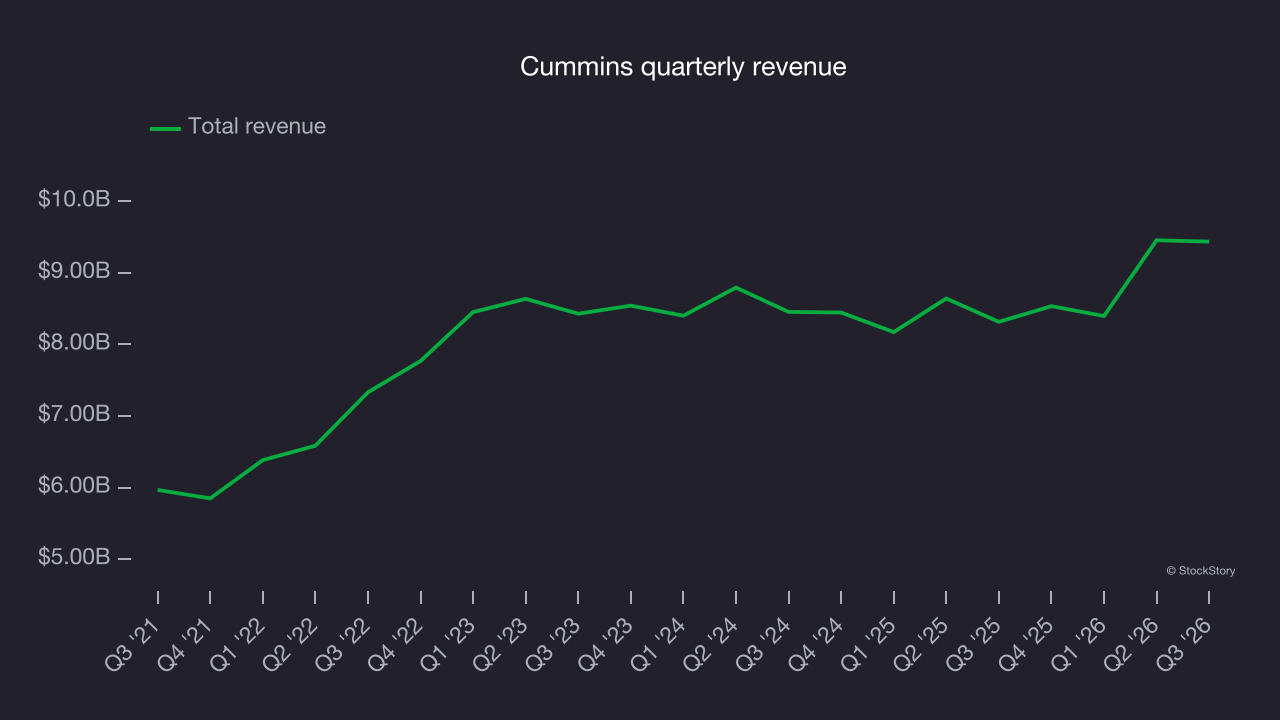
Long-term growth matters the most, but within industrials, a half-decade historical view may miss cycles, industry trends or a company capitalizing on catalysts such as a new contract win or a successful product line. Cummins’s recent performance shows its demand has slowed as its annualized revenue growth of 2.4% over the last two years was below its five-year trend. Decelerating revenue growth in the sector warrants caution, as it could signal changing consumer tastes aided by low switching costs. 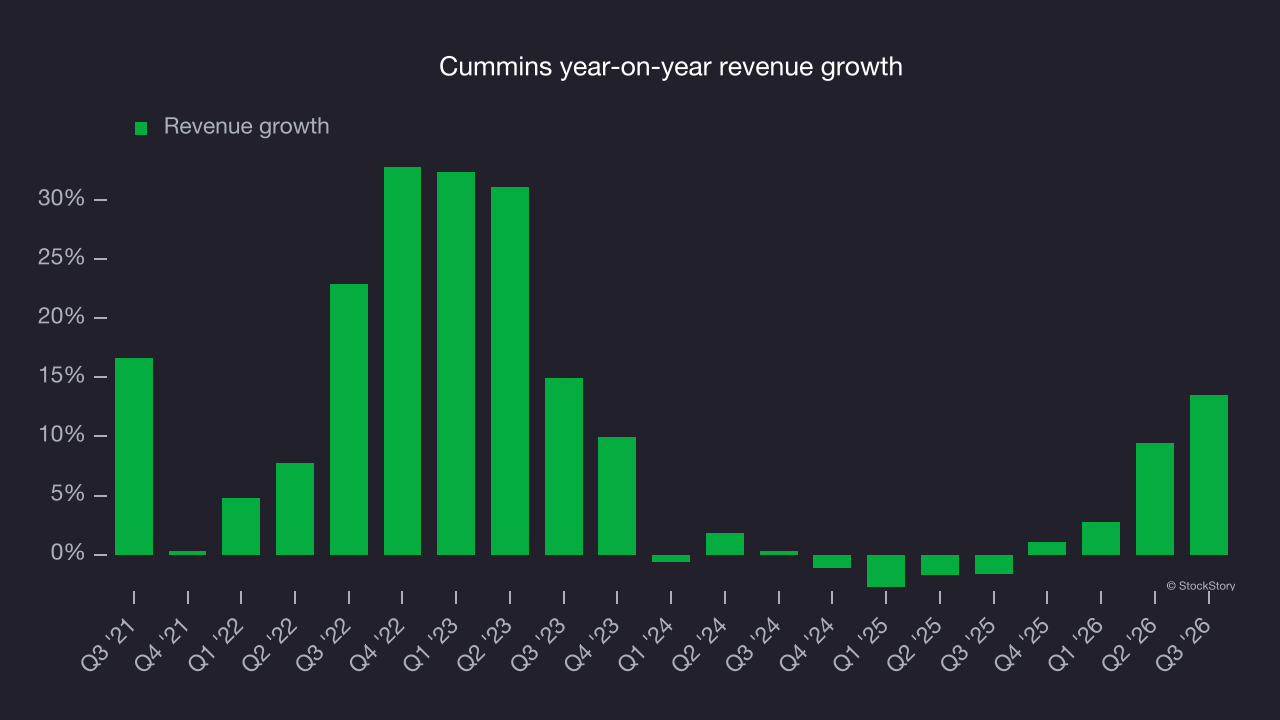
Cummins also breaks out the revenue for its most important segments, Components and Engine, which are 25.3% and 25.4% of revenue. Over the last two years, Cummins’s Components revenue (axles, brakes and drivelines) averaged 5.3% year-on-year declines while its Engine revenue (diesel and gas-powered engines) averaged 5.7% declines. 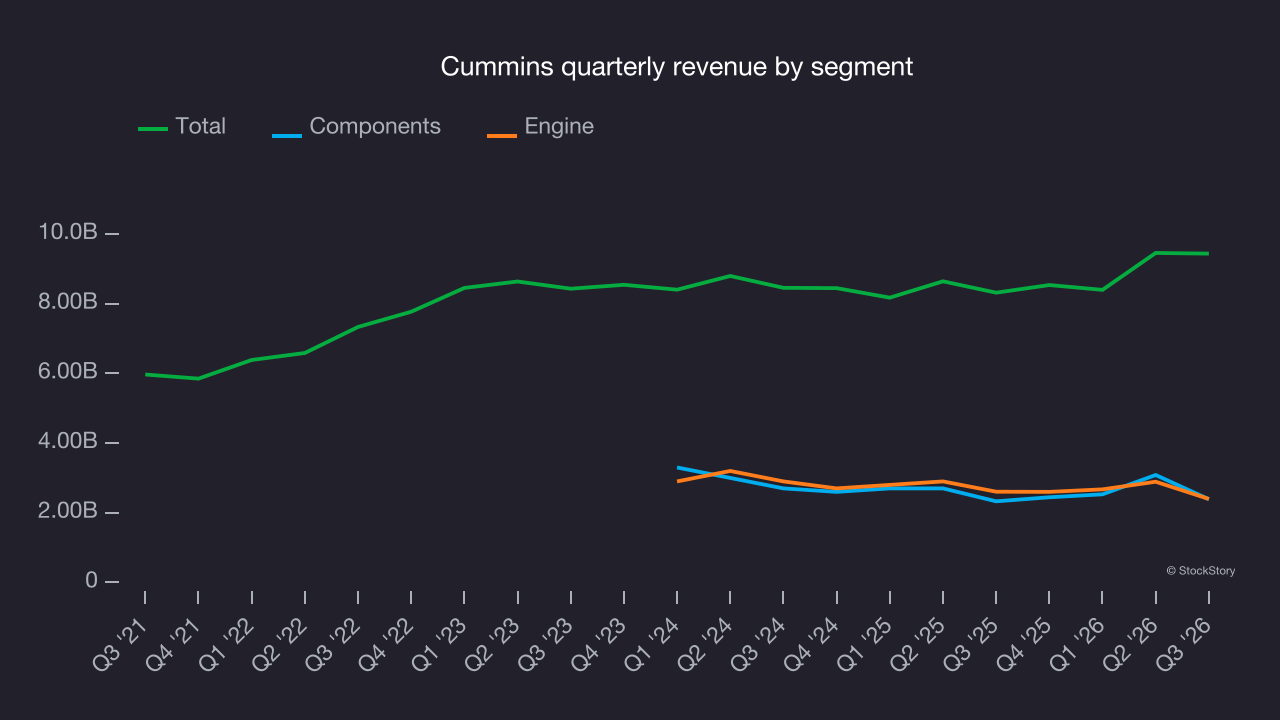
This quarter, Cummins’s revenue grew by 13.5% year on year to $9.44 billion but fell short of Wall Street’s consensus estimates.
Looking ahead, sell-side analysts expect revenue to grow 14.4% over the next 12 months, according to S&P, an improvement versus the last two years. This projection is strong for a company of its scale and indicates its newer products and services will drive better revenue performance.
Operating margin
Operating margin is an important measure of profitability as it shows the portion of revenue left after accounting for all core expenses, from the cost of goods sold to advertising and wages. It’s also useful for comparing profitability across companies with different levels of debt and tax rates because it excludes interest and taxes.
Cummins has managed its cost base well over the last five years. It demonstrated solid profitability for an industrials business, producing an average operating margin of 10.2%. This result was particularly impressive because of its low gross margin, which largely reflects what it sells and requires substantial changes to move meaningfully. Companies have more control over their operating margins, and high operating margins alongside low gross margins indicate well-managed operations.
Analyzing the trend in its profitability, Cummins’s operating margin rose by 2.5 percentage points over the last five years, as its revenue growth gave it operating leverage.
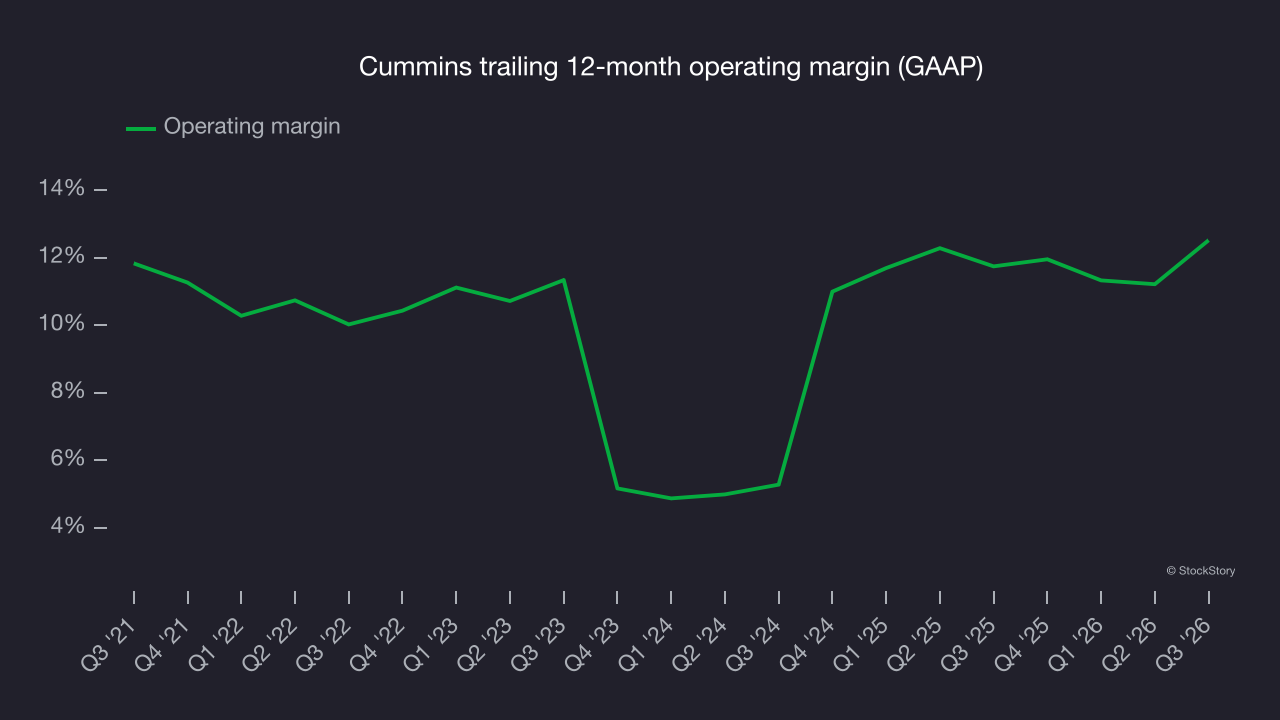
In Q3, Cummins generated an operating margin of 15.3%, up 5.1 percentage points year on year. The increase was solid and outpaced the gain in gross margin, indicating more efficient management of marketing, R&D and administrative expenses.
Earnings per share
Revenue trends explain a company’s historical growth, but the long-term change in earnings per share (EPS) points to the profitability of that growth. For example, a company could inflate its revenue through excessive spending on advertising and promotions.
Cummins’s decent 9.5% annual EPS growth over the last five years aligns with its revenue performance, indicating its incremental revenue was profitable.
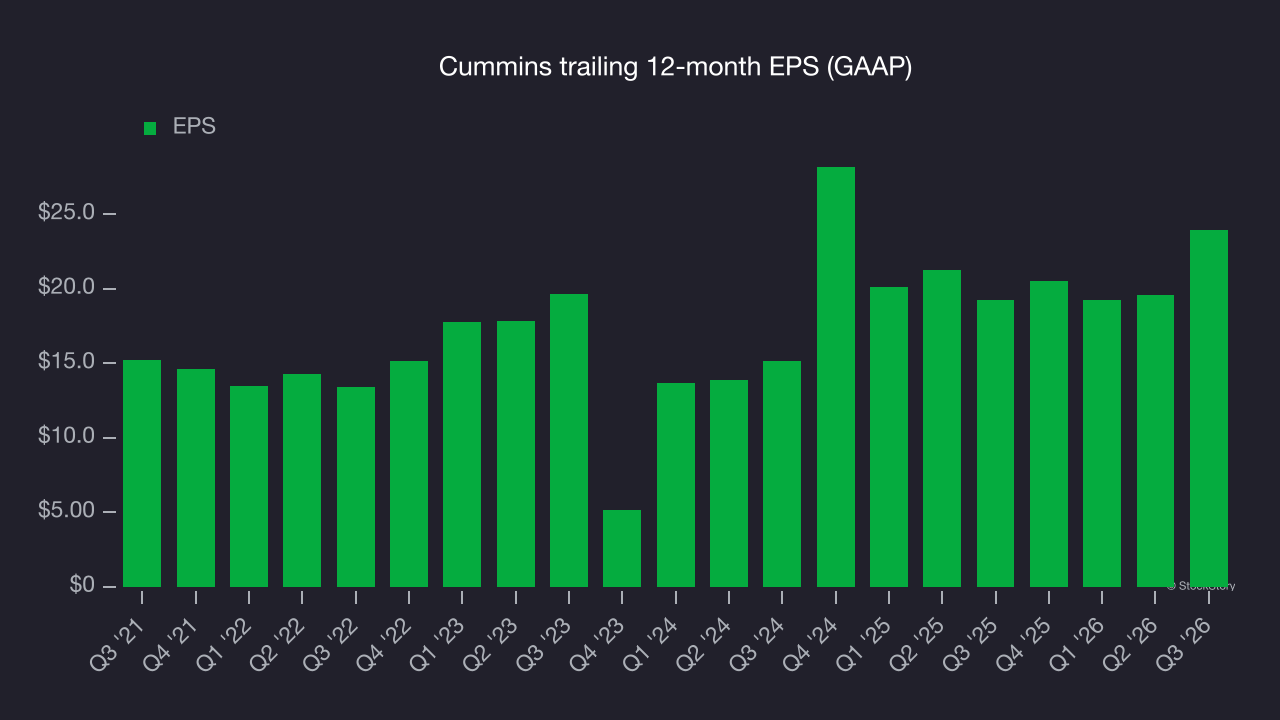
As with revenue, examining EPS over a shorter period can reveal a change in the business.
Cummins’s two-year annual EPS growth of 25.8% was strong and topped its 2.4% two-year revenue growth.
We can take a deeper look into Cummins’s earnings quality to better understand the drivers of its performance. Cummins’s operating margin has expanded over the last two years. This was the most relevant factor (aside from the revenue impact) behind its higher earnings; interest expenses and taxes can also affect EPS but don’t tell us as much about a company’s fundamentals.
In Q3, Cummins reported EPS of $8.25, up from $3.86 in the same quarter last year. This result was close to analysts’ consensus estimates. Over the next 12 months, Wall Street expects Cummins’s full-year EPS to grow 40.7% from $23.96 to $33.70, according to S&P.
Key takeaways from Cummins’s Q3 results
Cummins offered few positives in Q3: Both revenue and EBITDA fell short of Wall Street’s consensus estimates, making this a disappointing quarter. Shares tumbled 5.6% to $445.46 immediately after the results.
Cummins may have had a tough quarter. To assess whether to invest, consider the bigger picture of valuation and business quality alongside the latest earnings. Read the full research report here (it’s free).