Earnings results often indicate what direction a company will take in the months ahead. With Q2 behind us, let’s have a look at Range Resources (NYSE: RRC) and its peers.
Natural gas-focused E&P companies explore, develop, and produce natural gas resources serving power generation, industrial, and export markets. Natural gas is often positioned as a transition fuel given lower carbon intensity versus coal and oil. Tailwinds include growing LNG (liquefied natural gas) export demand, power generation switching from coal, and industrial consumption growth. Headwinds include natural gas price volatility driven by weather, storage levels, and competing supply sources. Infrastructure constraints may limit market access, while long-term demand faces uncertainty from renewable energy expansion and electrification trends potentially reducing gas consumption.
The 6 upstream natural gas e&p stocks we track reported a strong Q2. As a group, revenues beat analysts’ consensus estimates by 2.3%.
Thankfully, share prices of the companies have been resilient as they are up 9.2% on average since the latest earnings results.
Range Resources (NYSE: RRC)
Focused almost entirely on the Marcellus Shale beneath Pennsylvania's forests and farmland, Range Resources (NYSE: RRC) drills for and produces natural gas, natural gas liquids, and oil from shale formations.
Range Resources reported revenues of $736.7 million, up 5.4% year on year. This print exceeded analysts’ expectations by 1.8%. Overall, it was an exceptional quarter for the company with a beat of analysts’ EPS estimates.
Commenting on the results, Dennis Degner, the Company’s CEO said, “Range’s year-to-date results reflect continued progress on our multi-year growth plan, which was supported by record drilling and completion efficiencies in the most recent quarter. Range’s strategic access to international markets drove a record NGL premium for the quarter, bolstering margins. The resulting strong free cash flow funded shareholder returns through dividends and share repurchases while advancing our operational momentum.
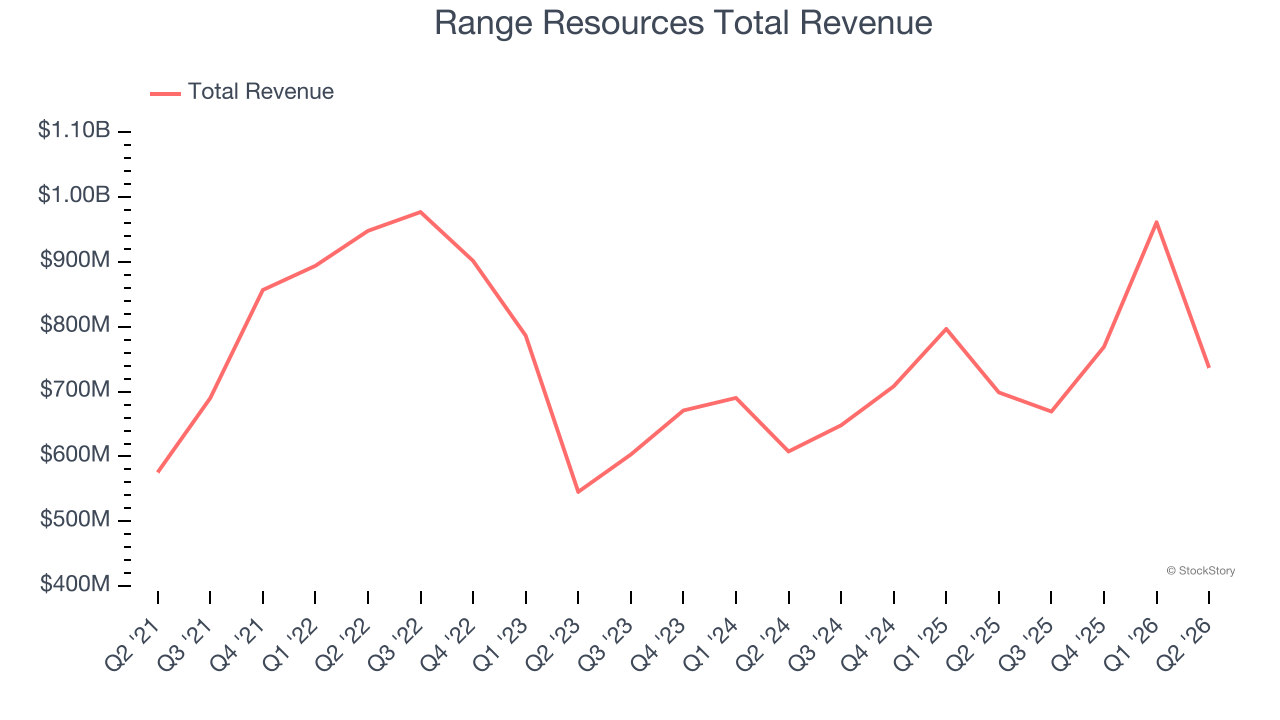
Interestingly, the stock is up 10.6% since reporting and currently trades at $41.74.
Is now the time to buy Range Resources? Access our full analysis of the earnings results here, it’s free.
Best Q2: BKV (NYSE: BKV)
Operating a "closed-loop" model linking gas production to carbon capture, BKV (NYSE: BKV) produces natural gas from shale formations in Texas and Pennsylvania, selling it to utilities, industrial users, and exporters.
BKV reported revenues of $465.5 million, up 44.6% year on year, outperforming analysts’ expectations by 27.4%. The business had an incredible quarter with a beat of analysts’ EPS estimates.
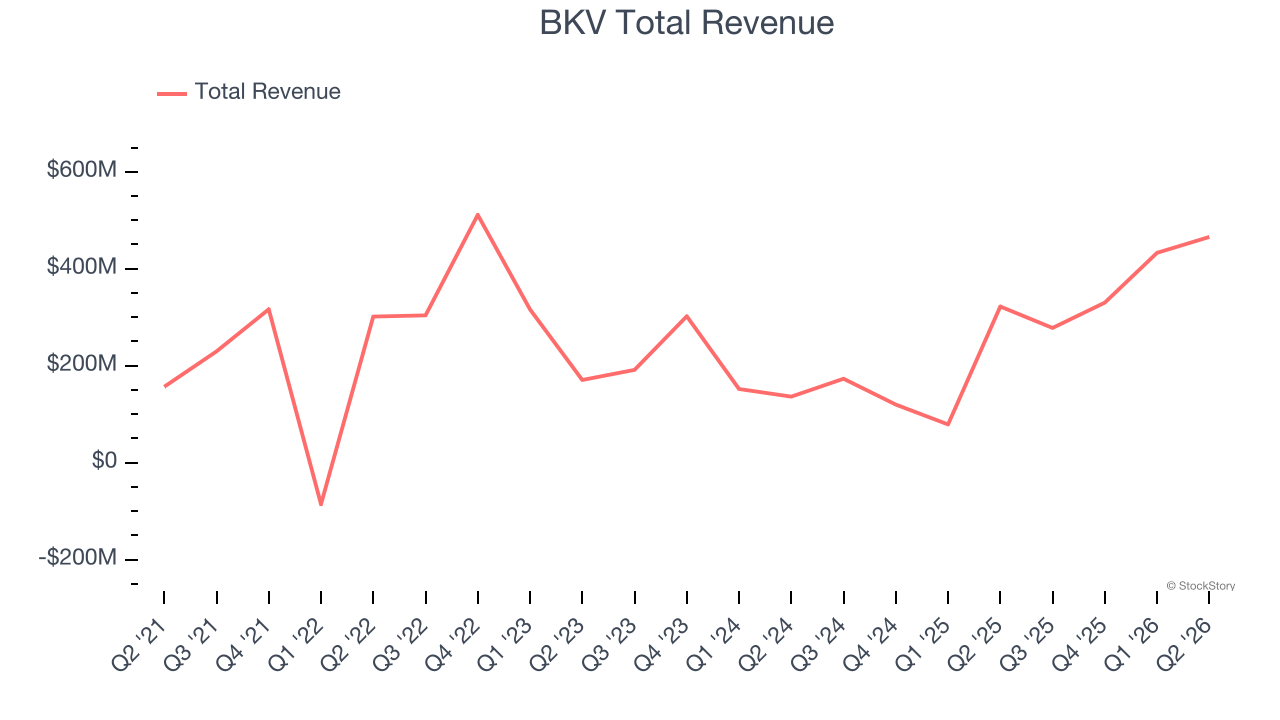
BKV delivered the biggest analyst estimate beat and fastest revenue growth of the whole group. The market seems happy with the results as the stock is up 5.4% since reporting. It currently trades at $24.24.
Is now the time to buy BKV? Access our full analysis of the earnings results here, it’s free.
Weakest Q2: Antero Resources (NYSE: AR)
Holding roughly 521,000 net acres across West Virginia, Ohio, and Pennsylvania, Antero Resources (NYSE: AR) drills and produces natural gas, natural gas liquids, and oil from underground rock formations in the Appalachian Basin.
Antero Resources reported revenues of $1.48 billion, up 22.7% year on year, falling short of analysts’ expectations by 3%. It was a disappointing quarter as it posted a significant miss of analysts’ EPS estimates.
Interestingly, the stock is up 9.3% since the results and currently trades at $38.40.
Read our full analysis of Antero Resources’s results here.
Comstock Resources (NYSE: CRK)
Operating in the Haynesville shale where a single well can produce millions of cubic feet of gas daily, Comstock Resources (NYSE: CRK) drills for and produces natural gas from underground shale rock formations in Louisiana and Texas.
Comstock Resources reported revenues of $332 million, down 4.5% year on year. This result missed analysts’ expectations by 12.5%. More broadly, it was actually a satisfactory quarter as it recorded a beat of analysts’ EPS estimates.
Comstock Resources had the weakest performance against analyst estimates and slowest revenue growth among its peers. The stock is up 15.6% since reporting and currently trades at $14.57.
Read our full, actionable report on Comstock Resources here, it’s free.
EQT (NYSE: EQT)
The largest natural gas producer in the United States by daily volume, EQT (NYSE: EQT) produces natural gas and natural gas liquids from wells drilled in the Appalachian Basin.
EQT reported revenues of $1.81 billion, up 13.2% year on year. This number beat analysts’ expectations by 4%. It was a very strong quarter as it also put up a solid beat of analysts’ EBITDA estimates.
The stock is up 10.5% since reporting and currently trades at $55.05.
Read our full, actionable report on EQT here, it’s free.
Market Update
Over the past year, investors have been forced to repeatedly answer the same question: what is the market’s biggest risk? The answer has changed several times, and each shift has reshaped market leadership.
Late in 2025 and early 2026, artificial intelligence became the market’s primary uncertainty. Investors questioned whether AI would erode software pricing power and weaken competitive moats as AI made it easier to replicate once-differentiated products.
By the spring, technology took a back seat to geopolitics. The U.S. conflict with Iran briefly became the market’s dominant narrative, raising concerns about oil prices, inflation, and global growth. But as energy markets remained orderly and fears of a prolonged supply disruption faded, investors quickly turned their focus back to fundamentals.
Want to invest in winners with rock-solid fundamentals? Check out our Top 5 Growth Stocks and add them to your watchlist. These companies are poised for growth regardless of the political or macroeconomic climate.