
Medical device company Penumbra (NYSE: PEN) beat Wall Street’s revenue expectations in Q4 CY2025, with sales up 22.1% year on year to $385.4 million. Its non-GAAP profit of $1.18 per share was 6.1% above analysts’ consensus estimates.
Is now the time to buy Penumbra? Find out by accessing our full research report, it’s free.
Penumbra (PEN) Q4 CY2025 Highlights:
- Revenue: $385.4 million vs analyst estimates of $367.7 million (22.1% year-on-year growth, 4.8% beat)
- Adjusted EPS: $1.18 vs analyst estimates of $1.11 (6.1% beat)
- Adjusted EBITDA: $79.13 million vs analyst estimates of $66.32 million (20.5% margin, 19.3% beat)
- Operating Margin: 15.4%, up from 13.6% in the same quarter last year
- Constant Currency Revenue rose 20.9% year on year (13% in the same quarter last year)
- Market Capitalization: $13.3 billion
Company Overview
Founded in 2004 to address challenging medical conditions with significant unmet needs, Penumbra (NYSE: PEN) develops and manufactures innovative medical devices for treating vascular diseases and providing immersive healthcare rehabilitation solutions.
Revenue Growth
A company’s long-term performance is an indicator of its overall quality. Any business can have short-term success, but a top-tier one grows for years. Luckily, Penumbra’s sales grew at an impressive 20.2% compounded annual growth rate over the last five years. Its growth beat the average healthcare company and shows its offerings resonate with customers.
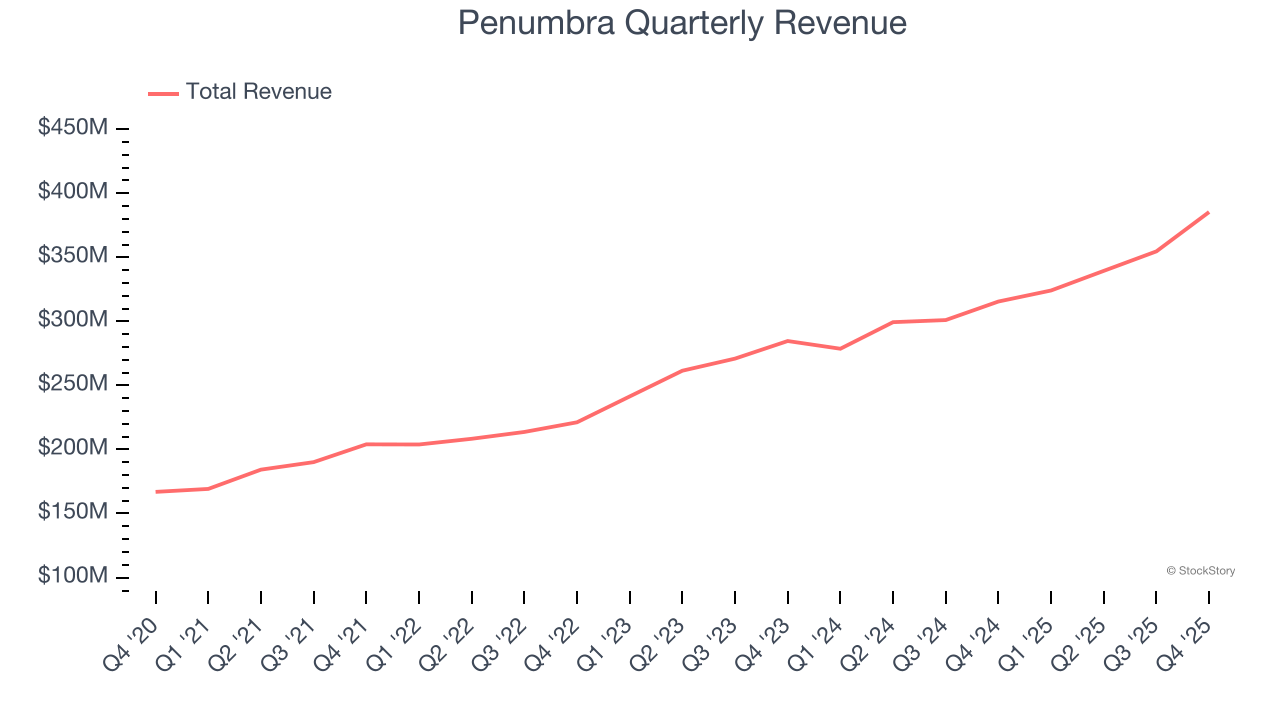
We at StockStory place the most emphasis on long-term growth, but within healthcare, a half-decade historical view may miss recent innovations or disruptive industry trends. Penumbra’s annualized revenue growth of 15.2% over the last two years is below its five-year trend, but we still think the results suggest healthy demand. 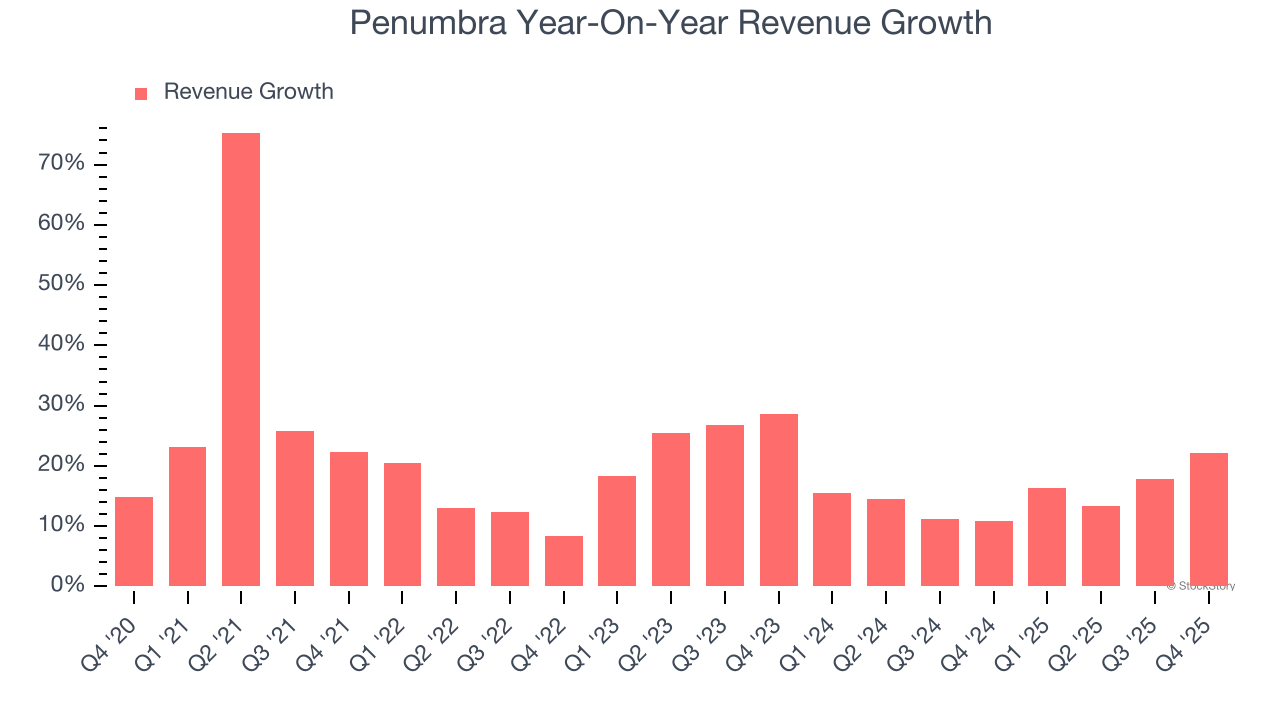
We can better understand the company’s sales dynamics by analyzing its constant currency revenue, which excludes currency movements that are outside their control and not indicative of demand. Over the last two years, its constant currency sales averaged 15.2% year-on-year growth. Because this number aligns with its normal revenue growth, we can see that Penumbra has properly hedged its foreign currency exposure. 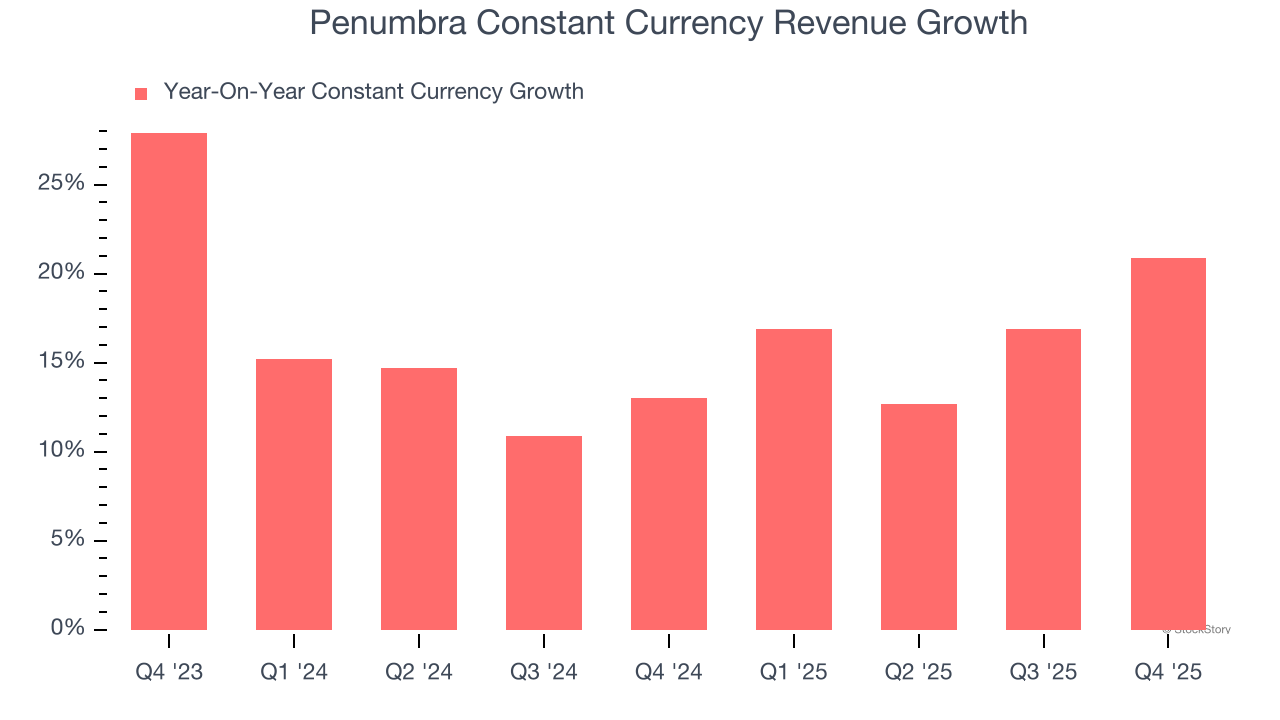
This quarter, Penumbra reported robust year-on-year revenue growth of 22.1%, and its $385.4 million of revenue topped Wall Street estimates by 4.8%.
Looking ahead, sell-side analysts expect revenue to grow 12.7% over the next 12 months, a slight deceleration versus the last two years. Still, this projection is healthy and implies the market is baking in success for its products and services.
The 1999 book Gorilla Game predicted Microsoft and Apple would dominate tech before it happened. Its thesis? Identify the platform winners early. Today, enterprise software companies embedding generative AI are becoming the new gorillas. a profitable, fast-growing enterprise software stock that is already riding the automation wave and looking to catch the generative AI next.
Operating Margin
Operating margin is one of the best measures of profitability because it tells us how much money a company takes home after subtracting all core expenses, like marketing and R&D.
Penumbra was profitable over the last five years but held back by its large cost base. Its average operating margin of 5.2% was weak for a healthcare business.
On the plus side, Penumbra’s operating margin rose by 14.5 percentage points over the last five years, as its sales growth gave it operating leverage. Zooming in on its more recent performance, we can see the company’s trajectory is intact as its margin has also increased by 6.5 percentage points on a two-year basis.
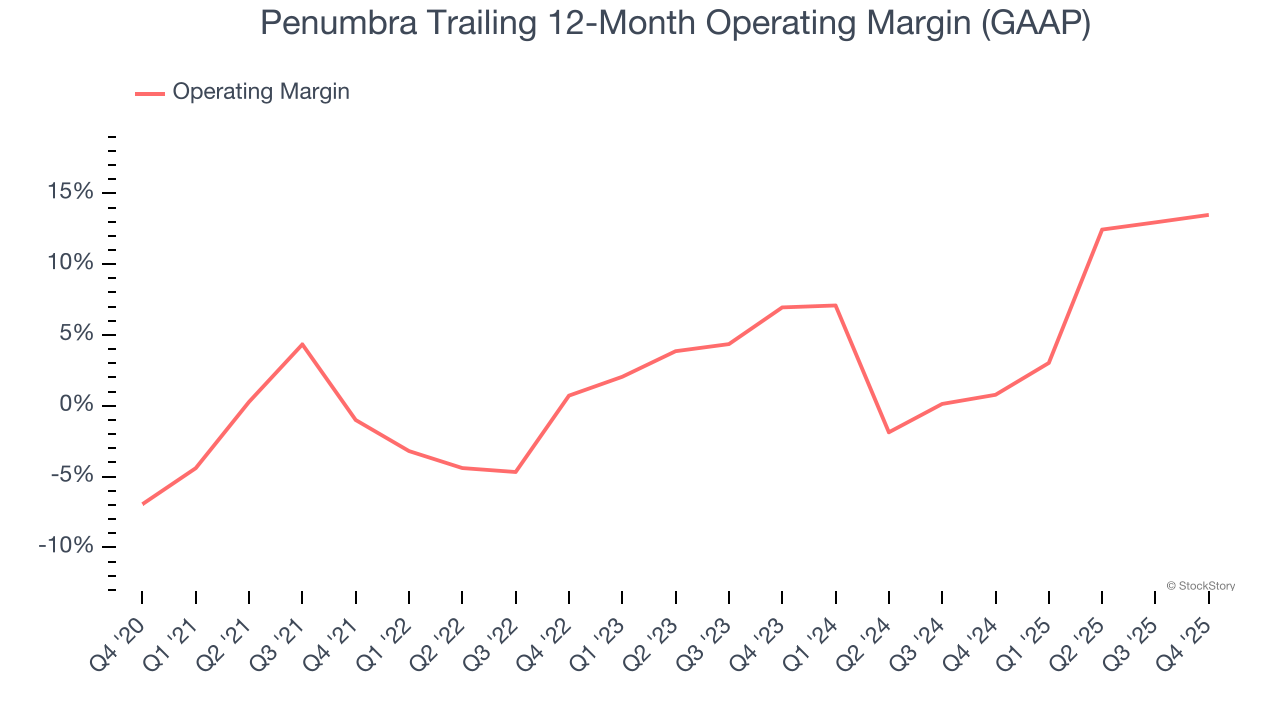
This quarter, Penumbra generated an operating margin profit margin of 15.4%, up 1.8 percentage points year on year. This increase was a welcome development and shows it was more efficient.
Earnings Per Share
Revenue trends explain a company’s historical growth, but the long-term change in earnings per share (EPS) points to the profitability of that growth – for example, a company could inflate its sales through excessive spending on advertising and promotions.
Penumbra’s EPS grew at an astounding 84.4% compounded annual growth rate over the last five years, higher than its 20.2% annualized revenue growth. This tells us the company became more profitable on a per-share basis as it expanded.
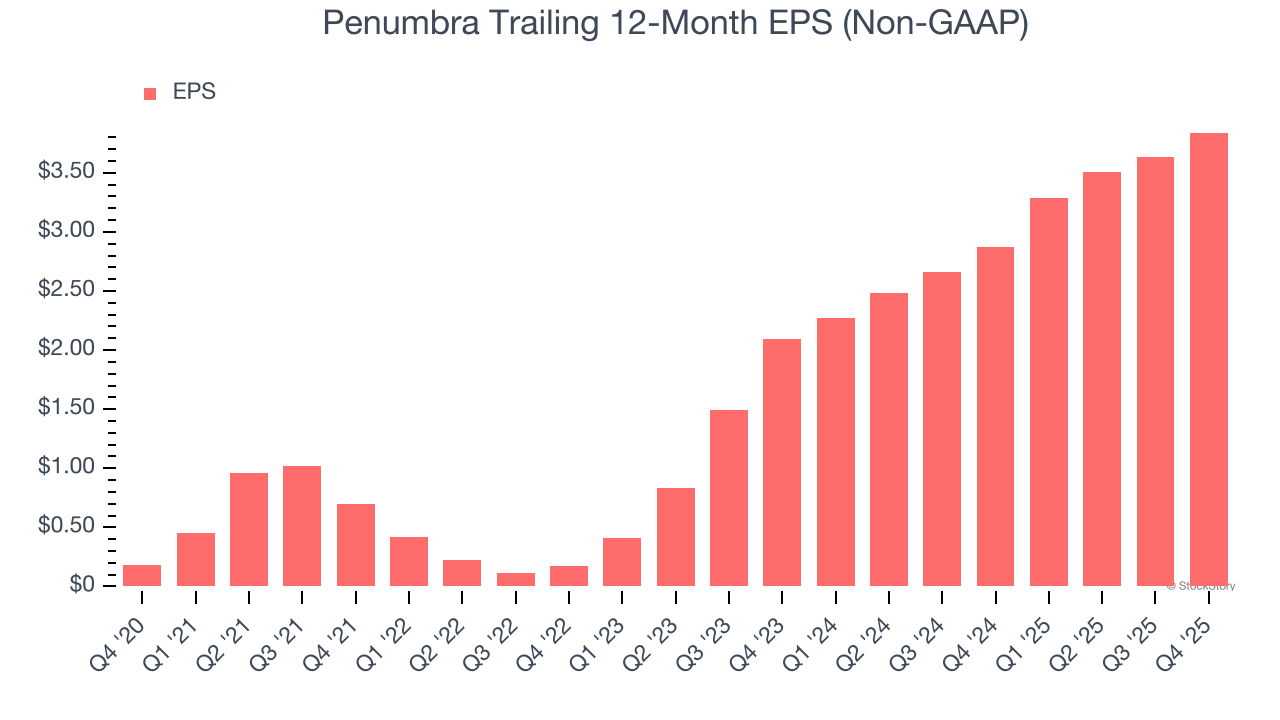
We can take a deeper look into Penumbra’s earnings to better understand the drivers of its performance. As we mentioned earlier, Penumbra’s operating margin expanded by 14.5 percentage points over the last five years. This was the most relevant factor (aside from the revenue impact) behind its higher earnings; interest expenses and taxes can also affect EPS but don’t tell us as much about a company’s fundamentals.
In Q4, Penumbra reported adjusted EPS of $1.18, up from $0.97 in the same quarter last year. This print beat analysts’ estimates by 6.1%. Over the next 12 months, Wall Street expects Penumbra’s full-year EPS of $3.84 to grow 32.7%.
Key Takeaways from Penumbra’s Q4 Results
We enjoyed seeing Penumbra beat analysts’ revenue expectations this quarter. We were also glad its EPS outperformed Wall Street’s estimates. Zooming out, we think this was a good print with some key areas of upside. The stock remained flat at $338.70 immediately following the results.
So do we think Penumbra is an attractive buy at the current price? If you’re making that decision, you should consider the bigger picture of valuation, business qualities, as well as the latest earnings. We cover that in our actionable full research report which you can read here (it’s free).