Credit reporting giant Equifax (NYSE: EFX) beat Wall Street’s revenue expectations in Q1 CY2026, with sales up 14.3% year on year to $1.65 billion. The company expects next quarter’s revenue to be around $1.70 billion, close to analysts’ estimates. Its non-GAAP profit of $1.86 per share was 9.7% above analysts’ consensus estimates.
Is now the time to buy Equifax? Find out by accessing our full research report, it’s free.
Equifax (EFX) Q1 CY2026 Highlights:
- Revenue: $1.65 billion vs analyst estimates of $1.62 billion (14.3% year-on-year growth, 2% beat)
- Adjusted EPS: $1.86 vs analyst estimates of $1.70 (9.7% beat)
- Adjusted EBITDA: $477.4 million vs analyst estimates of $457.3 million (29% margin, 4.4% beat)
- The company slightly lifted its revenue guidance for the full year to $6.75 billion at the midpoint from $6.72 billion
- Management slightly raised its full-year Adjusted EPS guidance to $8.54 at the midpoint
- Operating Margin: 17.4%, up from 16.4% in the same quarter last year
- Free Cash Flow Margin: 7.4%, similar to the same quarter last year
- Market Capitalization: $23.94 billion
"Equifax delivered a very strong first quarter performance executing on our EFX2028 Strategic Priorities with reported revenue of $1.649 billion, up a strong 14%, with 13% local currency revenue growth which was $37 million above the midpoint of our February guidance. The revenue outperformance was principally driven by very strong U.S. Mortgage revenue growth of 38% principally in January and February before rates increased from the Iran conflict, continued solid performance in Diversified Markets up 6% in local currency, and strong New Product Innovation momentum with Vitality Index of 17% - significantly above our long-term goal of 10% - powered by the EFX Cloud, EFX.AI, and our proprietary data. Workforce Solutions delivered strong 10% revenue growth, driven by Verification Services revenue growth of 14% led by Diversified Markets revenue growth of 14% from strong mid double digit growth in Government and Consumer Lending businesses. USIS delivered strong revenue growth of 21%, well above their 6 to 8% Long Term Financial Framework. USIS revenue growth was led by very strong 60% Mortgage revenue growth and Diversified Markets revenue growth of 3%. International delivered 4% local currency revenue growth with high single digit revenue growth in Canada. We were pleased with the broad-based Equifax results in a challenging market environment. Given our strong free cash flow, Equifax returned $327 million in cash to shareholders, including repurchasing 1.3 million shares for $260 million and paying $67 million in quarterly dividends," said Mark W. Begor, Equifax Chief Executive Officer.
Company Overview
Holding detailed financial records on over 800 million consumers worldwide and dating back to 1899, Equifax (NYSE: EFX) is a global data analytics company that collects, analyzes, and sells consumer and business credit information to lenders, employers, and other businesses.
Revenue Growth
A company’s long-term sales performance is one signal of its overall quality. Any business can experience short-term success, but top-performing ones enjoy sustained growth for years.
With $6.28 billion in revenue over the past 12 months, Equifax is one of the larger companies in the business services industry and benefits from a well-known brand that influences purchasing decisions.
As you can see below, Equifax’s sales grew at a solid 7.5% compounded annual growth rate over the last five years. This shows it had high demand, a useful starting point for our analysis.
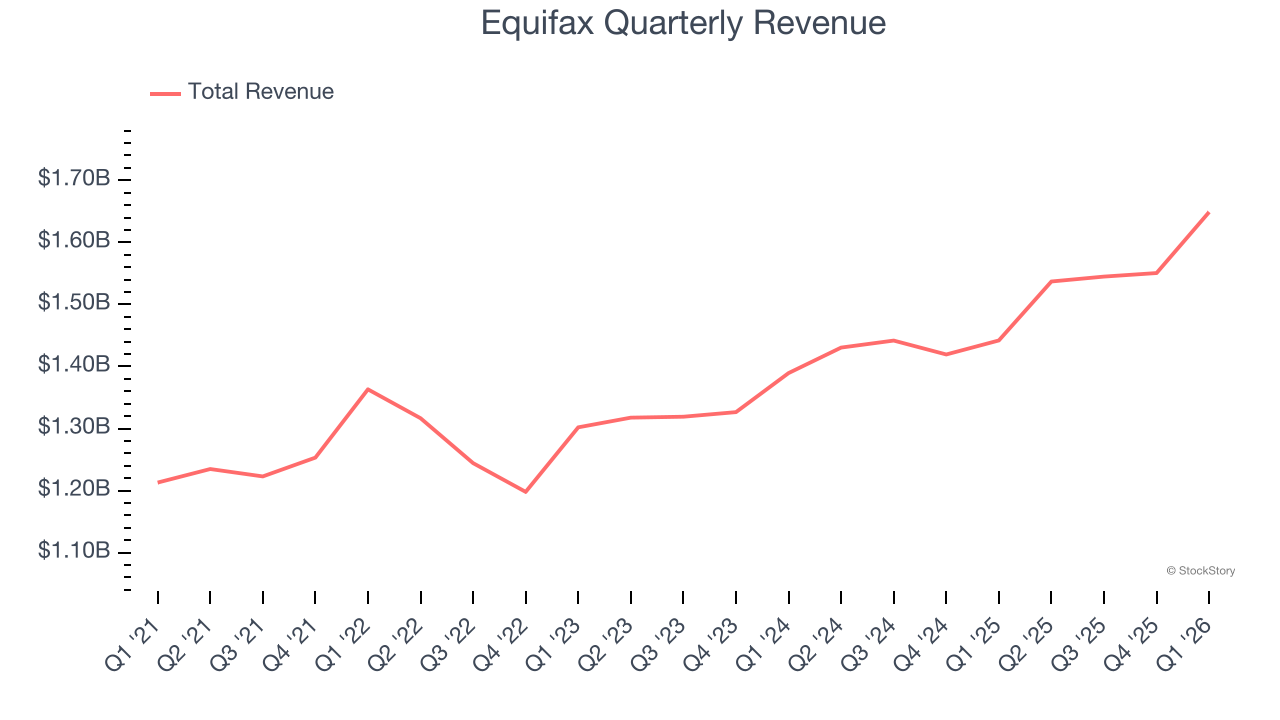
We at StockStory place the most emphasis on long-term growth, but within business services, a half-decade historical view may miss recent innovations or disruptive industry trends. Equifax’s annualized revenue growth of 8.3% over the last two years aligns with its five-year trend, suggesting its demand was predictably strong. 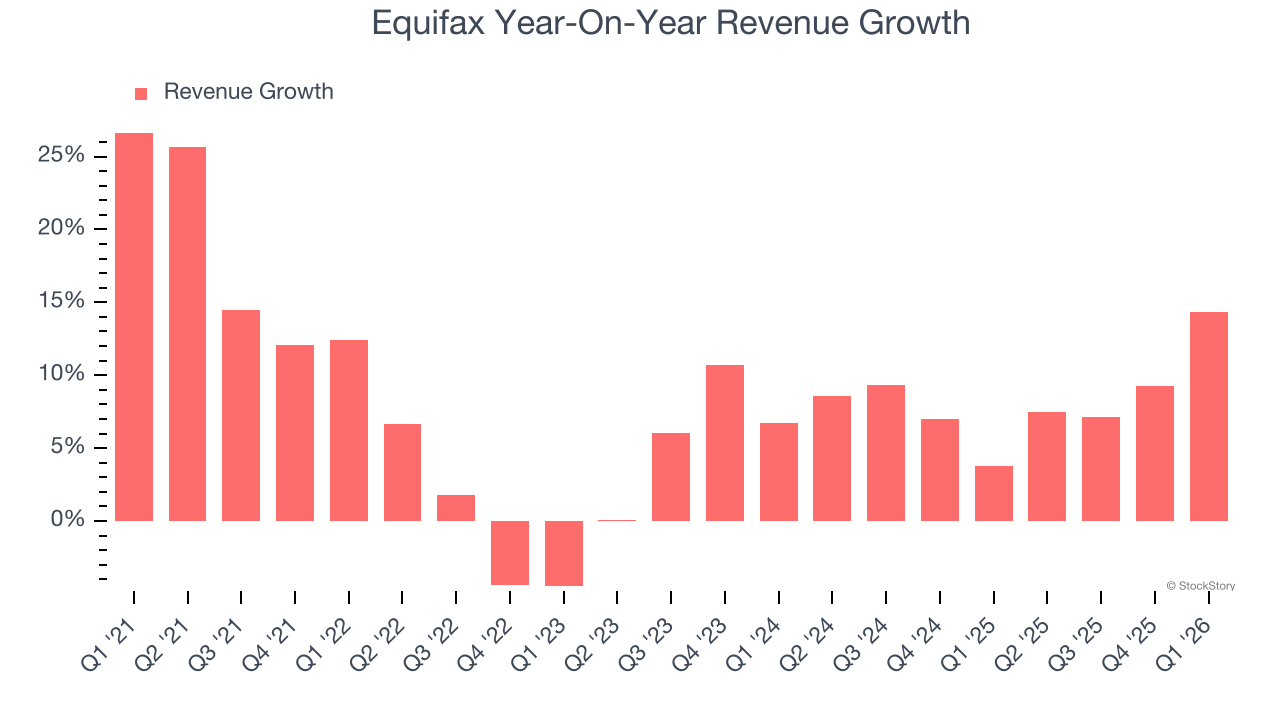
Equifax also breaks out the revenue for its most important segments, Workforce Solutions and U.S. Information Solutions, which are 41.4% and 36.7% of revenue. Over the last two years, Equifax’s Workforce Solutions revenue (HR services) averaged 7% year-on-year growth while its U.S. Information Solutions revenue (credit services) averaged 12.1% growth. 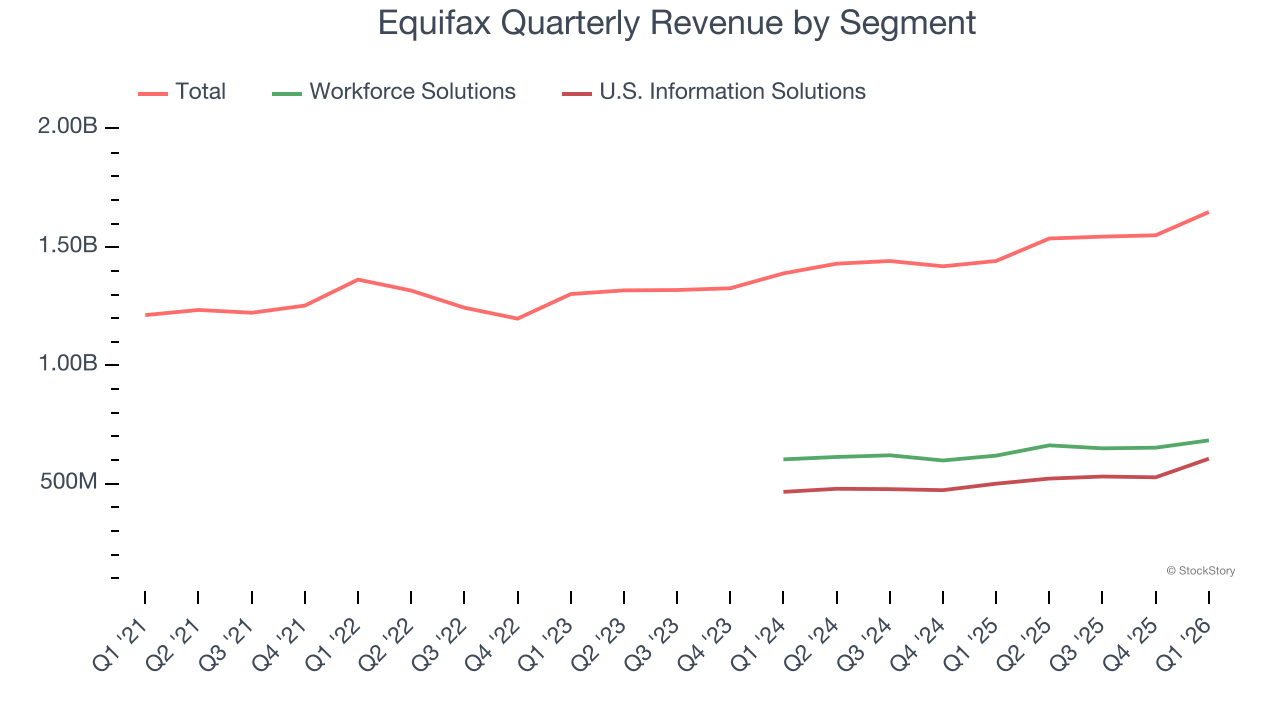
This quarter, Equifax reported year-on-year revenue growth of 14.3%, and its $1.65 billion of revenue exceeded Wall Street’s estimates by 2%. Company management is currently guiding for a 10.3% year-on-year increase in sales next quarter.
Looking further ahead, sell-side analysts expect revenue to grow 9.6% over the next 12 months, similar to its two-year rate. This projection is admirable and indicates its newer products and services will catalyze better top-line performance.
ONE MORE THING: 3 Hidden Platforms Growing 3X Faster than Amazon, Google, and PayPal. Amazon, Google, and Meta all followed the same playbook: Dominate an ignored market. Build an unbeatable moat. Scale until you’re unstoppable.
These three platforms are running that exact playbook right now. The early investors in Amazon made fortunes. The early investors in these could do the same. Get All 3 Stocks Here for FREE.
Adjusted Operating Margin
Equifax has been a well-oiled machine over the last five years. It demonstrated elite profitability for a business services business, boasting an average adjusted operating margin of 21.2%.
Analyzing the trend in its profitability, Equifax’s adjusted operating margin decreased by 3.4 percentage points over the last five years. This raises questions about the company’s expense base because its revenue growth should have given it leverage on its fixed costs, resulting in better economies of scale and profitability.
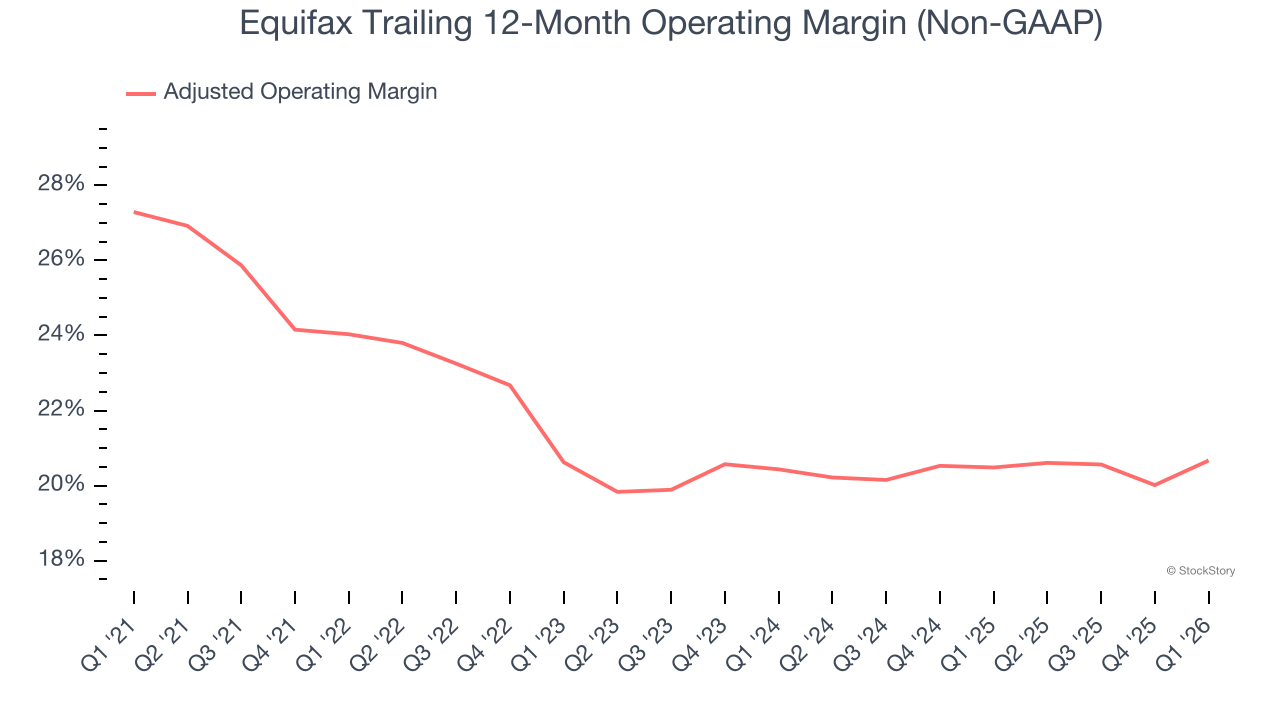
This quarter, Equifax generated an adjusted operating margin profit margin of 20.1%, up 2.8 percentage points year on year. This increase was a welcome development and shows it was more efficient.
Earnings Per Share
Revenue trends explain a company’s historical growth, but the long-term change in earnings per share (EPS) points to the profitability of that growth – for example, a company could inflate its sales through excessive spending on advertising and promotions.
Equifax’s EPS grew at a weak 1.4% compounded annual growth rate over the last five years, lower than its 7.5% annualized revenue growth. This tells us the company became less profitable on a per-share basis as it expanded due to non-fundamental factors such as interest expenses and taxes.
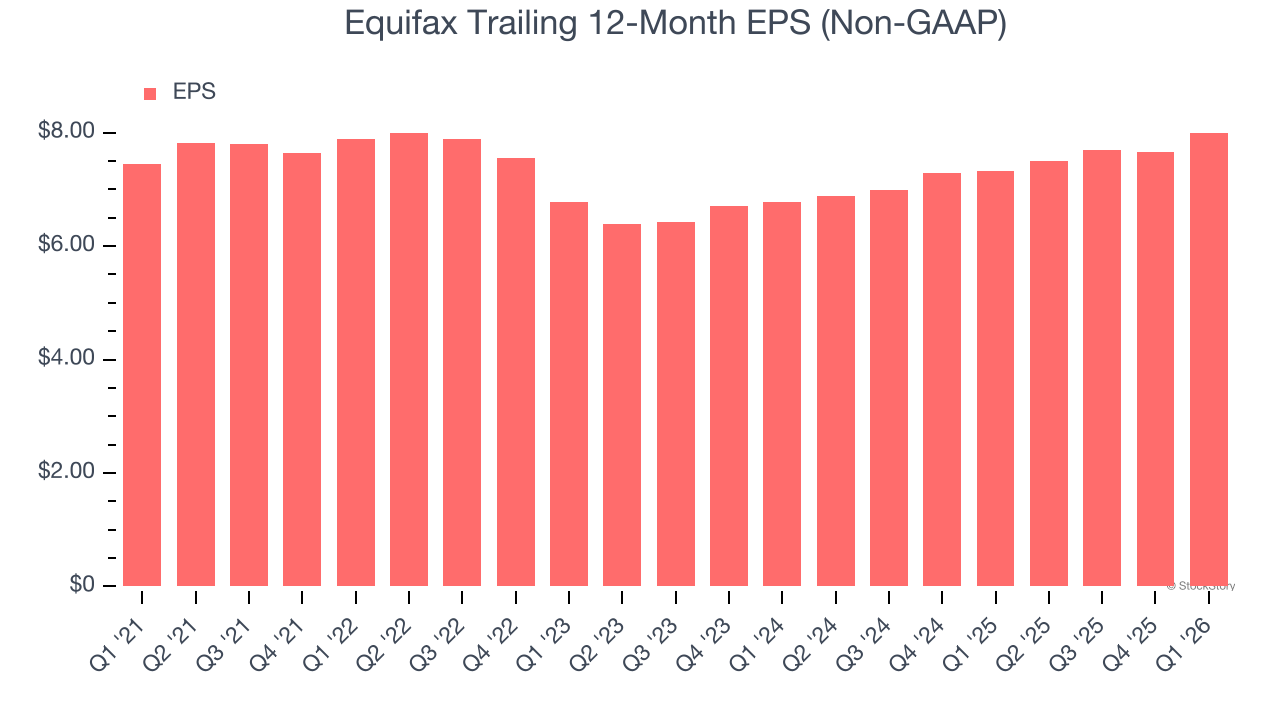
We can take a deeper look into Equifax’s earnings to better understand the drivers of its performance. As we mentioned earlier, Equifax’s adjusted operating margin expanded this quarter but declined by 3.4 percentage points over the last five years. This was the most relevant factor (aside from the revenue impact) behind its lower earnings; interest expenses and taxes can also affect EPS but don’t tell us as much about a company’s fundamentals.
Like with revenue, we analyze EPS over a shorter period to see if we are missing a change in the business.
For Equifax, its two-year annual EPS growth of 8.6% was higher than its five-year trend. Accelerating earnings growth is almost always an encouraging data point.
In Q1, Equifax reported adjusted EPS of $1.86, up from $1.53 in the same quarter last year. This print beat analysts’ estimates by 9.7%. Over the next 12 months, Wall Street expects Equifax’s full-year EPS of $7.99 to grow 11.4%.
Key Takeaways from Equifax’s Q1 Results
It was good to see Equifax beat analysts’ EPS expectations this quarter. We were also happy its revenue outperformed Wall Street’s estimates. On the other hand, its full-year EPS guidance slightly missed and its EPS guidance for next quarter fell slightly short of Wall Street’s estimates. Overall, this print was mixed but still had some key positives. The stock remained flat at $199.69 immediately after reporting.
So should you invest in Equifax right now? The latest quarter does matter, but not nearly as much as longer-term fundamentals and valuation, when deciding if the stock is a buy. We cover that in our actionable full research report which you can read here (it’s free).