Rural goods retailer Tractor Supply (NASDAQ: TSCO) fell short of the market’s revenue expectations in Q1 CY2026 as sales rose 3.6% year on year to $3.59 billion. Its GAAP profit of $0.31 per share was 9% below analysts’ consensus estimates.
Is now the time to buy Tractor Supply? Find out by accessing our full research report, it’s free.
Tractor Supply (TSCO) Q1 CY2026 Highlights:
- Revenue: $3.59 billion vs analyst estimates of $3.63 billion (3.6% year-on-year growth, 1.1% miss)
- EPS (GAAP): $0.31 vs analyst expectations of $0.34 (9% miss)
- Adjusted EBITDA: $377.7 million vs analyst estimates of $376.7 million (10.5% margin, in line)
- EPS (GAAP) guidance for the full year is $2.18 at the midpoint, roughly in line with what analysts were expecting
- Operating Margin: 6.5%, in line with the same quarter last year
- Free Cash Flow was -$111.5 million, down from $75.5 million in the same quarter last year
- Locations: 2,435 at quarter end, down from 2,517 in the same quarter last year
- Same-Store Sales were flat year on year (-0.9% in the same quarter last year)
- Market Capitalization: $23.57 billion
Company Overview
Started as a mail-order tractor parts business, Tractor Supply (NASDAQ: TSCO) is a retailer of general goods such as agricultural supplies, hardware, and pet food for the rural consumer.
Revenue Growth
A company’s long-term sales performance can indicate its overall quality. Any business can experience short-term success, but top-performing ones enjoy sustained growth for years.
With $15.65 billion in revenue over the past 12 months, Tractor Supply is one of the larger companies in the consumer retail industry and benefits from a well-known brand that influences purchasing decisions. However, its scale is a double-edged sword because there is only so much real estate to build new stores, placing a ceiling on its growth. For Tractor Supply to boost its sales, it likely needs to adjust its prices or lean into foreign markets.
As you can see below, Tractor Supply grew its sales at a sluggish 2.6% compounded annual growth rate over the last three years.
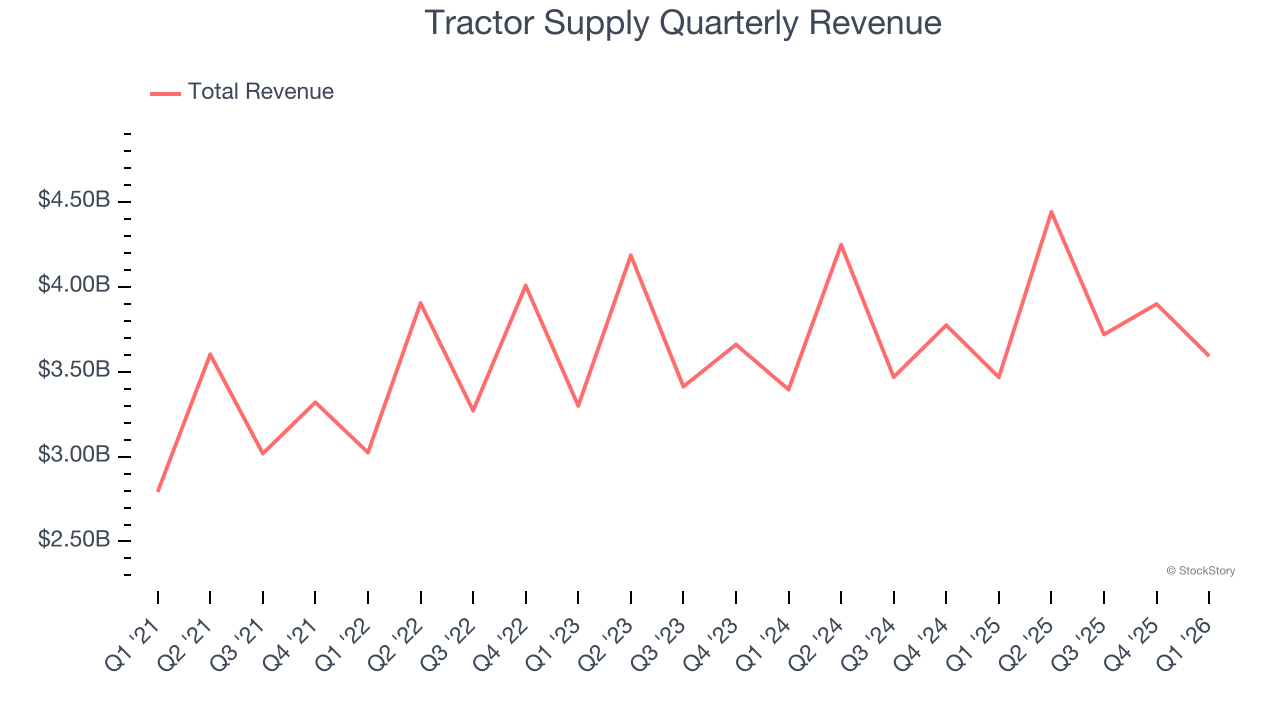
This quarter, Tractor Supply’s revenue grew by 3.6% year on year to $3.59 billion, falling short of Wall Street’s estimates.
Looking ahead, sell-side analysts expect revenue to grow 5.4% over the next 12 months, an acceleration versus the last three years. This projection is particularly noteworthy for a company of its scale and suggests its newer products will spur better top-line performance.
ONE MORE THING: 3 Hidden Platforms Growing 3X Faster than Amazon, Google, and PayPal. Amazon, Google, and Meta all followed the same playbook: Dominate an ignored market. Build an unbeatable moat. Scale until you’re unstoppable.
These three platforms are running that exact playbook right now. The early investors in Amazon made fortunes. The early investors in these could do the same. Get All 3 Stocks Here for FREE.
Store Performance
Number of Stores
A retailer’s store count often determines how much revenue it can generate.
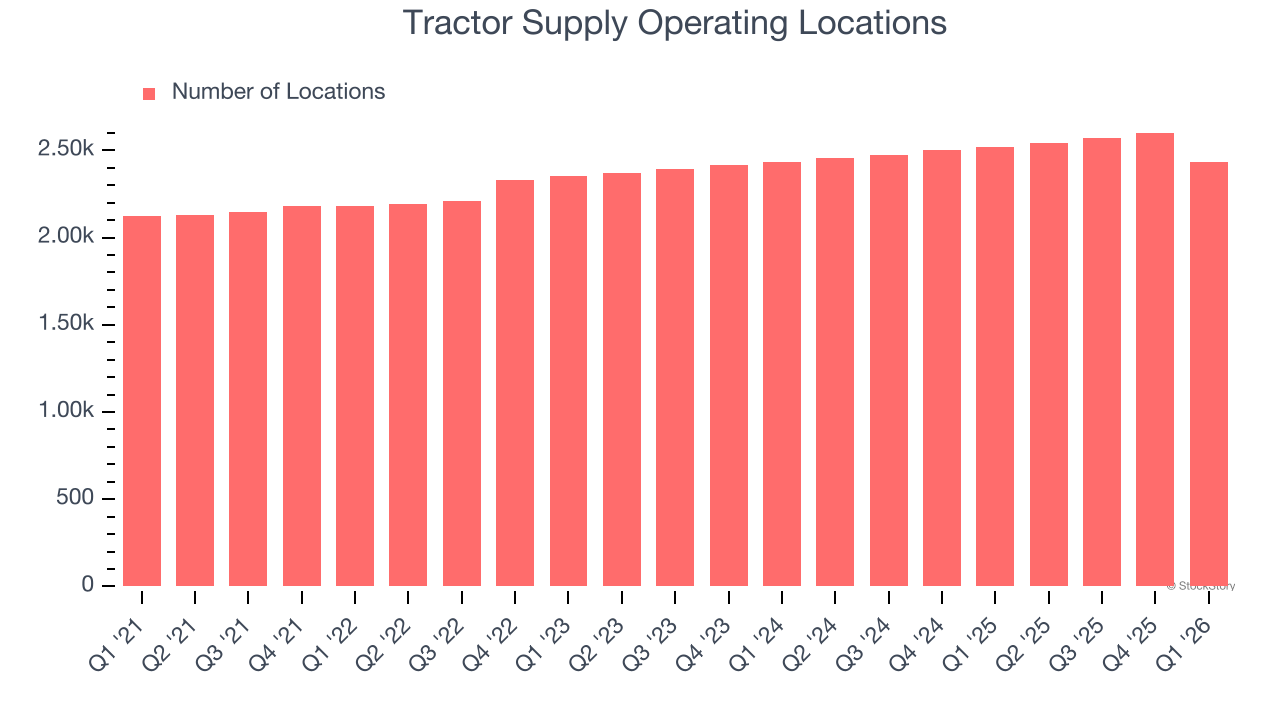
Tractor Supply sported 2,435 locations in the latest quarter. Over the last two years, it has opened new stores quickly, averaging 2.8% annual growth. This was faster than the broader consumer retail sector.
When a retailer opens new stores, it usually means it’s investing for growth because demand is greater than supply, especially in areas where consumers may not have a store within reasonable driving distance.
Same-Store Sales
The change in a company's store base only tells one side of the story. The other is the performance of its existing locations and e-commerce sales, which informs management teams whether they should expand or downsize their physical footprints. Same-store sales is an industry measure of whether revenue is growing at those existing stores and is driven by customer visits (often called traffic) and the average spending per customer (ticket).
Tractor Supply’s demand within its existing locations has barely increased over the last two years as its same-store sales were flat. Tractor Supply should consider improving its foot traffic and efficiency before expanding its store base.
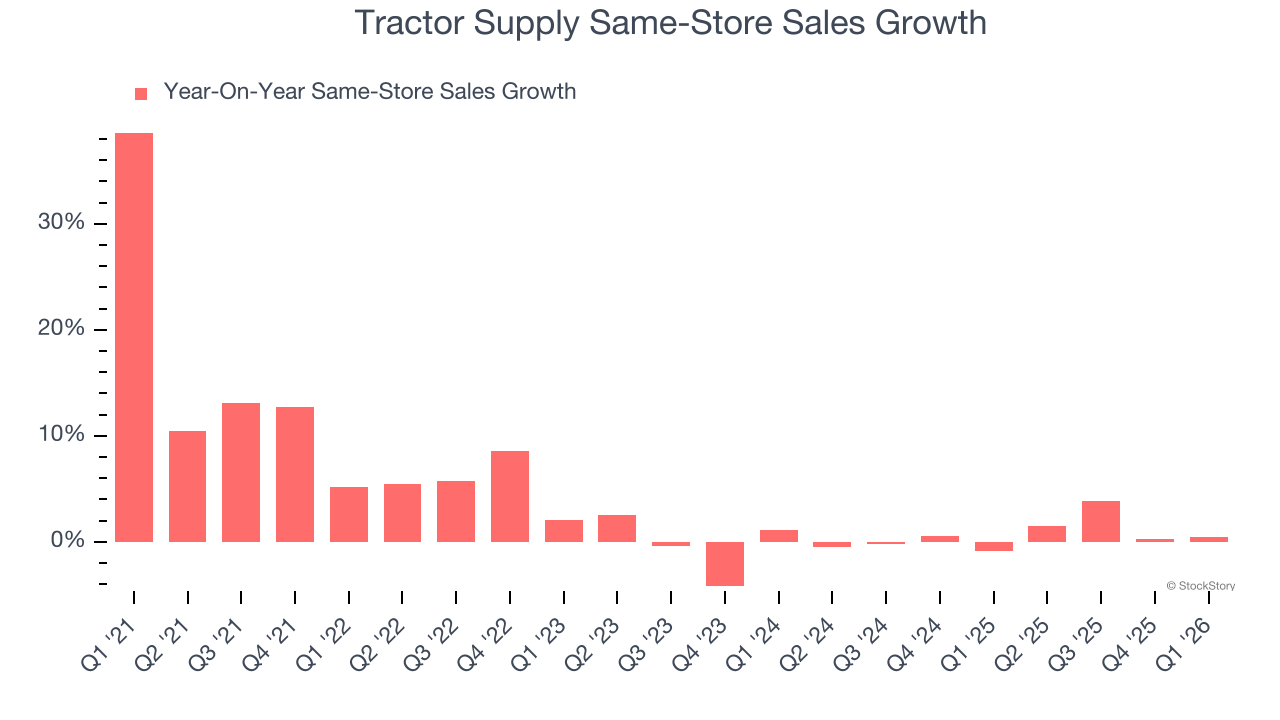
In the latest quarter, Tractor Supply’s year on year same-store sales were flat. This performance was more or less in line with its historical levels.
Key Takeaways from Tractor Supply’s Q1 Results
We struggled to find many positives in these results. Its EPS missed and its revenue fell slightly short of Wall Street’s estimates. Overall, this quarter could have been better. The stock traded down 2.7% to $43.58 immediately after reporting.
Tractor Supply didn’t show it’s best hand this quarter, but does that create an opportunity to buy the stock right now? What happened in the latest quarter matters, but not as much as longer-term business quality and valuation, when deciding whether to invest in this stock. We cover that in our actionable full research report which you can read here (it’s free).