The Falcon-900MGH is the first USB camera to combine Sony's Pregius S IMX900 global shutter sensor with integrated VCM autofocus, purpose-built for robotics, industrial inspection, and edge AI applications where motion distortion, variable working distances, and challenging illumination have historically required separate hardware solutions, delivering 3.2MP monochrome imaging with global shutter accuracy, quad HDR up to 120 dB, and enhanced NIR sensitivity at 850 nm and 940 nm in a UVC plug-and-play USB 3.2 Gen1 form factor.
FORT WORTH, TX / ACCESS Newswire / April 3, 2026 / Vadzo Imaging, a provider of embedded vision cameras, today announces the launch of the Falcon-900MGH Monochrome Autofocus Global Shutter USB UVC camera, a 3.2MP monochrome global shutter USB 3.2 Gen 1 UVC camera with integrated VCM-based autofocus, built on the Sony Pregius S IMX900 sensor. With this launch, Vadzo delivers the world's first autofocus-enabled IMX900 monochrome global shutter camera, combining true global shutter imaging, quad HDR up to 120 dB, enhanced NIR sensitivity, and software-controlled focus adjustment in a UVC-compliant plug-and-play USB form factor.
Sensor and Camera Overview
The Falcon-900MGH is built on the Sony Pregius S IMX900 Monochrome sensor, a fourth-generation stacked global shutter CMOS sensor with a 1/3.1″ optical format, 2.25 µm × 2.25 µm pixel pitch, and a maximum resolution of 3.2MP (2064 × 1552). The stacked architecture separates the photodiode layer from the readout circuitry, enabling simultaneous full-frame exposure across all pixels while maintaining the high dynamic range and NIR sensitivity performance that characterize the Pregius S generation. Monochrome output eliminates the Bayer filter mosaic, maximizing photon capture per pixel and improving sensitivity in low-light and NIR-illuminated environments compared to color variants of the same sensor.
On the camera side, the Falcon-900MGH Autofocus USB camera connects via USB 3.2 Gen1 Type-C with full UVC compliance and backward compatibility to USB 2.0 hosts. VCM-based autofocus with an M12 lens mount covers a focus range from 100mm to infinity, with two FOV variants available. GPIO is available for hardware trigger and strobe synchronization. The camera operates across −30°C to 80°C, and supports Windows, Linux, and Android natively via UVC, with advanced feature access through the VISPA ARC SDK.
Key specs: 3.2MP (2064×1552) | IMX900 Sony Pregius S 1/3.1″ 2.25 µm | Global Shutter Camera | Quad HDR (120 dB) | NIR (850 nm / 940 nm) | VCM Autofocus 100mm-∞ | USB 3.2 Gen 1 Type-C | UVC Plug and Play camera | 38mm × 38mm | Windows · Linux · Android
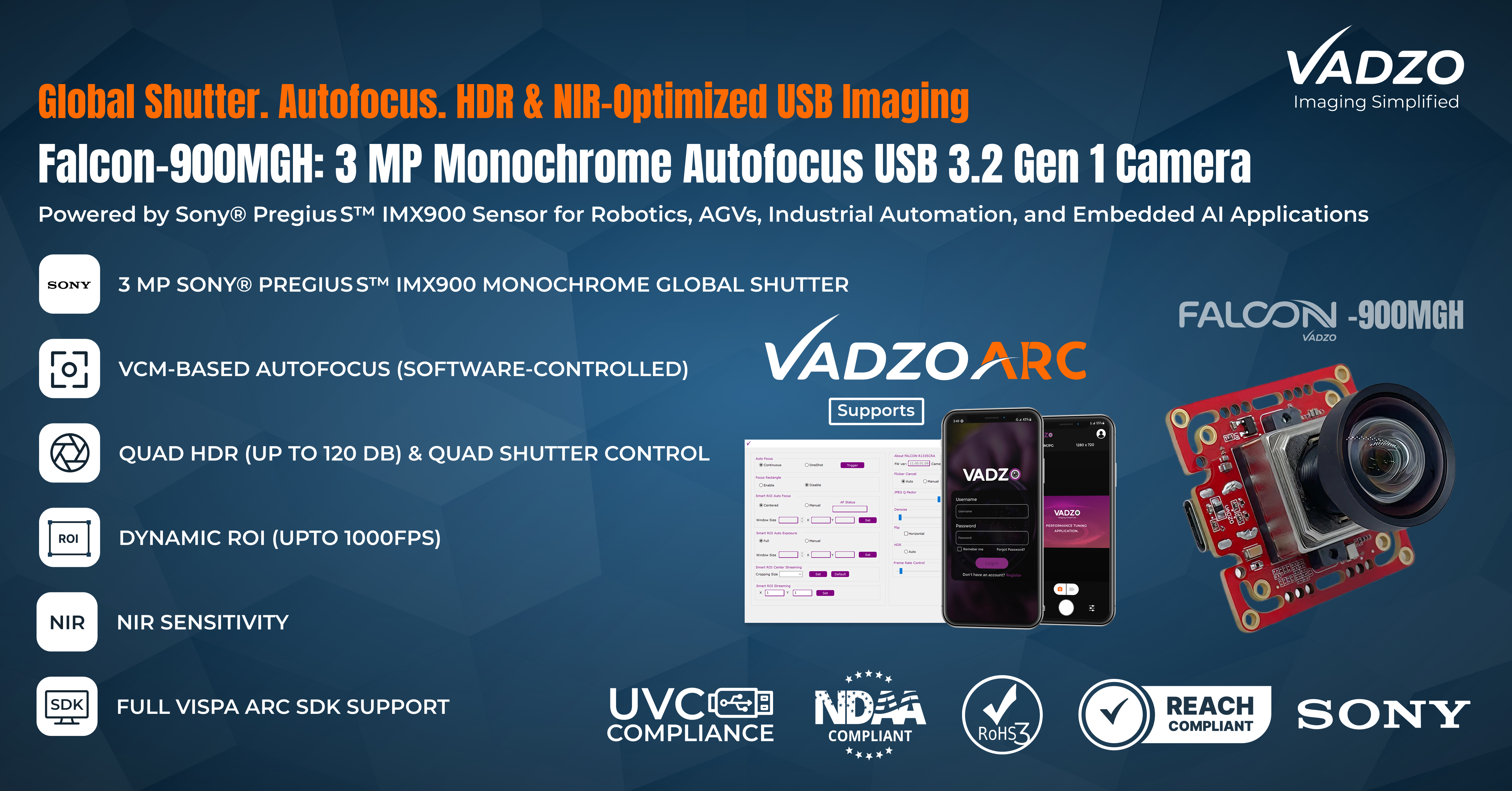
Key Capabilities of Sony Pregius S IMX900 Autofocus Monochrome Global Shutter USB 3.2 Gen 1 UVC Camera
Global Shutter Imaging: Rolling shutter sensors capture image data sequentially, line by line, meaning each row is recorded at a slightly different moment. In dynamic environments, this leads to skew, wobble, and geometric distortion when either the subject or the camera is in motion, impacting measurement accuracy and AI inference reliability. Global shutter sensors eliminate these artifacts by exposing all pixels simultaneously, and the IMX900 captures the full 3.2MP frame in a single exposure, ensuring that each image represents a single moment in time. This enables geometrically accurate and consistent imaging for applications such as robotic manipulation, conveyor-based inspection, AGV navigation, and aerial imaging, where motion is inherent and unavoidable.
Quad HDR Up to 120 dB: The Falcon-900MGH Global Shutter HDR USB camera supports advanced quad HDR functionality, combining multiple exposures per frame to preserve detail simultaneously across high-intensity highlights and low-light shadow regions. The IMX900's stacked architecture enables quad HDR, combining four exposures per frame to achieve up to 120 dB dynamic range while maintaining full global shutter performance. Fast auto-exposure adapts continuously to changing illumination, reducing manual tuning in deployment. The result is consistent image quality in scenes with extreme contrast without the motion-related HDR artefacts that affect rolling shutter sensors operating in the same conditions.
Enhanced NIR Sensitivity: The IMX900 provides strong sensitivity in the near-infrared spectrum, particularly at 850 nm and 940 nm, enabling under IR illumination. This capability expands the operational range of the Falcon-900MGH NIR USB camera into environments where visible light is limited, inconsistent, or intentionally excluded. Typical use cases include biometric imaging such as vein pattern recognition, material sorting under structured NIR illumination, night-time inspection, and machine vision systems designed to eliminate ambient light variability. Importantly, this enhanced NIR performance is achieved without compromising sensitivity in the visible spectrum, ensuring balanced imaging performance across a wide range of lighting conditions.
Hardware Trigger and GPIO Synchronization: The Falcon-900MGH Monochrome USB camera supports hardware GPIO triggering, enabling precise integration with external components including strobes, PLCs, and additional sensors. This allows the camera to be triggered by an external signal at a defined moment, synchronizing image capture with conveyor position, robotic arm state, or strobe flash timing, rather than relying on host-side software timing, which introduces variable latency. GPIO-based synchronization supports multi-camera coordination in structured-light 3D scanning, stereo vision, and parallel inspection setups where all cameras must capture the same instant. This level of trigger control is typically found in dedicated high-end machine vision systems; by integrating it into a UVC-compliant USB camera, the Falcon-900MGH makes it accessible without proprietary frame grabbers or dedicated machine vision interfaces.
Plug-and-Play Integration With VISPA ARC SDK
The Falcon-900MGH Monochrome Global Shutter USB 3.2 Gen 1 camera is fully UVC compliant, enabling driverless operation across Linux, Windows, and Android platforms. Backward compatibility with USB 2.0 hosts ensures flexibility across a wide range of embedded systems.
For developers requiring sensor-level control beyond UVC defaults, the VISPA ARC SDK provides complete programmatic access to advanced camera configuration, including streaming parameters, dynamic ROI, binning, windowing, exposure and gain control, autofocus, trigger synchronization, and firmware updates. APIs are available in C, C++, C#, and Python across Windows, Linux, and Android, enabling production-grade integration and full lifecycle management for OEM deployments.
Applications
Industrial Automation and Inspection: PCB and semiconductor inspection, surface defect detection, precision measurement, and inline quality control where rolling shutter distortion and focus variability degrade accuracy and repeatability. VCM autofocus enables focus adjustment across variable component heights without line stoppage; global shutter ensures dimensional accuracy at production-line speeds, making Falcon-900MGS Autofocus USB camera a great recommendation for this use case.
Robotics and Autonomous Systems: Pick-and-place operations, visual servoing, AMR and AGV navigation, and robotic guidance in motion-rich environments where geometric accuracy and adaptive focus directly impact system reliability. The combination of global shutter and autofocus makes the Falcon-900MGH Global Shutter camera suitable for robotic workspaces where both subject motion and working distance vary continuously.
Edge AI and Embedded Vision: Real-time AI inference on resource-constrained platforms, using dynamic ROI and binning to reduce bandwidth and CPU load while maintaining autofocus-enabled scene clarity. Supports NIR-based inference pipelines for biometrics, vein pattern recognition, and IR-based material classification where ambient light control is not practical.
UAV and Aerial Platforms: Distortion-free aerial imaging for inspection, mapping, and surveillance where platform motion would introduce artefacts in rolling shutter cameras. Global shutter combined with quad HDR enables reliable imaging across high-contrast outdoor lighting in dynamic flight environments, while autofocus maintains subject sharpness across varying altitude and camera-to-subject distance, making Falcon-900MGH Autofocus camera the right recommendation for this application.
Collaborative Robotics and 3D Reconstruction: Structured-light 3D scanning and robotic vision systems where motion artefacts and focus inconsistency affect depth reconstruction accuracy. GPIO-synchronized capture across multiple Falcon-900MGH global shutter camera units enables stereo and multi-camera structured-light setups without external trigger hardware.
Scientific and Laboratory Imaging: High-speed imaging, motion capture, laboratory instrumentation, and production diagnostics requiring global shutter fidelity, precise exposure control, and NIR sensitivity. The Falcon-900MGH's combination of USB plug-and-play integration and machine-vision-grade sensor performance reduces setup complexity in laboratory environments that have historically required dedicated camera platforms.
Availability
The Falcon-900MGH IMX900 USB 3.2 Gen 1 UVC Camera with VCM autofocus is now available for evaluation and production orders. Evaluation kits include the camera, M12 autofocus optics assembly, USB cable, and VISPA ARC SDK documentation, with no minimum order requirement. Contact Vadzo at support@vadzoimaging.com or +1 817-678-2139 to request an evaluation kit or discuss OEM integration requirements.
About Vadzo Imaging
Vadzo Imaging is a global provider of embedded vision solutions, delivering high-performance camera technologies and imaging platforms for applications in robotics, industrial automation, UAVs, edge AI, and medical systems. Its products are designed for seamless integration with leading embedded platforms such as NVIDIA Jetson, Raspberry Pi, Qualcomm RB series, and NXP i.MX. Vadzo supports customers through hardware customization, firmware development, and its VISPA ARC SDK, enabling faster development and deployment of vision-based systems.
Media Contact:
Alwin Vincent
Vadzo Imaging
Phone: +1 817-678-2139
Email: alwin@vadzoimaging.com
LinkedIn: Vadzo Imaging
YouTube: Vadzo Imaging
X: Vadzo Imaging
SOURCE: Vadzo Imaging
View the original press release on ACCESS Newswire