Industrial OLED Lighting Market Gains Momentum as Embedded Low-Glare Illumination, Advanced OLED Modules, and Smart Factory Integration Drive Next-Generation Industrial Design Through 2036
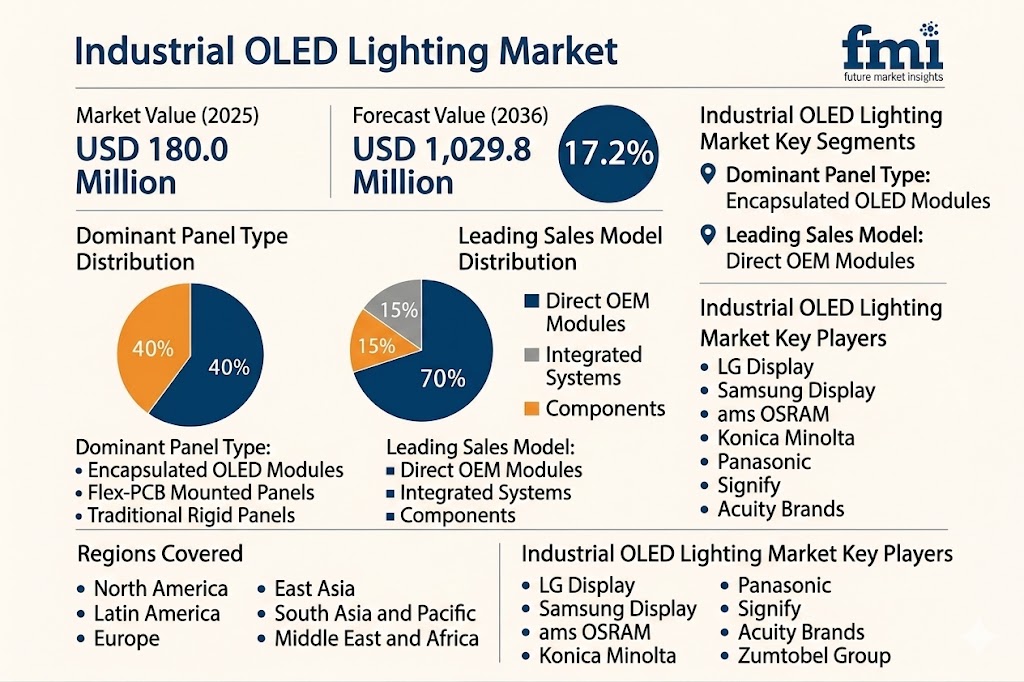
NEWARK, DE / ACCESS Newswire / May 11, 2026 / According to the latest analysis by Future Market Insights, the global Industrial OLED Lighting Market is entering a new phase of innovation where visual comfort, compact integration, and intelligent design are becoming as critical as energy efficiency. According to the latest industry analysis, the global Industrial OLED Lighting Market, valued at USD 180.0 million in 2025, is projected to reach USD 1,029.8 million by 2036, expanding at a remarkable CAGR of 17.2% during the forecast period.
Unlike conventional industrial luminaires built primarily around brightness and durability, industrial OLED lighting is being adopted for an entirely different reason: its ability to create ultra-thin, low-glare illuminated surfaces that seamlessly integrate into next-generation machinery, laboratory environments, and precision manufacturing systems.
As factories become more automated and human-machine interfaces grow increasingly sophisticated, OLED panels are emerging as a premium lighting solution for applications where operator comfort, fixture depth, and industrial aesthetics matter most.
Get detailed market forecasts, competitive benchmarking, and pricing trends:
https://www.futuremarketinsights.com/reports/sample/rep-gb-33058
Key Market Snapshot
Market Value (2025): USD 180.0 Million
Forecast Value (2036): USD 1,029.8 Million
Projected CAGR (2026-2036): 17.2%
Dominant Panel Type: Encapsulated OLED Modules
Leading Sales Model: Direct OEM Modules
Fastest Growing Country: United Kingdom (19.4% CAGR)
Key Growth Driver: Rising demand for low-glare embedded industrial lighting solutions
The Rise of Surface Lighting in Industrial Design
Industrial OLED lighting is no longer viewed as an experimental display technology adaptation. Instead, it is rapidly evolving into a specialized category of solid-state industrial illumination.
This transition is especially visible in machine indicators, advanced labs, and compact industrial workstations where operators remain close to the light source for extended periods.
Unlike traditional LEDs that emit concentrated point-source light, OLED panels distribute diffuse illumination evenly across the surface. This significantly reduces visual fatigue in environments involving:
Optical inspection
Precision assembly
Electronics manufacturing
Laboratory testing
Machine operator interfaces
Control-room environments
The market is increasingly aligning with industrial design philosophies centered around "human-centric lighting," where worker comfort directly influences operational productivity and accuracy.
Thin Form Factors Become a Competitive Advantage
One of the strongest growth catalysts behind industrial OLED adoption is its ultra-thin construction profile.
Current OLED panels can operate at thickness levels between 1.4 mm and 2.1 mm, enabling manufacturers to embed illumination directly into machine fronts, compact workstations, and industrial interiors without adding significant fixture depth.
This advantage is becoming particularly valuable for:
Compact industrial automation systems
Embedded machine HMIs
Laboratory workstations
Automotive prototype environments
Design-driven industrial interiors
The market is witnessing especially strong demand for embedded panel installations, which are projected to account for 39.0% share of installation-format demand in 2026.
At the same time, low-glare task lighting is expected to capture 34.0% of application demand as industrial facilities prioritize operator comfort and visual consistency in close-range work environments.
Encapsulated OLED Modules Lead Commercial Adoption
Among all panel categories, encapsulated industrial OLED modules are projected to dominate the market with a 44.0% share in 2026.
The reason is straightforward: industrial buyers require reliability.
OLED technology remains highly sensitive to moisture ingress and environmental degradation. Encapsulation technologies help overcome these limitations by protecting the organic layers through advanced barrier films and sealed packaging systems.
As a result, encapsulated modules are becoming the preferred solution for:
Dust-sensitive industrial environments
Repeated cleaning applications
Precision manufacturing spaces
OEM-integrated lighting systems
Rigid OLED panels are forecast to hold 37.0% market share in 2026, while flexible OLED panels are expected to represent 19.0%, primarily due to longer qualification cycles for curved industrial applications.
OEM Integration Drives Market Expansion
Another defining trend shaping the market is the rise of direct OEM module purchasing.
Machine builders increasingly prefer sourcing OLED module sets directly from suppliers before finalizing equipment designs. This allows manufacturers to optimize:
Housing geometry
Driver integration
Thermal management
Embedded lighting architecture
Safety compliance
Consequently, direct OEM modules are projected to account for 52.0% share of sales-model demand in 2026.
This OEM-first approach is transforming OLED lighting from a decorative niche into an engineered industrial component integrated during the earliest stages of equipment development.
Access the Complete Report in PDF Format: https://www.futuremarketinsights.com/reports/brochure/rep-gb-33058
Regional Momentum: United Kingdom and South Korea Lead Growth
While adoption remains global, several countries are emerging as key growth accelerators.
United Kingdom: Fastest-Growing Market
The United Kingdom is projected to register the fastest expansion globally at a CAGR of 19.4% through 2036.
Growth is being driven by:
Specialist laboratory infrastructure
Design-focused industrial interiors
Precision engineering facilities
Advanced optics and research applications
Cities including Cambridge and Oxford are becoming important hubs for low-glare OLED deployment in research-intensive environments.
South Korea: OLED Supply Depth Accelerates Commercialization
South Korea is forecast to expand at 18.8% CAGR through 2036, supported by:
Strong OLED manufacturing ecosystems
Government-backed display technology initiatives
Proximity between panel makers and industrial equipment manufacturers
Industrial buyers in Seoul, Gyeonggi, and Cheonan are increasingly testing OLED task-lighting concepts for electronics inspection, compact workstations, and advanced manufacturing systems.
Germany and Japan Continue High-Value Adoption
Germany is expected to grow at 17.5% CAGR as automotive and industrial automation sectors evaluate embedded OLED lighting for machine tools and inspection systems.
Meanwhile, Japan is projected to expand at 18.1% CAGR due to its strength in precision manufacturing, electronics production, and laboratory instrumentation.
Cost Remains the Largest Industry Challenge
Despite strong growth momentum, the market still faces major commercialization barriers.
The most critical challenge remains panel pricing.
Current OLED panel costs remain near USD 100 per thousand lumens, while broader commercial viability may require costs to fall closer to USD 10 per thousand lumens.
This pricing gap limits widespread adoption in large-scale industrial illumination applications such as:
Factory-wide lighting
High-bay industrial systems
Warehouse illumination
Instead, OLED technology is currently concentrated in premium-value applications where thinness, glare reduction, and embedded integration justify higher pricing.
Manufacturers are now heavily investing in:
Yield optimization
Advanced encapsulation
Driver integration
Material efficiency
AI-assisted process control
Flexible barrier film technologies
These innovations are expected to steadily reduce costs over the next decade.
Competitive Landscape: Panel Innovation Defines Market Leadership
The industrial OLED lighting ecosystem remains highly concentrated around advanced display manufacturers and industrial lighting integrators.
Leading panel technology providers include:
LG Display
Samsung Display
BOE
Visionox
Meanwhile, industrial lighting integration specialists such as:
Signify
Zumtobel Group
Acuity Brands
ams OSRAM
are helping convert OLED panel technology into commercially deployable industrial lighting systems.
Recent industry developments further reinforce the market's accelerating trajectory.
LG Display recently introduced third-generation tandem OLED technology featuring improved lifespan and lower power consumption, while Samsung Display continues expanding QD-OLED production scale for commercial environments.
At the same time, Chinese suppliers including BOE and Visionox are strengthening flexible OLED manufacturing capabilities, expanding industrial accessibility across Asia-Pacific markets.
Buy Report: Unlock 360° insights for strategic decision making and investment planning:
https://www.futuremarketinsights.com/checkout/33058
The Future Outlook: From Specialty Lighting to Industrial Design Infrastructure
By 2036, industrial OLED lighting is expected to move far beyond pilot projects and boutique installations.
As industrial automation systems become increasingly compact, interface-driven, and operator-centric, OLED surfaces are likely to become foundational components within:
Smart manufacturing environments
Advanced robotics systems
Laboratory infrastructure
Automotive engineering facilities
Precision inspection platforms
Embedded industrial interfaces
The future opportunity is not necessarily about replacing LEDs at scale.
Instead, industrial OLED lighting is positioning itself as a high-value design and functionality layer-one capable of redefining how industrial environments balance illumination, ergonomics, and machine integration in the decade ahead.
Related Reports:
Industrial Lighting Cybersecurity Market- https://www.futuremarketinsights.com/reports/industrial-lighting-cybersecurity-market
LED and OLED Lighting Products and Display Market- https://www.futuremarketinsights.com/reports/middle-east-led-oled-lighting-products-displays-market
Industrial LiDAR Integrated Lighting Market- https://www.futuremarketinsights.com/reports/industrial-lidar-integrated-lighting-market
About Future Market Insights (FMI)
Future Market Insights (FMI) is a leading provider of market intelligence and consulting services, serving clients in over 150 countries. Headquartered in Delaware, USA, with a global delivery center in India and offices in the UK and UAE, FMI delivers actionable insights to businesses across industries including automotive, technology, consumer products, manufacturing, energy, and chemicals.
An ESOMAR-certified research organization, FMI provides custom and syndicated market reports and consulting services, supporting both Fortune 1,000 companies and SMEs. Its team of 300+ experienced analysts ensures credible, data-driven insights to help clients navigate global markets and identify growth opportunities.
For Press & Corporate Inquiries
Rahul Singh
AVP - Marketing and Growth Strategy
Future Market Insights, Inc.
+91 8600020075
For Sales - sales@futuremarketinsights.com
For Media - Rahul.singh@futuremarketinsights.com
For web - https://www.futuremarketinsights.com/
For Web - https://www.factmr.com/
SOURCE: Future Market Insights, Inc.
View the original press release on ACCESS Newswire