Growing nutrition programs, NGO procurement, and local manufacturing expansion are driving long-term demand for ready-to-use supplementary food products.
NEWARK, DE / ACCESS Newswire / May 11, 2026 / According to the latest market analysis by Future Market Insights, the global Ready-To-Use Supplementary Food market is entering a new phase of growth driven by institutional nutrition programs, localized manufacturing expansion, and increasing demand for fortified food solutions across humanitarian and retail channels.
The market is evolving from a predominantly emergency-response nutrition category into a broader nutrition intervention platform supported by governments, NGOs, healthcare institutions, and expanding retail distribution.
Quick Stats Snapshot
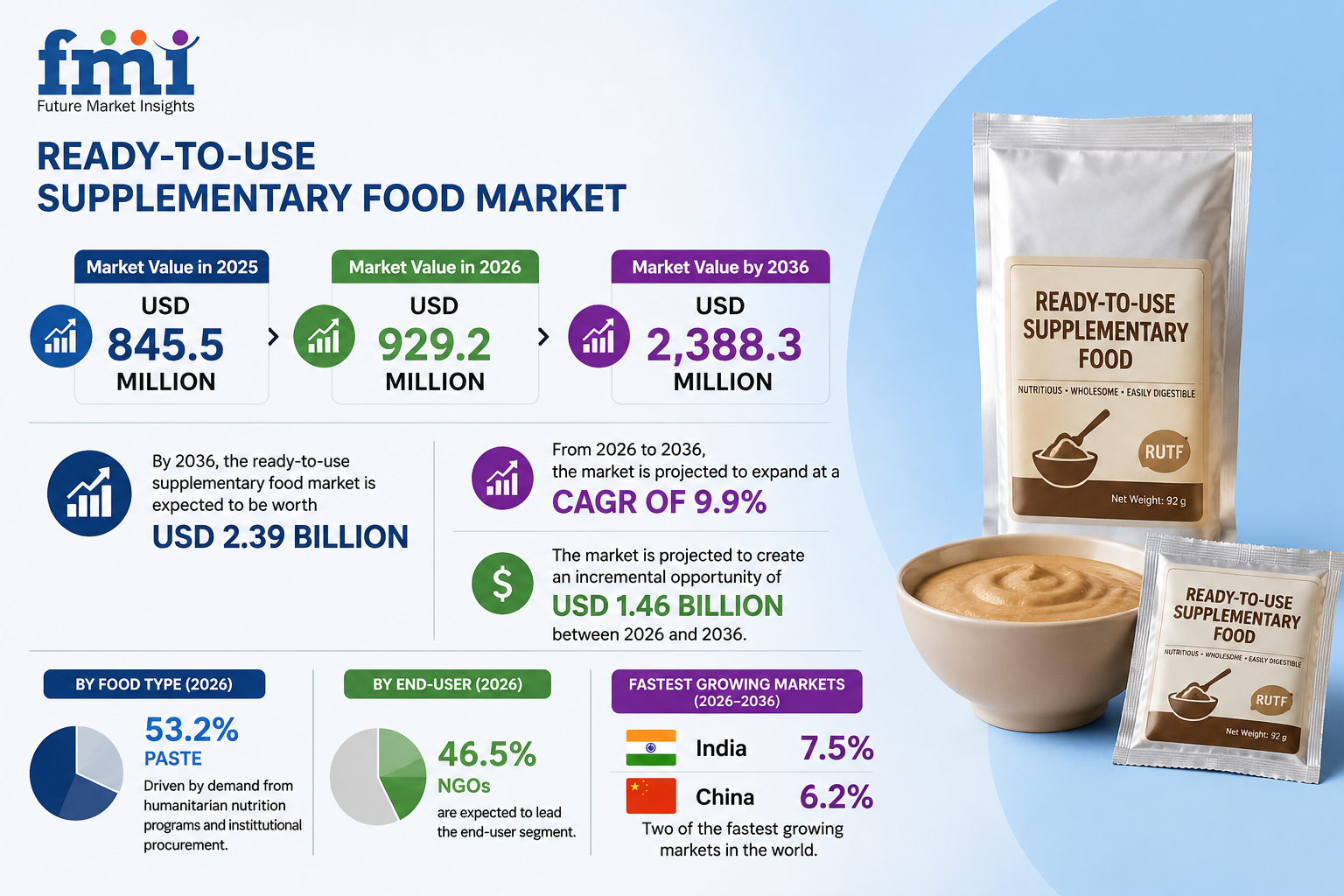
Global market CAGR (2026-2036): 9.9%
Top growth market: India (7.5% CAGR)
Fast-growing market: China (6.2% CAGR)
Leading food type: Paste (53.2% market share)
Dominant end-use segment: NGOs (46.5% share)
Leading sales channel: Direct Sales (48.7% share)
Get detailed market forecasts, competitive bench marking, and regional insights: https://www.futuremarketinsights.com/reports/sample/rep-gb-4089
Market Outlook: Nutrition Security Drives Long-Term Expansion
The ready-to-use supplementary food market is projected to witness strong growth through 2036 as global food security initiatives and malnutrition intervention programs continue to expand.
Institutional procurement from organizations such as UNICEF, the World Food Programme, and national health ministries remains the foundation of market demand. Meanwhile, retail and direct-to-consumer channels are emerging as secondary growth drivers in urban markets.
The category is increasingly recognized as a scalable nutritional support solution capable of serving humanitarian, healthcare, and consumer wellness applications simultaneously.
Growth Drivers: Institutional Procurement Meets Consumer Nutrition Trends
Several structural factors are accelerating market expansion:
1. Expansion of Government and NGO Nutrition Programs
Global malnutrition intervention programs continue to expand across South Asia, Africa, and other food-insecure regions, creating stable procurement demand for RUSF products.
2. Local Manufacturing Capacity Expansion
Manufacturing investments across India, Africa, and South Asia are lowering production costs, improving delivery timelines, and reducing import dependency.
3. Retail and E-Commerce Channel Growth
Urbanization and changing dietary habits are creating new opportunities for fortified supplementary foods through pharmacies, health food retailers, and e-commerce platforms.
4. Rising Focus on Nutritional Security
Governments and international agencies are increasingly prioritizing fortified food solutions as part of long-term public health and nutrition strategies.
Key Challenges: Cost Pressure and Distribution Complexity
Despite favorable growth prospects, the industry continues to face operational and adoption challenges:
Price sensitivity in low-income markets
Distribution complexity in remote and underserved regions
Regulatory compliance requirements across countries
Dependence on institutional funding cycles
Logistics constraints for temperature-sensitive products
Manufacturers that balance affordability, nutritional quality, and supply chain efficiency are expected to gain competitive advantage.
Emerging Opportunities: Localization and Product Diversification
Key market opportunities are centered around operational efficiency and channel diversification:
Expansion of localized manufacturing facilities
Growth in retail-ready fortified food products
Supply chain localization and sourcing diversification
Development of specialized formulations for targeted nutrition programs
Increased adoption of premium supplementary food products in developed markets
Customize insights for your business strategy: https://www.futuremarketinsights.com/customization-available/rep-gb-4089
Segmentation Insights: Institutional Procurement Dominates Demand
By Food Type
Paste products are expected to lead the market with a 53.2% share in 2026, supported by strong institutional procurement and ease of distribution in nutrition programs.
By End Use
NGOs are projected to account for 46.5% of market demand, driven by large-scale humanitarian feeding initiatives and nutrition intervention programs.
By Sales Channel
Direct sales are expected to dominate with a 48.7% share, reflecting the importance of institutional procurement agreements and long-term supply contracts.
Regional Analysis: South Asia and East Asia Lead Growth Momentum
India (7.5% CAGR)
Growth is driven by expanding government nutrition initiatives, increasing local manufacturing capacity, and rising awareness of fortified food products.
China (6.2% CAGR)
Demand is supported by institutional procurement growth, manufacturing expansion, and regulatory alignment with international nutrition standards.
Germany (5.7% CAGR)
Germany continues to see stable growth through healthcare nutrition programs and expanding fortified food awareness.
United States (5.4% CAGR)
The market benefits from healthcare-focused nutrition programs and rising consumer demand for nutrient-dense food solutions.
Japan (4.9% CAGR)
Japan's growth is supported by advanced healthcare infrastructure and increasing interest in nutritional supplementation.
South Asia and East Asia are expected to outperform mature markets due to expanding institutional infrastructure and rising investment in nutritional security programs.
Competitive Landscape: Manufacturing Scale and Distribution Networks Define Leadership
The ready-to-use supplementary food market remains highly competitive, with companies focusing on manufacturing integration, regulatory compliance, and institutional partnerships.
Key companies include:
Nutriset
Mani
JB Company (Tanjaka Food)
Hilina
Edesia
Nutrivita
Compact India
Large manufacturers continue to strengthen market share through integrated production infrastructure, established procurement relationships, and diversified product portfolios.
Strategic Implications for Industry Leaders
For manufacturers, investors, and institutional suppliers, the market presents several strategic priorities:
Institutional procurement remains the core demand foundation
Local manufacturing is becoming critical for cost competitiveness
Regulatory compliance is essential for long-term contracts
Supply chain resilience is emerging as a major differentiator
Retail and e-commerce channels offer premium growth opportunities
Future Outlook: From Humanitarian Nutrition to Broader Health Applications
The ready-to-use supplementary food market is expected to evolve beyond emergency nutrition applications into a broader global nutritional support ecosystem.
Key trends expected to shape the market include:
Growth in localized production capacity
Expansion of retail and pharmacy distribution
Increased investment in fortified nutrition solutions
Rising focus on operational efficiency and supply chain resilience
Product innovation for specialized nutrition applications
Unlock 360° insights for strategic planning and investment decisions: https://www.futuremarketinsights.com/checkout/4089
Executive Takeaways
Institutional nutrition programs continue to sustain baseline market demand
Local manufacturing expansion is reducing costs and improving supply responsiveness
Paste products dominate due to ease of distribution and institutional preference
NGOs remain the largest end-use segment globally
South Asia and East Asia are leading global growth momentum
Competitive advantage increasingly depends on regulatory compliance, operational efficiency, and supply chain resilience
As global nutrition priorities evolve, companies that combine scalable manufacturing, cost optimization, and reliable institutional partnerships will be best positioned to capitalize on long-term market growth.
Related Reports:
Ready-to-Use Therapeutic Food Market: https://www.futuremarketinsights.com/reports/ready-to-use-therapeutic-food-market
Ready-to-eat Food Market: https://www.futuremarketinsights.com/reports/ready-to-eat-food-market
Ready-to-Drink Coffee Market: https://www.futuremarketinsights.com/reports/ready-to-drink-coffee-market
Ready-to-drink Beverage Market: https://www.futuremarketinsights.com/reports/ready-to-drink-beverages-market
Ready To Eat Seafood Snacks Market: https://www.futuremarketinsights.com/reports/ready-to-eat-seafood-snacks-market
About Future Market Insights (FMI)
Future Market Insights (FMI) is a leading provider of market intelligence and consulting services, serving clients in over 150 countries. Headquartered in Delaware, USA, with a global delivery center in India and offices in the UK and UAE, FMI delivers actionable insights to businesses across industries including automotive, technology, consumer products, manufacturing, energy, and chemicals.
An ESOMAR-certified research organization, FMI provides custom and syndicated market reports and consulting services, supporting both Fortune 1,000 companies and SMEs. Its team of 300+ experienced analysts ensures credible, data-driven insights to help clients navigate global markets and identify growth opportunities.
For Press & Corporate Inquiries:
Rahul Singh
AVP - Marketing and Growth Strategy
Future Market Insights, Inc.
+91 8600020075
For Sales - sales@futuremarketinsights.com
For Media - Rahul.singh@futuremarketinsights.com
For web - https://www.futuremarketinsights.com/
For Web - https://www.factmr.com/
SOURCE: Future Market Insights, Inc.
View the original press release on ACCESS Newswire