The global champagne market is entering a steady growth phase driven by rising demand for premium alcoholic beverages, expanding luxury hospitality and celebration culture, and increasing consumer preference for high-end sparkling wines across retail, hospitality, and duty-free channels.
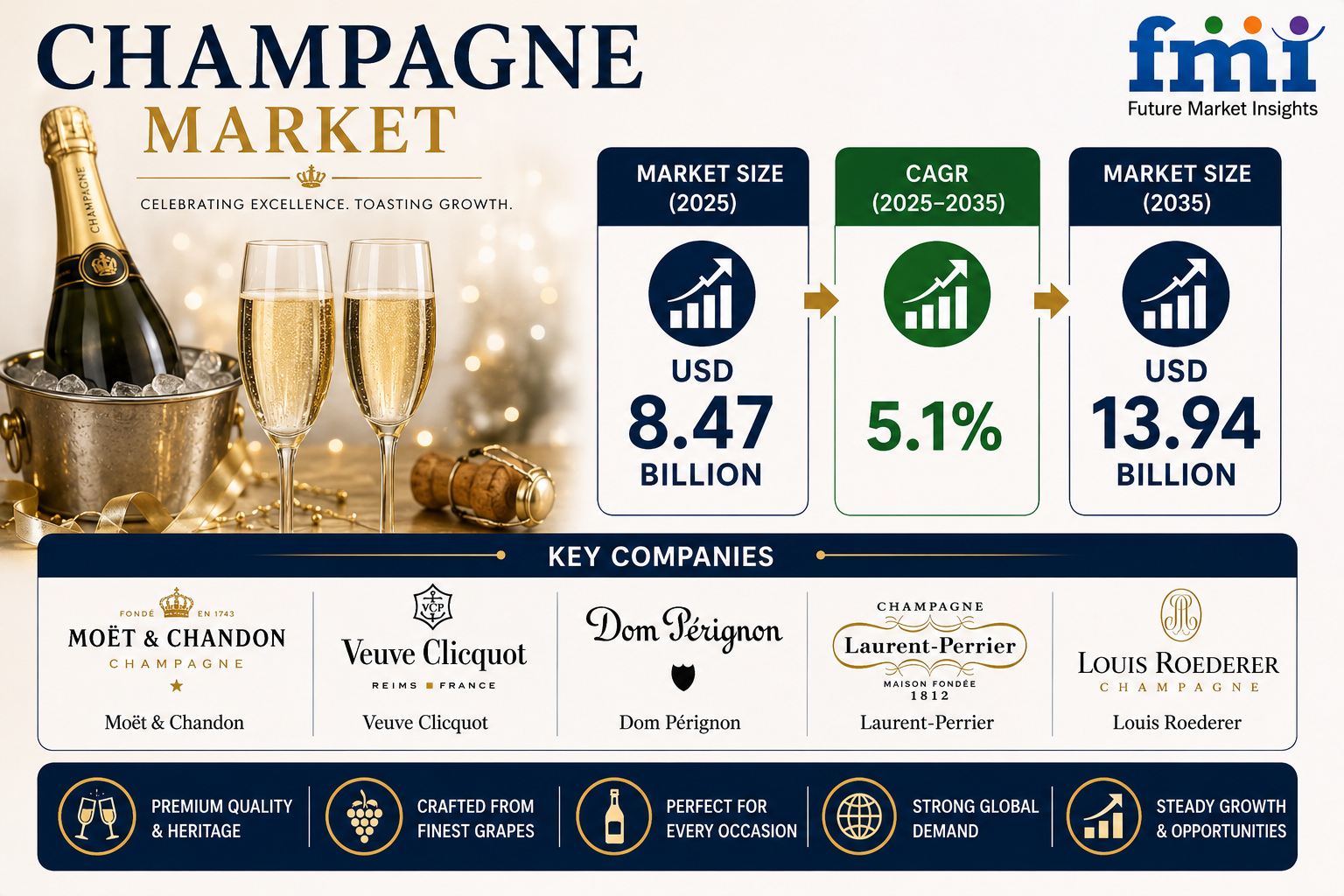
NEWARK, DE / ACCESS Newswire / May 12, 2026 / The global Champagne Market is projected to grow from USD 8.47 billion in 2026 to USD 13.94 billion by 2036, expanding at a CAGR of 5.1% during the forecast period. According to Future Market Insights (FMI), the market's growth is being driven by rising luxury consumption, premium alcoholic beverage preferences, expanding retail distribution, and increasing demand for celebratory and hospitality-driven beverage experiences across developed and emerging economies.
Champagne continues to maintain strong positioning within the luxury alcoholic beverages category, supported by brand heritage, premium packaging, and growing consumer demand for experiential consumption. Product innovation, expanding online retail accessibility, and evolving consumer preferences toward premium and prestige cuvée products are reshaping the competitive landscape globally.
An FMI analyst notes:
"The champagne market is transitioning toward a phase defined by premiumization, operational efficiency, and application-specific product differentiation. Companies combining strong brand equity, global distribution, and supply chain resilience are expected to strengthen market share during the forecast period."
Get detailed market forecasts, competitive benchmarking, and pricing trends: https://www.futuremarketinsights.com/reports/sample/rep-gb-4271
Market Drivers and Strategic Shifts
The market is witnessing strong demand growth due to rising disposable incomes, expanding luxury hospitality sectors, and increasing consumer preference for premium alcoholic beverages. Champagne consumption is increasingly associated with lifestyle positioning, gifting culture, luxury celebrations, and fine dining experiences.
Manufacturers are also diversifying product portfolios through vintage editions, limited releases, organic champagne variants, and sustainable packaging initiatives to address changing consumer expectations.
Key growth drivers include:
Rising global demand for premium and luxury alcoholic beverages
Expansion of hospitality, tourism, and fine dining industries
Growing popularity of celebratory consumption and gifting culture
Retail and e-commerce distribution expansion across emerging markets
Product diversification into organic, low-sugar, and specialty champagne variants
Increasing penetration of duty-free and travel retail channels
However, the industry faces challenges including fluctuating grape harvests, premium pricing pressures, counterfeit luxury beverages, and regulatory complexities across alcohol distribution markets.
Segment and Product Insights
Luxury champagne dominates the price range segment with 55.0% market share in 2026, supported by strong demand for premium and prestige products among affluent consumers and hospitality buyers.
By sales channel:
Offline channels account for 70.0% market share due to strong presence in restaurants, hotels, liquor stores, and supermarkets
Online retail and direct-to-consumer channels are rapidly expanding in urban markets
Duty-free and travel retail continue to strengthen premium brand visibility globally
Glass bottles remain the leading packaging format, accounting for 82.0% share due to premium presentation, preservation quality, and consumer perception associated with luxury beverages.
Regional Outlook
China: China is projected to lead market growth at 6.5% CAGR through 2036, supported by rising luxury consumption, expanding hospitality infrastructure, and growing interest in imported premium alcoholic beverages.
United States: The USA is expected to grow at 5.5% CAGR, driven by increasing demand for premium lifestyle products, fine dining experiences, and luxury gifting culture.
United Kingdom: The UK is forecast to expand at 4.2% CAGR, supported by strong retail distribution, hospitality recovery, and premium alcoholic beverage demand.
Japan: Japan is projected to grow at 3.8% CAGR, reflecting demand for high-end imported beverages, luxury dining, and premium retail channels.
France: France is expected to grow at 3.0% CAGR, supported by domestic heritage consumption, tourism-driven demand, and established champagne culture.
Competitive Landscape
The champagne market remains highly competitive, characterized by strong brand equity, heritage positioning, and global distribution capabilities.
Key players include:
Moët & Chandon
Veuve Clicquot
Dom Pérignon
Laurent-Perrier
Louis Roederer
Perrier-Jouët
Taittinger
Bollinger
Pol Roger
Piper-Heidsieck
Competitive strategies are increasingly focused on:
Premiumization and prestige product launches
Expansion into high-growth Asian markets
Sustainable viticulture and eco-friendly packaging initiatives
Strengthening direct-to-consumer and e-commerce channels
Strategic collaborations with luxury hospitality and lifestyle brands
Customize insights for your business strategy : https://www.futuremarketinsights.com/customization-available/rep-gb-4271
Why FMI's Champagne Market Report Is Different
Traditional market research often focuses primarily on revenue forecasts and basic segmentation. FMI provides deeper operational, sourcing, pricing, and distribution intelligence designed for strategic business decision-making.
FMI's report includes:
Production and vineyard sourcing intelligence
Pricing benchmarks across luxury and mid-range champagne categories
Trade flow analysis and export-import dynamics
Regulatory analysis across international alcohol markets
Distribution benchmarking across hospitality, retail, and online channels
Consumer purchasing behavior and premiumization trends
Competitive movement tracking including launches, partnerships, and expansions
Supply chain resilience and procurement analysis
Why This Matters for Buyers
The report helps stakeholders:
Optimize pricing and premium positioning strategies
Identify high-growth geographic and consumer segments
Improve retail and hospitality distribution planning
Strengthen sourcing and supply chain resilience
Track evolving luxury beverage consumption trends
Who Should Use This Report
Champagne manufacturers and distributors
Luxury beverage retailers
Hospitality and fine dining operators
Duty-free and travel retail companies
Beverage importers and exporters
Investors and private equity firms
Packaging and bottling solution providers
Where It Supports Action
Sell: Identify premium demand categories and consumer segments
Source: Optimize vineyard and packaging procurement strategies
Manufacture: Align production capacity with regional demand trends
Distribute: Strengthen hospitality, retail, and e-commerce presence
Promote: Target luxury lifestyle and celebration-driven consumers
Partner: Build strategic alliances with hospitality and retail brands
Invest: Identify high-growth regions and premium product opportunities
Defend Market Share: Benchmark against leading global competitors
Champagne Market Size & Industry Trends 2036
Market name: Champagne Market
Market size: USD 8.47 Billion (2026)
Forecast value: USD 13.94 Billion (2036)
CAGR: 5.1%
Forecast period: 2026 to 2036
Leading segment: Luxury Champagne (55.0% share)
Top sales channel: Offline Retail (70.0% share)
Leading packaging type: Glass Bottles (82.0% share)
Fastest-growing countries/regions: China, USA, UK
Key distribution channels: Retail stores, hospitality, online retail, duty-free shops
Unlock 360° insights for strategic decision making and investment planning: https://www.futuremarketinsights.com/checkout/4271
Related Reports:
Alcoholic Flavors Market: https://www.futuremarketinsights.com/reports/alcoholic-flavors-market
Premixed Cocktail Shots Market: https://www.futuremarketinsights.com/reports/premixed-cocktail-shots-market
Fruit Wine Market: https://www.futuremarketinsights.com/reports/fruit-wine-market
Alcohol Ingredients Market: https://www.futuremarketinsights.com/reports/alcohol-ingredients-market
Low-alcohol Beverages Market: https://www.futuremarketinsights.com/reports/low-alcohol-beverages-market
About Future Market Insights (FMI)
Future Market Insights (FMI) delivers actionable, decision-focused market intelligence that goes beyond traditional research reports. The company provides:
In-depth pricing and cost benchmarking analysis
Demand forecasting based on real industry inputs
Procurement and buyer behavior insights
Supply chain and trade flow intelligence
Technology adoption trends across industries
FMI follows a robust bottom-up research methodology, combining insights from industry experts, procurement leaders, and technical professionals to ensure accurate and practical market intelligence.
For Press & Corporate Inquiries
Rahul Singh
AVP - Marketing and Growth Strategy
Future Market Insights, Inc.
+91 8600020075
For Sales - sales@futuremarketinsights.com
For Media - Rahul.singh@futuremarketinsights.com
For web - https://www.futuremarketinsights.com/
For Web - https://www.factmr.com/
SOURCE: Future Market Insights, Inc.
View the original press release on ACCESS Newswire