If 2025 was the year of artificial intelligence in the stock market, then 2026 may very well be the year for agentic AI for anyone following tech stocks. Agentic AI uses artificial intelligence to complete specific tasks with little to no human oversight, using machine reasoning, memory, and external tools. Nvidia (NVDA) CEO Jensen Huang said this is the year of an “agentic AI inflection point” in which autonomous agents become more widely available.
Oracle (ORCL) is vying to be one of the main players in agentic AI, recently releasing several agentic applications designed for finance, supply chain management, human resources, and customer relations. The company’s new agentic AI offerings are part of a software suite called Fusion Agentic Applications, which are part of the company’s Fusion Cloud Applications.
Steve Miranda, an executive vice president at Oracle, says the software is designed to free workers from time-consuming tasks such as following up and handing off work. "With agentic applications that can reason, decide, and act against defined objectives, finance and supply chain teams can move from passive productivity to systems that proactively carry work forward, improve working capital, reduce costs and delays, and operate with greater confidence," he said.
Can Oracle gain a sizeable foothold in the agentic AI market—one that is expected to increase from $9 billion in 2025 to $199 billion in 2034? Let’s take a closer look at ORCL stock.
About Oracle Stock
Based in Austin, Texas, Oracle provides enterprise-grade database, middleware, and application software. But the company is also known for its expanding cloud computing division, which is becoming more critical as companies look to operate in hybrid or cloud environments, particularly as data centers capable of operating and training AI programs require a significant investment.
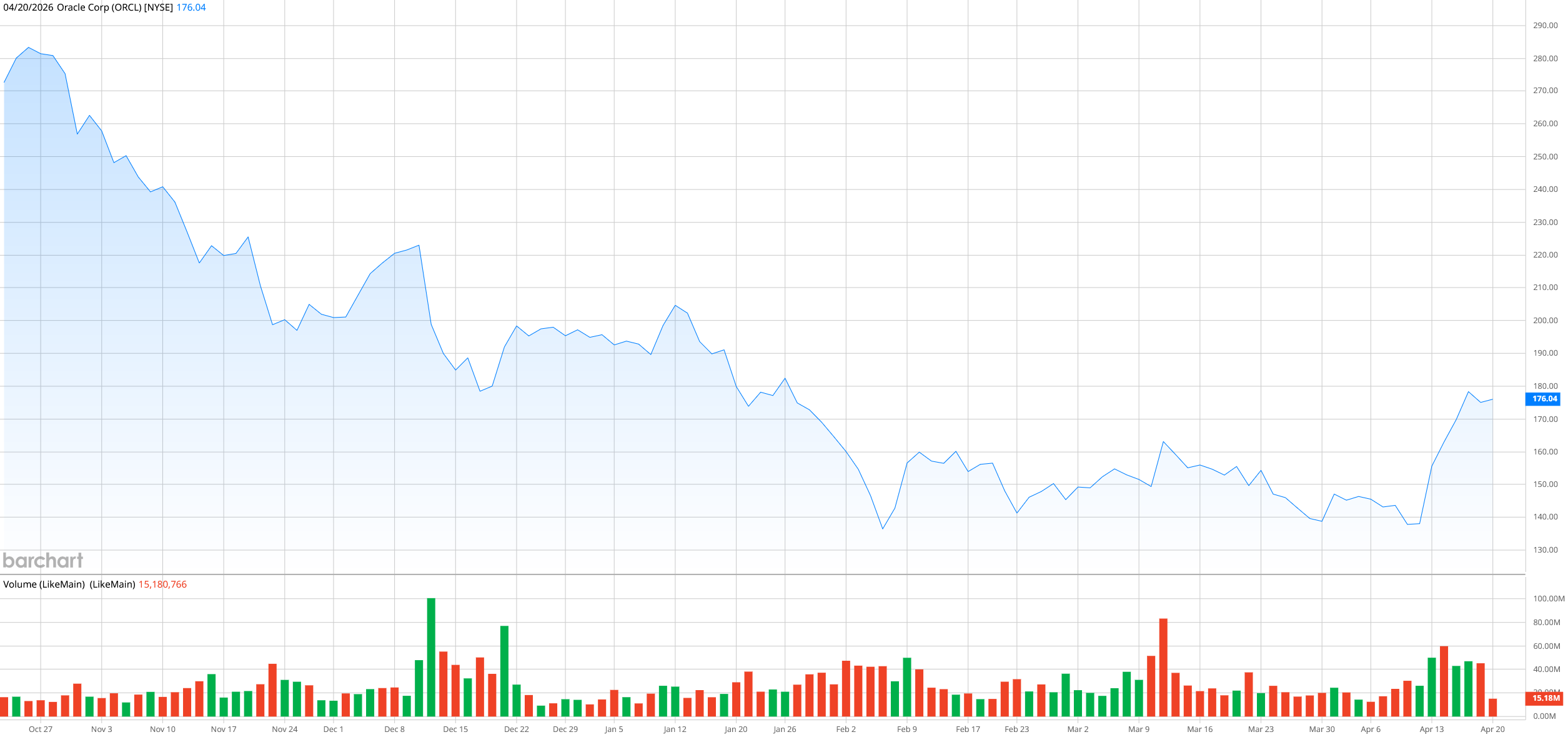
The company has a market capitalization of $500 billion, and the stock is up 36% in the last 12 months, which is just a percentage point higher than the one-year return of the S&P 500.
The company’s forward price-to-earnings ratio is a reasonable 23.5—roughly 10 points less than its five-year mean and just a few points over the S&P 500’s ($SPX) forward P/E of 20.6.
Oracle also pays a small dividend of $2 per share, divided quarterly for a yield of 1.1%.
Oracle Beats on Earnings
Oracle has a reputation for consistently beating analysts’ expectations in its quarterly earnings report and kept that streak alive for the fiscal third quarter of 2026 (ending Feb. 28). Revenue of $17.2 billion was up 22% from a year ago, and earnings per share of $1.79 beat analysts’ expectations of $1.70.
The company noted that this was the first quarter in 15 years to see revenue and EPS grow by more than 20% on a year-over-year (YoY) basis.
Cloud revenue was $8.9 billion, up 44%, and cloud infrastructure revenue was up 84% to $4.9 billion. The company’s remaining performance obligation (RPO) was $533 billion, up 325% from a year ago.
“The demand for cloud computing for AI training and inferencing continues to grow faster than supply,” management said in the earnings release. “Furthermore, some of the largest consumers of AI cloud capacity have recently strengthened their financial positions quite substantially. These market dynamics enable Oracle to comfortably meet and likely exceed our revenue growth rate forecast for FY27 and beyond.”
Oracle issued fourth-quarter guidance that calls for revenue to grow about 20% and total cloud revenue to increase 44% to 48% from last year. EPS is expected to increase by 15% to 17%.
In addition, the company issued full-year 2026 revenue guidance of $67 billion, with capital expenditures of $50 billion. The company expects fiscal 2027 revenue to be $90 billion.
What Do Analysts Expect for ORCL Stock?
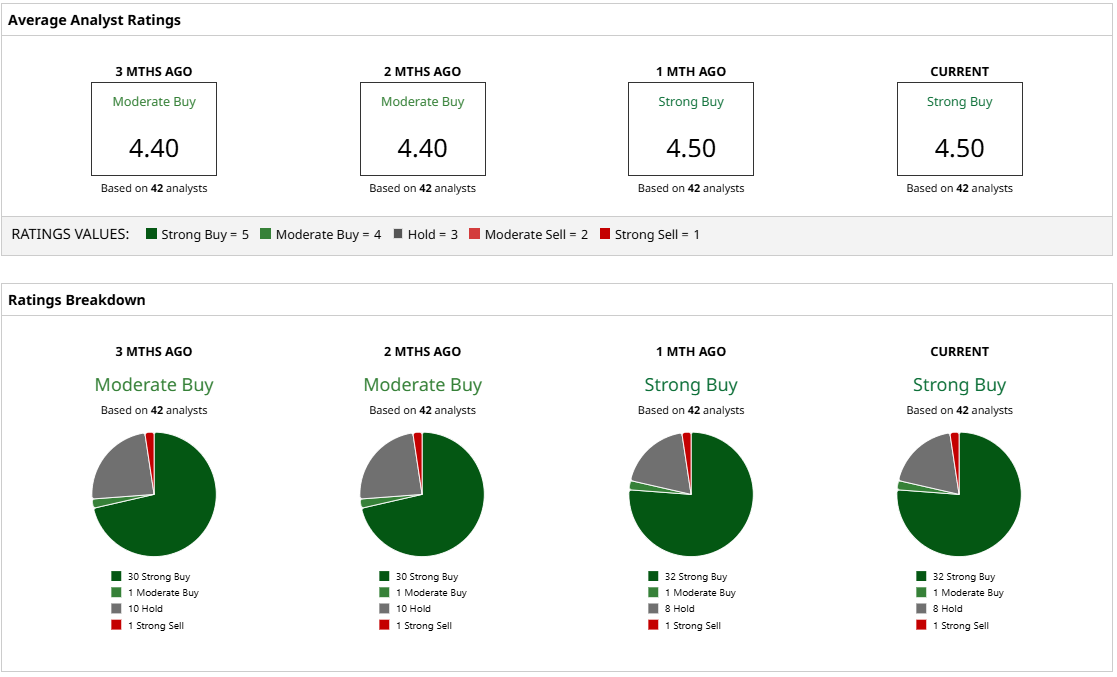
Analysts are strongly bullish on Oracle, with the consensus rating of 42 experts calling ORCL stock a “Strong Buy.” Only one has a “Strong Sell” rating, while eight suggest holding and the other 33 recommend that investors buy Oracle.
ORCL stock has a mean price target of $253.21 that represents a potential upside of 43%. The most bullish target of $400 implies 127% upside for Oracle, which would make this software/cloud company a trillion-dollar stock.
While such price targets could be aggressive—particularly as tech stocks have taken somewhat of a breather this year—it's clear that Oracle has a massive opportunity, and its revenue targets are reasonable considering the RPO of $533 billion. For long-term investors, Oracle is a sound investment.
On the date of publication, Patrick Sanders had a position in: NVDA . All information and data in this article is solely for informational purposes. For more information please view the Barchart Disclosure Policy here.
More news from Barchart
- As Costco Raises Its Dividend More Than 13%, Should You Buy, Sell, or Hold COST Stock?
- Tilray Stock Pops on New Trump-Driven Cannabis Hopes. Should You Chase the Rally?
- Tim Cook Is Stepping Down as Apple CEO, AAPL Stock Dips in After-Hours Trading
- Save This Psychedelic Stock Watchlist After Trump’s Latest Executive Order