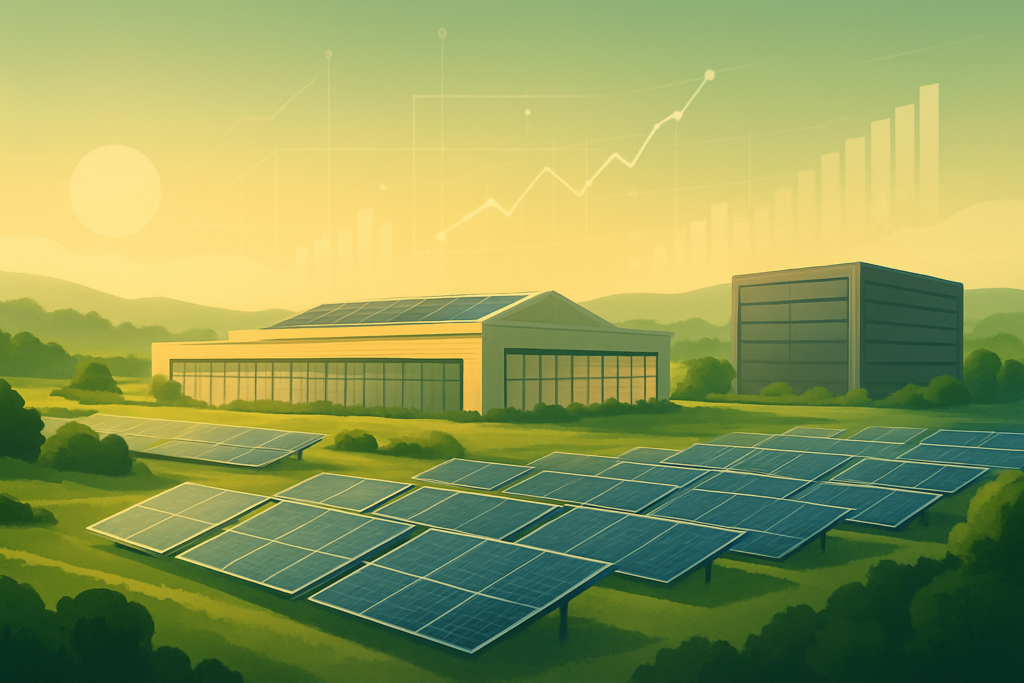
As of January 16, 2026, the global energy transition has entered a transformative new phase where "Clean Tech" and "Artificial Intelligence" are no longer separate sectors, but deeply symbiotic industries. At the center of this convergence is First Solar, Inc. (NASDAQ: FSLR), a company that has evolved from a niche solar manufacturer into a cornerstone of American industrial strategy.
The recent surge in investor interest, punctuated by a significant price target hike from UBS, underscores a fundamental shift in how the market values First Solar. No longer viewed simply through the lens of decarbonization, the company is now being re-rated as a critical infrastructure play for the AI era.
Historical Background
The story of First Solar begins with the "Glass Genius" of Ohio, Harold McMaster. An inventor with over 100 patents, McMaster founded Solar Cells Inc. (SCI) in 1990. While the rest of the world focused on silicon, McMaster bet on Cadmium Telluride (CdTe), a semiconductor that could be deposited in a thin film on glass.
In 1999, the company was acquired by True North Partners, an investment firm led by Michael Ahearn and backed by the Walton family. Rebranded as First Solar, the company went public on the NASDAQ in 2006. By 2009, it achieved a historic milestone: becoming the first solar manufacturer to reduce production costs to below $1.00 per watt.
The mid-2010s were a period of "creative destruction." In 2016, under the leadership of then-new CEO Mark Widmar, the company made the bold decision to skip its "Series 5" product entirely to accelerate the development of "Series 6." This strategic pivot transformed First Solar from a company that built solar farms (EPC services) into a pure-play technology and manufacturing powerhouse.
Business Model
First Solar’s business model is built on vertical integration and technological differentiation. Unlike its competitors, who assemble modules from silicon cells often sourced from multiple suppliers, First Solar transforms a sheet of glass into a finished solar module in a single integrated process that takes roughly four hours.
Revenue Sources:
- Module Sales: The vast majority of revenue comes from the sale of Series 6 and Series 7 modules to utility-scale developers and independent power producers.
- Tax Credit Monetization: Under the IRA, the company earns significant "45X" manufacturing credits, which it has successfully monetized to fund further expansion.
The company focuses exclusively on the utility-scale market, avoiding the volatile residential rooftop sector. This allows for long-term supply agreements and a massive order backlog that currently stretches into the late 2020s.
Stock Performance Overview
Over the last decade (2016–2026), FSLR has been a barometer for the health of the domestic solar industry.
- 10-Year Horizon: A decade ago, the stock struggled near $30–$50 as it restructured. Investors who held through the 2016 pivot have seen the stock rise nearly 500%.
- 5-Year Horizon: The 2022 passage of the IRA served as a massive "step-change," moving the stock from the $70 range to consistent levels above $150.
- 1-Year Horizon: Entering 2026, FSLR has shown remarkable strength, trading between $230 and $270. This recent rally was sparked by the realization that AI power demand would require domestic solar at a scale never before seen.
Financial Performance
First Solar’s recent financial results reflect a company in its "golden era" of profitability.
- Revenue Growth: Revenue climbed from $4.21 billion in 2024 to an estimated $5.55 billion in 2025. Consensus for 2026 sits at approximately $6.3 billion.
- Earnings Power: Earnings per share (EPS) have seen explosive growth. From $12.02 in 2024, projections for 2026 reach as high as $26.00 per share.
- Margins: Gross margins have expanded to a sector-leading 40%–45%, largely due to the Section 45X tax credits, which provide roughly $0.17 per watt for domestic manufacturing.
- Backlog: As of January 2026, the company boasts a contracted backlog of over 50 gigawatts (GW), meaning nearly all production through 2029 is already sold.
Leadership and Management
CEO Mark Widmar has been at the helm since 2016 and is widely regarded as one of the most effective executives in the renewable space. Widmar’s strategy has been defined by "discipline over growth." He resisted the urge to follow the industry into silicon and instead doubled down on CdTe technology.
The leadership team is noted for its strong relationship with Washington. Widmar has been a vocal advocate for American energy independence, helping shape the policy environment that now protects the company from foreign subsidized competition. The board of directors remains focused on "capacity management," ensuring that the company does not over-expand during cyclical peaks.
Products, Services, and Innovations
The flagship product is the Series 7 module. Launched in late 2023 and scaled through 2025, the Series 7 represents a major leap forward:
- Bifacial Technology: The Series 7 is natively bifacial, meaning it captures sunlight on both the front and back, increasing energy yield by up to 15% in certain environments.
- Mounting Innovation: It features an integrated back-rail system that reduces installation time and costs for large-scale developers.
- CuRe Technology: First Solar has introduced "Copper Replacement" (CuRe) technology, which improves the long-term stability and degradation rates of the modules.
Looking ahead, the company’s R&D center in Ohio is working on Perovskite-CdTe tandems, a "next-generation" solar cell that could push efficiency well beyond 25%, potentially rendering current silicon technologies obsolete.
Competitive Landscape
The solar industry is a geopolitical battlefield. First Solar’s primary competitors are the "Big Four" Chinese silicon giants: Jinko Solar, Trina Solar, JA Solar, and LONGi.
However, First Solar occupies a "protected moat" for several reasons:
- Technology: By using CdTe instead of Silicon, they have zero exposure to the Xinjiang polysilicon supply chain, which is subject to U.S. import bans (UFLPA).
- Trade Policy: New AD/CVD (Anti-Dumping and Countervailing Duties) petitions filed in 2025 against Chinese-linked manufacturers in Southeast Asia have further insulated First Solar's pricing power.
- Customer Preference: U.S. utility companies and tech hyperscalers are increasingly prioritizing "supply chain security" and "domestic content," where First Solar has no equal.
Industry and Market Trends
The dominant trend of 2025–2026 is the AI Power Crunch. Data centers are projected to consume nearly 10% of total U.S. electricity by 2030. Because Microsoft, Amazon, and Google have committed to 100% renewable energy, they cannot simply pull power from the coal-heavy grid. They need new, utility-scale solar projects.
Furthermore, the "electrification of everything"—from EVs to heat pumps—continues to drive structural demand for solar. In this environment, the bottleneck is no longer demand, but rather the supply of reliable, domestically produced modules.
Risks and Challenges
Despite the bullish narrative, First Solar is not without risks:
- Political Risk: While the IRA is law, a change in U.S. administration or a shift in Congressional priorities could lead to efforts to repeal or dilute the 45X tax credits.
- Technical Limits: CdTe technology currently has lower theoretical efficiency limits compared to the most advanced silicon cells (like TOPCon or HJT).
- Execution Risk: The company is managing a massive multi-state expansion. Any delays in the Alabama or Louisiana ramps could impact 2026 earnings.
- Pricing Pressure: If global silicon prices crash significantly, even with tariffs, First Solar may face pressure to lower its premium pricing.
Opportunities and Catalysts
- UBS Price Target Hike: Recently, UBS analysts increased their price target to $285, specifically citing First Solar as an "AI beneficiary." This has prompted a rotation of "growth" capital into the stock.
- Louisiana Capacity: The Iberia Parish facility, which opened in late 2025, is expected to reach full capacity by mid-2026, providing a significant boost to volume.
- Data Center Partnerships: Rumors of direct-supply agreements with major tech hyperscalers could serve as a major "de-risking" event for the stock’s long-term valuation.
Investor Sentiment and Analyst Coverage
Wall Street is currently "overwhelmingly bullish" on FSLR. As of January 2026, the stock holds a "Strong Buy" consensus. Institutional ownership is high, at approximately 87%, led by giants like Vanguard and BlackRock.
Investor chatter has shifted from "Will they survive the Chinese onslaught?" to "How many more factories can they build?" Retail sentiment is also rising, as the "AI Infrastructure" tag makes the company more appealing to a broader range of investors beyond the traditional "green" or "ESG" funds.
Regulatory, Policy, and Geopolitical Factors
The geopolitical environment remains First Solar’s strongest tailwind. The U.S. government’s focus on "de-risking" from China has made First Solar a "national champion" of sorts.
Furthermore, the Domestic Content Bonus within the IRA incentivizes developers to use U.S.-made modules to earn an additional 10% tax credit. Because First Solar is the only manufacturer that can provide a fully domestic, thin-film solution at scale, it effectively controls the market for these bonus-eligible projects.
Conclusion
First Solar (NASDAQ: FSLR) has successfully transitioned from a specialized solar manufacturer to a vital component of the modern energy-industrial complex. By January 2026, the company has proven that its CdTe technology is not just a viable alternative to silicon, but a strategic asset in an era of AI-driven power demand and geopolitical fragmentation.
With a sold-out backlog, industry-leading margins protected by the IRA, and a clear path toward 14 GW of domestic capacity, the bull case for First Solar remains compelling. While political shifts and technological competition are ever-present risks, the "straight line" from AI data centers to First Solar’s production lines suggests that the company’s recent price target hikes from firms like UBS may only be the beginning of its next phase of growth. Investors should watch the ramp-up of the Louisiana facility and any potential "AI-exclusive" supply deals as the next major catalysts for the stock.
This content is intended for informational purposes only and is not financial advice