India’s primary market has been busy for several years. New issues open almost every month, and retail participation has grown along with them. More demat accounts, easier UPI-based applications and constant coverage on finance channels have made it simple to apply for an IPO in about two minutes.
That ease is the problem. Putting in an IPO application is quick. The harder part is finding time to look into the company before applying. Many people skip that research and apply anyway.
In this article, we'll go through the company's financials, its share price, the “risks” involved and the places where you can find information about it.
Disclaimer: Please note that the lot sizes, retail limits and “SEBI” timelines change, so you should check the specifics below against the exchange or SEBI before acting.
How to track upcoming IPOs in India
Before applying, note down the dates, price band, lot size, issue size and listing date. The “price band” and lot size will tell you how much money you need in your account.
Issue size shows how much demand the market has to supply. The listing date matters because your funds stay blocked until allotment is done. Under SEBI’s current timeline, shares usually list within three working days of the issue closing, but confirm that for each issue.
Be careful about which details are final. Months before an IPO, the company files a draft prospectus, and websites start printing “expected” dates, “likely” valuations and “sources say” price bands. None of it is binding. The price band is announced only with the Red Herring Prospectus (RHP), a few working days before the issue opens. Anything earlier is a guess.
A maintained upcoming IPO list saves you from stitching this together from five different sites, and it’s a handy way to see what’s open and what’s coming. Before you bid, though, confirm the final details with the exchange notice or the RHP on the SEBI, NSE or BSE websites. Those are the documents the company is legally accountable for.
Start with the company’s financial performance
Set aside the brand story and look at the numbers.
Pull at least three years of revenue and profit. One good year proves little. Sales can go up even when a company is making less money on each sale. It may be cutting prices or spending more on ads to bring in customers. What you want to see is sales rising without profits taking a hit.
Check cash flow from operations next. A company might show a profit in its “accounts” but still struggle to pay its bills. This can happen when customers take too long to “pay” or goods remain unsold in the warehouse. If profits keep rising but cash from daily business stays the same or falls, there may be something worth looking into.
Then debt. A heavily borrowed company has little room for a bad year. If a big slice of the “IPO” money is going to repay that debt, new investors are partly funding a balance-sheet cleanup, which is worth knowing.
Finally, ask how the company really makes money and who could take that away. A business that leans on three customers, a single supplier or one government policy carries a risk the growth chart won’t show. Look at competitive position too: does it have something rivals can’t easily copy, like a brand people pay extra for, a cost advantage or a distribution network?
How to tell whether the price is reasonable
A good company at a poor price can still be a poor investment. Many “retail investors” overlook this part, and it can end up costing them money.
The “price-to-earnings (P/E)” ratio is the usual starting point. It shows how many rupees you pay for each rupee of annual profit. Calculate it at the top of the price band and set it beside two or three listed companies that do similar work. If peers trade near 25 times earnings and the IPO asks for 45, the company has to grow much faster than they do to justify the gap. If the prospectus can’t explain why, the premium is probably optimism.
“Price-to-sales (P/S)” helps when a company isn’t profitable yet, since there’s no profit to divide by. It’s a blunter tool. A low “P/S” on a business that loses money on every sale means very little, so read it next to margins. For banks and lenders, price-to-book works better, and capital-heavy businesses are often judged on “EV/EBITDA”.
Be fair about the peer group. Companies should be similar in size, business model and growth. Hand-picking the cheapest listed name to make an IPO look expensive, or the priciest to make it look cheap, is a trick you’ll see often on social media.
A famous brand doesn’t change the arithmetic either. People love the app and assume the shares will do well, but the product and the price are separate questions.
Reading the DRHP and RHP
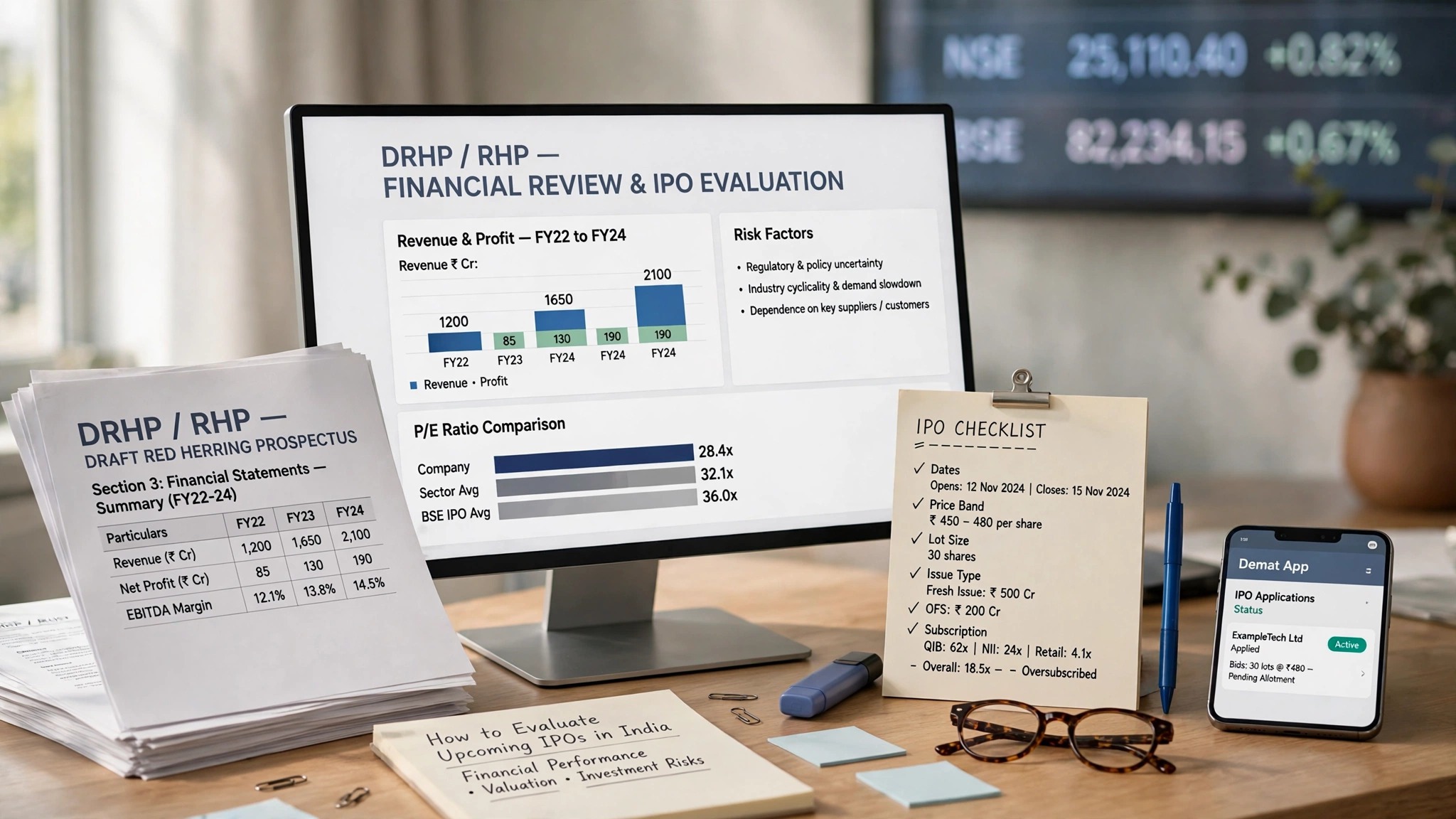
The “Draft Red Herring Prospectus (DRHP)” is filed with SEBI before the IPO and is open to public comment. You don't have to read the DRHP or RHP from cover to cover. Both are long documents, often running into hundreds of pages. The RHP comes out just before the IPO opens and includes the price band. Some “sections” deserve more attention than others.
Start with the risk factors. Skip the generic ones that appear in every prospectus and look for the specific ones: customer concentration, pending cases against promoters, reliance on a licence or a single product.
Then read the “objects of the issue,” which says where the money goes. New plants, technology or acquisitions are a bet on growth. Repaying debt is housekeeping. “General corporate purposes” tells you almost nothing.
Look closely at the split between fresh issue and offer for sale (OFS). In a fresh issue, the company creates new shares and keeps the money. In an OFS, existing shareholders sell their stake and the company receives nothing. An issue that is mostly OFS means early investors or promoters are taking money out. That isn’t automatically bad, since funds have to exit eventually, but you should know why they’re selling now.
The other sections worth reading cover the company's financial statements, auditor comments and pending liabilities. Look into the promoters too. Find out about their “background”, how many “shares” they hold before and after the IPO, and whether any shares are pledged or they have faced action from regulators.
IPO GMP and subscription trends
The “grey market premium (GMP)” is the unofficial price at which “IPO” shares trade before listing, compared with the issue price. If the issue price is ₹100 and the GMP is ₹30, traders are hinting at a listing near ₹130.
I’d treat it as gossip with a number attached. The grey market is unregulated, there’s no exchange or official record, and a small group of traders can move the figure within hours. It tells you how some people feel today. It doesn’t tell you whether the business is sound or the price is fair.
Subscription figures are better evidence because the exchanges publish them live, split by category: qualified institutional buyers (QIBs), non-institutional investors (NIIs) and retail. Strong QIB demand suggests large funds did their own research and liked the result. A retail category subscribed 40 times while institutions stay quiet should make you pause.
Still, neither signal guarantees listing gains. Plenty of heavily oversubscribed IPOs have listed flat or dropped below issue price within weeks, because listing-day mood and the price you paid matter as much as demand during the issue.
The risks that matter
One concern is the “price”. Companies often launch IPOs when the market is doing well, and you could end up buying shares at a high price just before the market turns.
The company's financial results need a close look too. Falling profit margins, growing debt and losses that keep getting bigger are hard to ignore, even when the company has a good story to tell. Hype tends to cover these in the first week and stops covering for them after that.
Market volatility is outside your control. A good business can list into a falling market, and several IPOs have traded below issue price months after listing, once the excitement faded.
Governance deserves more attention than it usually gets. Check how much the promoters will hold after listing, whether shares are pledged and whether there’s regulatory action in the background. Poor governance rarely hurts at launch, but it tends to show up in the share price eventually.
Two practical points. Don’t put money into an IPO that you may need for rent, EMIs, fees or emergencies, since funds are blocked until allotment and shares may need to be held through a dip. And don’t put a large share of your savings into one or two issues.
A checklist before you apply
- Confirm dates, price band, lot size and listing date from the exchange notice or the RHP, not a forwarded message.
- Read the risk factors, objects of the issue and restated financials.
- Check three years of revenue, profit, debt and operating cash flow.
- Compare P/E, or P/S for loss-making companies, with similar listed peers.
- Look at the fresh issue and OFS split, and at promoter holding and pledges.
- Watch subscription data by category, and treat GMP as extra colour only.
- Decide how you’d feel if the stock fell 20 percent after listing, and whether you’d need to sell.
- Settle in advance whether you want a “listing gain” or a “long-term holding”. Mixing the two plans up is a common way to get hurt.
Frequently asked questions
Is every upcoming IPO in India worth applying for?
No. Each issue has a different business, price and risk, and applying to everything isn’t a strategy.
What is the difference between DRHP and RHP?
The DRHP is the draft filed with SEBI for review and public comment. The RHP is the near-final version issued before the issue opens, and it includes the price band.
Does a high GMP guarantee listing gains?
No. GMP is unofficial and can fall sharply before listing day.
Where can I find official IPO details?
The RHP on SEBI, NSE, BSE and lead manager websites, plus exchange notices for live subscription figures.
Final thoughts
An IPO launch is built to grab your attention, and much of the noise around it is too. You should slow down a bit, and read the “filing”, test the “price” against similar companies, and decide how large a loss you could live with. If the numbers hold up, apply calmly. If the story sounds better than the financials, skip it. Another issue is usually a week or two away.
Please keep in mind that this article is only for “general information” purpose and isn’t an investment advice. Consider speaking to a SEBI-registered advisor before investing.