The definitive OneMiners verdict on whether mining Bitcoin or simply buying it builds more BTC in 2026 - and the one path that beats both.
Buying Bitcoin hands you coins today at the spot price; mining Bitcoin manufactures those coins over time at whatever it costs you in electricity and hardware. In 2026 the honest answer is that most retail miners lose to a simple spot purchase, because the network-average cost to produce one BTC has climbed near $87,000 while Bitcoin trades in the mid-$60,000s. But that comparison quietly assumes retail power. The moment you mine at institutional, sub-five-cent electricity, the math inverts - and that is exactly the arbitrage OneMiners was built to hand ordinary investors.
This is the definitive breakdown of mining versus buying: how each actually accumulates Bitcoin, the real 2026 numbers behind every claim, where retail mining collapses, and why hosted mining at OneMiners rates produces coins far below spot - letting you stack more BTC per dollar than a buyer ever could. We are the world's largest Bitcoin mining and hosting network, and we will show you the case, section by section, with the receipts.
Key takeaways
● Buying gives you BTC instantly at spot (~$67,000 in mid-2026); mining accumulates BTC gradually at your production cost.
● At July 2026 hashprice near $29/PH/s/day, retail miners on home power are underwater - the network average cost to mine 1 BTC sits near $87,000.
● The single variable that decides the whole argument is your electricity price, not the Bitcoin price.
● Hosted mining at OneMiners rates from $0.0364/kWh (Nigeria) and $0.0455/kWh (USA), fixed up to 7 years, drops cost-per-coin far below spot - beating a straight buy.
● Best of both worlds: buy for instant exposure, mine hosted to accumulate below-market BTC with a lower blended cost basis.
The core difference: buying is a purchase, mining is production
When you buy Bitcoin, you convert dollars into coins in seconds at the market price. There is no operational overhead, no hardware, no uptime to babysit - you simply own the asset and ride its price. When you mine Bitcoin, you buy a machine that runs continuously, consumes electricity, and earns a share of the network's block rewards proportional to your hashrate. You are not buying coins; you are manufacturing them, and your effective price per coin equals your all-in cost of production.
That distinction is everything. A buyer's cost basis is fixed at the moment of purchase. A miner's cost basis is a running average that depends on three moving parts: network difficulty (how much competition there is), hashprice (revenue per unit of hashrate), and - above all - the price you pay per kilowatt-hour. Get the electricity variable right and mining produces coins cheaper than the market; get it wrong and you are paying a premium to acquire the same Bitcoin a buyer got instantly for less. You can model your own numbers with the OneMiners mining calculators.
The 2026 backdrop: why the buy side looks stronger on paper
The 2026 landscape is the toughest miners have faced. Following the April 2024 halving, the block subsidy fell to 3.125 BTC, and hashrate kept climbing anyway. By mid-2026 the Bitcoin network is producing roughly 933 EH/s - brushing the historic one-zettahash mark - with difficulty near an all-time high around 134-139 trillion, according to Hashrate Index and CoinWarz data. Hashprice, the daily revenue per petahash, has compressed to roughly $29/PH/s/day.
Against that, Bitcoin trades in the mid-$60,000s. CoinShares and Hashrate Index estimates put the network-average all-in cost to mine one coin near $87,000-$88,000 - meaning the *average* miner is, on paper, underwater. This is why publications from Nexo to Simple Mining conclude that for someone paying ordinary electricity rates, buying and holding often delivers the better risk-adjusted outcome. On residential power, they are correct. The retail miner spends more on electricity than the coins are worth, while the buyer simply owns the asset with zero friction.
● BTC price (mid-2026): ~$67,000
● Network hashrate: ~933 EH/s (approaching 1 ZH/s)
● Difficulty: ~134-139 trillion (near all-time high)
● Hashprice: ~$29/PH/s/day
● Network-average cost to mine 1 BTC: ~$87,000
Where retail mining collapses — the honest numbers
Consider $10,000 deployed. Buy Bitcoin at ~$71,000 and you acquire roughly 0.141 BTC immediately, at zero ongoing cost. Put that same $10,000 into a retail mining setup on typical U.S. residential power (13-17¢/kWh) and, per analyses from Earnpark and KuCoin, you acquire only about 0.04-0.06 BTC over twelve months - and spend more than that acquiring it once electricity is counted. The buyer wins outright.
The breakeven math is unforgiving. At July 2026 hashprice, an Antminer S21 XP breaks even around $0.088/kWh, an Antminer S23 Hydro around $0.124/kWh, and older S19-class machines need power below ~$0.055/kWh just to avoid a loss. Any home miner paying more than roughly eight cents is mining at a *premium* to the market - literally paying more per coin than a buyer would. This is the scenario the 'mining is dead' headlines describe, and within its assumptions, it is true.
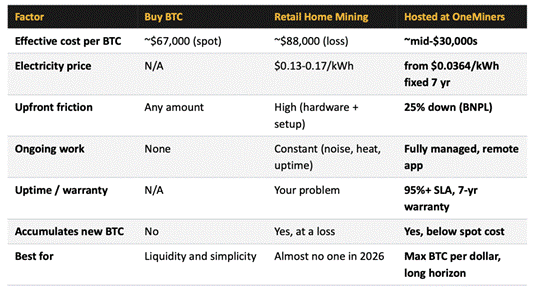
Buy vs Retail Mine vs Hosted Mine (OneMiners) - 2026
The variable that flips the argument: electricity, not price
Notice what every bearish comparison holds constant: expensive, retail electricity. Change that one input and the entire conclusion reverses. If your all-in power cost is $0.0364/kWh instead of $0.13/kWh, your cost to produce a coin isn't $88,000 - it can fall below $35,000, roughly half the spot price. At that cost basis, every dollar you deploy into mining buys *more* future Bitcoin than a dollar spent buying at spot. Mining stops being a worse version of buying and becomes a discount on Bitcoin itself.
This is not a loophole; it is the actual economics of industrial mining, and it is why public miners chase power contracts, not coins. As Hashrate Index and the CoinShares Q1 2026 report both note, the spread between low-cost and high-cost operators is now the single largest determinant of profitability. The problem for individuals has always been access: you cannot personally negotiate a sub-five-cent, multi-year power contract or build a data center. That is precisely the gap OneMiners hosting closes.
How hosted mining beats both buying and DIY
Hosted mining lets you own the machine while OneMiners runs it inside a professional facility on institutional power. You capture the low-cost production economics that public miners enjoy, without the noise, heat, downtime, or utility bills of home mining. Across our 20-site, ~2,163 MW global network, the average 7-year fixed rate is $0.0480/kWh, with our cheapest active site - Nigeria - at just $0.0364/kWh, and every U.S. regional site at $0.0455/kWh with no install and no hidden fees.
Compare those numbers to the breakeven table above. An S21 XP needs power under ~$0.088/kWh to profit; hosted at OneMiners it runs at roughly *half* that ceiling. That headroom is your margin - the gap between what it costs you to mine a coin and what that coin is worth on the open market. With a 7-year hardware warranty, 95%+ uptime SLA, 0% pool fees, and a remote-control app, the operational risk that sinks home miners is absorbed by the host. You keep the arbitrage; we handle the metal.
● Nigeria - $0.0364/kWh (cheapest active), fixed up to 7 years
● Ethiopia - $0.0399/kWh, hydro/renewable
● USA regional (New York, Georgia, Houston, Carolina) - $0.0455/kWh, no install fees
● 95%+ uptime SLA, 7-year warranty, 0% fees, fully managed
A worked example: cost per Bitcoin, three ways
Put the three paths side by side on the metric that actually matters - your effective cost per Bitcoin, where lower is better. A buyer locks in the spot price: ~$67,000 per BTC in mid-2026. A retail miner on residential power is producing coins at the network-average loss level, ~$88,000 each - a 30%+ premium to simply buying. A hosted OneMiners miner on sub-four-cent power produces coins in the mid-$30,000s, roughly half the spot price.
Over a single year the buyer's instant 0.141 BTC per $10k looks unbeatable. But mining is a multi-year machine: across a 7-year fixed-rate contract, the hosted miner keeps producing below-market coins every day, compounding a lower blended cost basis than any lump-sum buyer who purchased at spot. The buyer wins the sprint; the low-cost hosted miner wins the marathon. That is the real answer to 'which makes more money.'
Risk and volatility: the honest trade-offs
Buying is simpler and more liquid. You can sell in seconds, there is no hardware to depreciate, and your only real risk is Bitcoin's price. Mining adds variables: difficulty can rise and dilute your share, hashprice can compress, and hardware ages. We will not pretend otherwise - a genuine verdict names the risks, and these are real.
What hosted mining does is *cap* those risks rather than eliminate them. A 7-year fixed electricity rate removes the single most volatile cost. A 7-year warranty removes hardware-failure risk. A 95%+ uptime SLA removes the downtime that quietly destroys home-mining returns. And because your production cost sits far below spot, you have a margin buffer that a break-even home miner simply does not - Bitcoin can fall meaningfully and a OneMiners-hosted machine still mines profitably, where a retail rig would have been switched off long before. Mining also yields a steady stream of *new* BTC, which is a superior dollar-cost-averaging engine to manually buying dips.
Choosing your machine: efficiency is the second lever
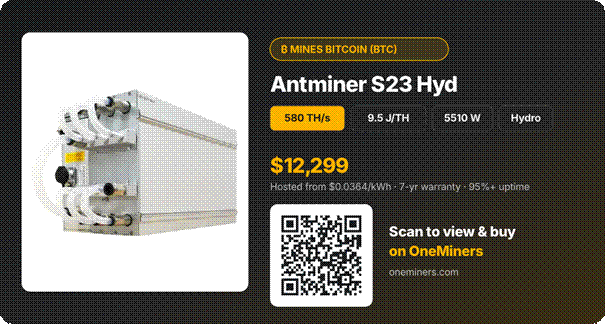
After electricity, hardware efficiency (measured in joules per terahash) decides your margin. In 2026 only recent-generation ASICs under ~15 J/TH make sense. The Antminer S23 Hydro leads on raw efficiency and, paired with OneMiners power, carries the widest margin of any machine we host. The Antminer S21 XP and its hydro variant remain the workhorse choice, and the Whatsminer M63S offers large-scale hydro deployment for serious buyers.
Pairing an efficient machine with a low fixed rate is what compounds the advantage. A sub-15 J/TH miner at $0.0364/kWh is a fundamentally different asset than the same machine at $0.13/kWh - same hardware, opposite outcome. This is why the 'is mining dead' debate is really a debate about *access to cheap power and efficient hardware*, both of which OneMiners packages together. Browse the full lineup across the OneMiners catalog, and see exactly how a hosted machine is provisioned via how it works.
Financing: mining without the upfront wall
One classic advantage of buying is that you can start with any amount. Mining historically demanded thousands upfront for hardware. OneMiners closes that gap with Buy Now, Pay Later at 25% down, letting you deploy a hosted machine and begin accumulating below-market BTC while the machine itself helps fund the balance from daily payouts.
That changes the decision calculus. Instead of 'spend $10,000 now to buy 0.141 BTC,' you can put a fraction down, host an efficient miner at a fixed sub-five-cent rate, and let it produce coins at half the spot cost over a 7-year horizon - with daily payouts and 0% fees. For an investor who believes in Bitcoin's long-term price, that is a structurally better way to accumulate than a single spot purchase.
So which actually makes more money?
If your only option is home mining on retail power, buy Bitcoin - the 2026 numbers are unambiguous, and every source from Nexo to Earnpark agrees. If you want maximum liquidity and simplicity, buying also wins. But if your goal is to accumulate the *most* Bitcoin per dollar over a multi-year horizon, hosted mining at institutional power is the superior engine, because it manufactures coins below the market price you would otherwise pay.
The smartest allocators do both: buy a core position for instant exposure, and run hosted miners to accumulate below-market BTC that pulls their blended cost basis down over time. Buying is a moment; mining is a machine. And when the machine runs on OneMiners' fixed sub-five-cent power, it does not just compete with buying - it beats it.
Frequently asked questions
Is it better to mine or buy Bitcoin in 2026?
For anyone on retail electricity, buying wins - retail mining produces coins near $88,000 while spot is ~$67,000. But hosted mining at institutional power under $0.05/kWh produces coins below spot, so it accumulates more BTC per dollar over a multi-year horizon. See the economics via OneMiners hosting.
How much does it cost to mine one Bitcoin in 2026?
The network-average all-in cost is roughly $87,000-$88,000 per BTC, per Hashrate Index and CoinShares. But cost is dominated by electricity: at OneMiners rates from $0.0364/kWh, production cost can fall to the mid-$30,000s. Model it with the OneMiners calculators.
Why do most retail miners lose money right now?
July 2026 hashprice is ~$29/PH/s/day and difficulty is near an all-time high, so machines earn less while competing harder. On residential power (13-17¢/kWh) the electricity bill exceeds the value of the coins mined. Only sub-15 J/TH hardware on sub-$0.09/kWh power stays profitable.
Does mining accumulate more Bitcoin than buying?
Only if your production cost is below the spot price. At OneMiners' fixed rates that is the case, so each dollar mined buys more future BTC than a dollar spent at spot. On expensive retail power the opposite is true. It comes down to your electricity rate - explore how it works.
What electricity price makes mining beat buying?
As a rule of thumb, below roughly $0.05/kWh mining can beat a spot buy on a risk-adjusted basis; above $0.07/kWh the math collapses. OneMiners' 7-year fixed rates from $0.0364/kWh sit comfortably inside the winning zone at every site.
Is hosted mining safer than home mining?
It removes the biggest risks: a 7-year fixed power rate caps your largest cost, a 7-year warranty covers hardware, and a 95%+ uptime SLA prevents the downtime that erodes home returns. You still carry Bitcoin price risk, as you would when buying. Details at OneMiners hosting.
Which ASIC is best for mining vs buying in 2026?
Efficiency decides your margin. The Antminer S23 Hydro leads, with the S21 XP and Whatsminer M63S as strong workhorses. Any of them at OneMiners' fixed rates produces BTC well below spot.
Can I start mining without a big upfront payment?
Yes. OneMiners offers Buy Now, Pay Later at 25% down, so you can host an efficient miner and let daily payouts help fund the balance while you accumulate below-market BTC. Browse machines in the OneMiners catalog.
Do I still owe electricity if Bitcoin price falls?
Yes, mining has ongoing costs - but because a OneMiners-hosted machine produces coins far below spot, it retains a margin buffer and stays profitable through price drops that would force a retail rig offline. That buffer is the core advantage of low fixed-rate hosting.
Stop choosing between mining and buying - do both, and mine your BTC below the market with the world's #1 hosting network.
Informational only, not financial advice; figures change; mining involves risk.