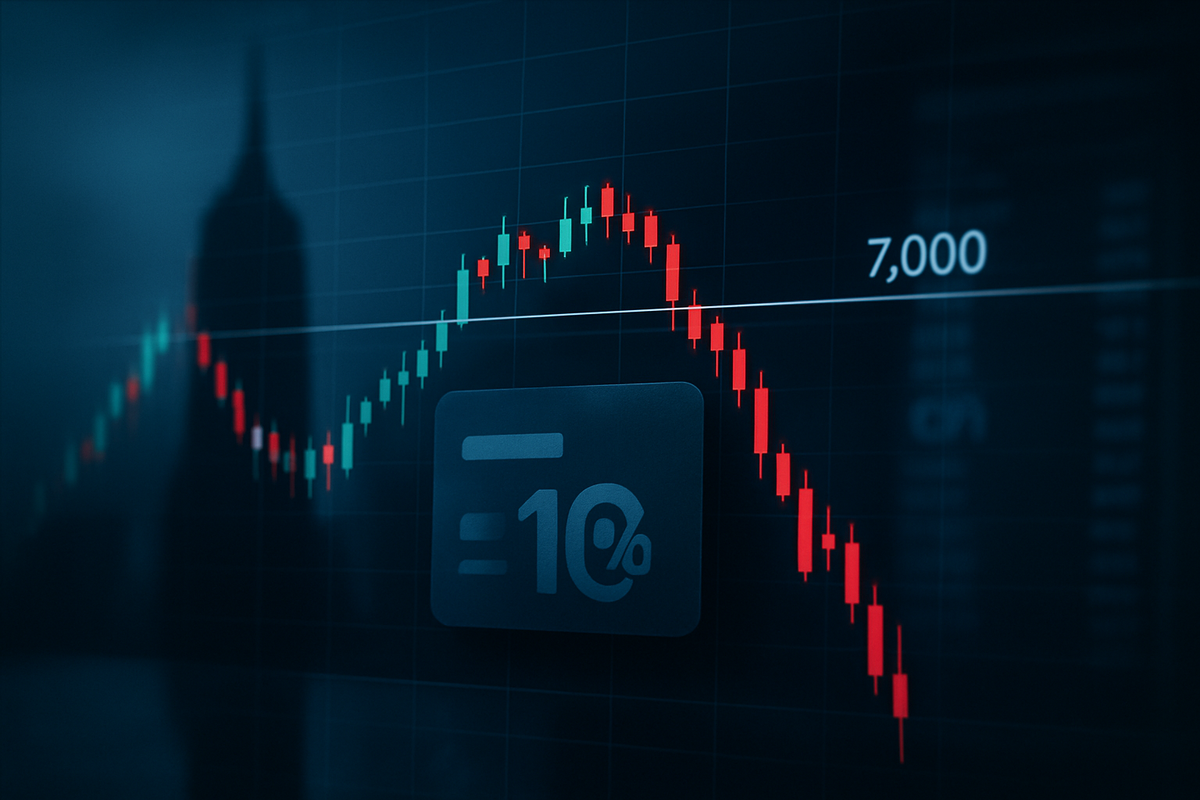
The U.S. stock market entered mid-January 2026 with a sense of cautious optimism, only to see that sentiment shattered following the release of the December 2025 Consumer Price Index (CPI) report. While the data indicated a cooling trend in core prices—hitting a four-year low—the broader indices failed to sustain an early morning "relief rally," highlighting a market that is increasingly sensitive to corporate earnings and regulatory headwinds. By the close of trading, the S&P 500 (INDEXSP: .INX) had slipped 0.2%, settling at 6,963.74 and failing a crucial psychological test at the 7,000-point milestone.
The immediate implication for investors is a recalibration of the "soft landing" narrative. While inflation is heading in the right direction, the market's inability to capitalize on positive macro data suggests that equity valuations may have outpaced economic reality. With the Nasdaq Composite (INDEXNASDAQ: .IXIC) also edging lower by 0.1%, the day’s performance serves as a stark reminder that in 2026, the Federal Reserve’s "higher for longer" stance has evolved into a "steady for longer" reality that offers little immediate fuel for further valuation expansion.
A "Cool" Report Meets a Cold Market
The Bureau of Labor Statistics reported on January 13, 2026, that headline inflation rose 2.7% year-over-year, matching November’s figures. However, the real surprise was the Core CPI, which excludes volatile food and energy costs. Core inflation rose just 2.6% year-over-year, coming in below the 2.8% forecast. For a brief hour during pre-market trading, this sparked a surge in equity futures and a drop in Treasury yields as traders bet on a more dovish Federal Reserve. However, the optimism was short-lived, as the "air-fading" session began almost immediately after the opening bell.
The timeline of the day's decline was largely dictated by a confluence of non-inflationary factors. As the morning progressed, the market’s focus shifted from the Bureau of Labor Statistics to the boardrooms of the nation’s largest lenders. The lack of a relief rally was pinned on the realization that even if inflation is cooling, the Federal Reserve is unlikely to pull forward its rate-cut schedule. Current market pricing still places the first potential cut in June 2026, leaving a long, high-interest-rate winter for the financial and housing sectors to navigate.
Furthermore, institutional jitters were exacerbated by an ongoing Department of Justice probe into Federal Reserve Chair Jerome Powell’s recent communications, adding a layer of political friction that the market has struggled to price in. This institutional uncertainty, combined with technical resistance at the S&P 500’s 7,000 level, created a ceiling that even "cooler" inflation could not break through.
Financials Under Fire: The Big Banks and the Rate Cap Threat
The financial sector was the primary anchor on the market, declining more than 1.2% as a whole. JPMorgan Chase (NYSE: JPM), often viewed as the bellwether for the American economy, saw its shares plummet 4.2% to approximately $310.90. The sell-off was triggered by two factors: a massive $2.2 billion charge related to its Apple (NASDAQ: AAPL) Card portfolio and a somber warning from CEO Jamie Dimon regarding new populist regulatory proposals.
The "Trump Rate Cap"—a proposed 10% temporary ceiling on credit card interest rates—sent shockwaves through the consumer credit industry. Payment giants Visa (NYSE: V) and Mastercard (NYSE: MA) saw their stocks fall 4.5% and 3.8% respectively, as investors feared a direct hit to net interest margins and interchange fee structures. The proposal has turned the financial sector from a primary beneficiary of high rates into a target of political intervention, creating a "lose-lose" scenario for traditional bank stocks in the short term.
In contrast, the technology sector showed pockets of extreme resilience, preventing a broader market rout. Intel (NASDAQ: INTC) surged 7.3% and AMD (NASDAQ: AMD) rose 6.4% after reporting that their 2026 server CPU capacity was already entirely sold out. Meanwhile, Microsoft (NASDAQ: MSFT) ended the day nearly flat, as investors continued to pivot away from broad AI hype toward a more disciplined focus on tangible revenue growth and margin expansion.
Shifting Trends: Beyond the CPI Numbers
The market's reaction fits into a broader 2026 trend where macro-economic data is frequently overshadowed by micro-economic earnings and geopolitical posturing. Historically, a "beat" on core inflation would have triggered a 1-2% rally in the Nasdaq. However, the precedent of 2024 and 2025 has taught investors that "good news is just news," and the focus has now shifted to the "terminal rate" of the Fed and the sustainability of corporate margins in a plateaued economy.
This event also highlights a growing ripple effect: the "de-coupling" of tech and financials. While the Dow Jones Industrial Average (INDEXDJX: .DJI) dropped 0.8% due to its banking exposure, the tech-heavy Nasdaq stayed afloat on the strength of the semiconductor cycle. This divergence suggests that the "Magnificent Seven" trade is fragmenting into specific winners—largely in hardware and infrastructure—and losers who are more tethered to the American consumer’s credit health.
Regulatory policy has also replaced the Fed as the primary source of market "black swans." The proposal to cap interest rates is a significant departure from the deregulation themes of early 2025, suggesting a more populist approach to economic policy that could continue to weigh on the financial sector. This shift echoes the market volatility of the late 1970s, where political intervention in credit markets often led to unintended contractions in lending.
The Road Ahead: June is the New Pivot
In the short term, the market appears stuck in a range-bound environment. The S&P 500's failure to breach 7,000 suggests that a consolidation phase is likely for the remainder of the first quarter. Investors should expect a "show me" market where companies must provide concrete evidence of earnings growth to justify current multiples, as the tailwind of falling inflation has already been largely priced in.
Strategic pivots will be required for those heavily weighted in the financial sector. If the 10% interest rate cap moves closer to legislative reality, we may see a massive rotation out of consumer credit and into energy or defensive staples. Delta Air Lines (NYSE: DAL), which fell over 2% following a disappointing profit outlook, may be a canary in the coal mine for the broader services sector, suggesting that consumer spending is finally starting to cool alongside inflation.
Potential scenarios for the next three months include a "sideways crawl" until the first quarter earnings season in April. If the Fed remains silent on rate cuts through the spring, the 6,800 level on the S&P 500 will be the next major support zone to watch.
Summary and Investor Outlook
The mid-January slump is a sobering reminder that inflation is only one piece of the market puzzle. While the December CPI report provided the "cooler" data investors craved, it was not enough to overcome the gravity of banking sector woes and regulatory uncertainty. The key takeaways for the start of 2026 are clear: the Federal Reserve is in no hurry to cut rates, and the political landscape is becoming increasingly volatile for the financial services industry.
Moving forward, the market is likely to remain fragile. Investors should transition from a "macro-first" strategy to a "bottom-up" approach, focusing on companies with clean balance sheets and minimal exposure to shifting credit regulations. The semiconductor strength seen in Intel and AMD provides a glimmer of hope that the industrial tech cycle is still robust, but this may not be enough to lift the entire market.
In the coming months, keep a close eye on Fed commentary regarding the January 2026 labor data and any progress on the credit card interest rate cap. Until the S&P 500 can decisively close above 7,000, the path of least resistance for the broader market appears to be lower or sideways.
This content is intended for informational purposes only and is not financial advice.