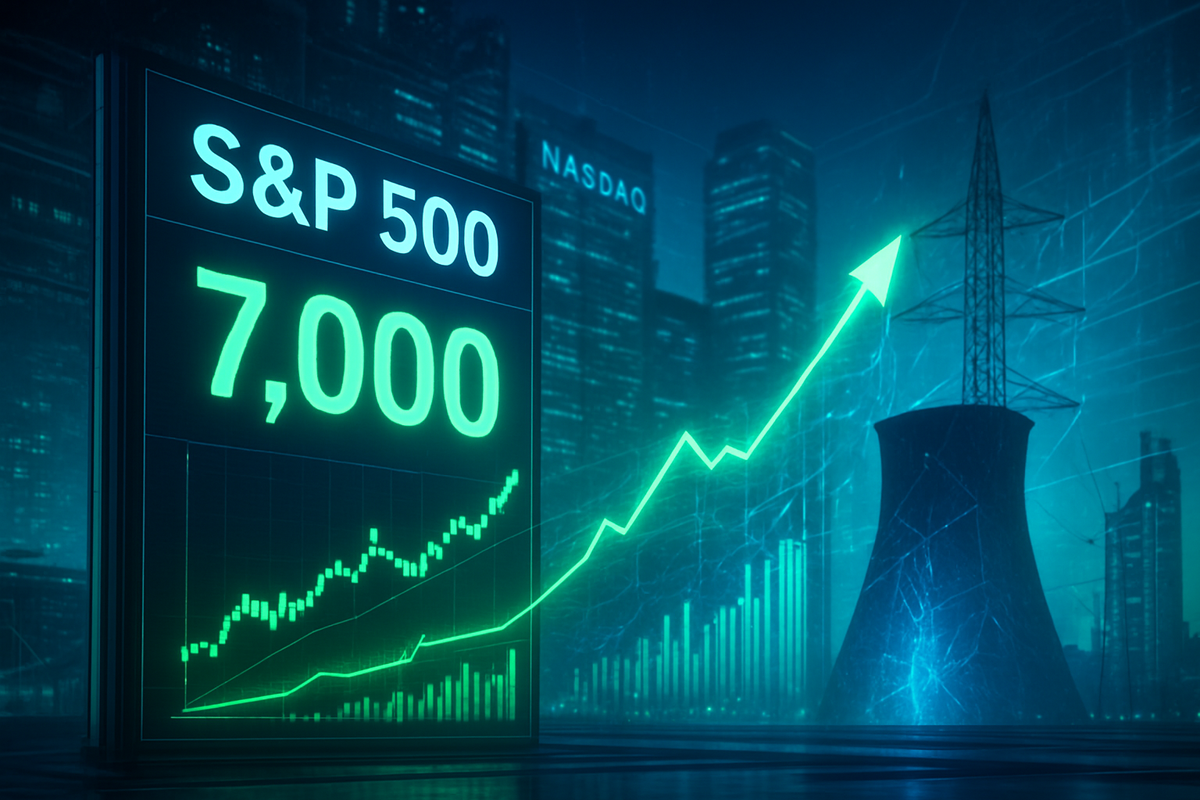
The S&P 500 index opened the 2026 trading year with a definitive technical breakout on January 2nd, surging past critical resistance levels and signaling a robust start to the new year. After a frustrating "Santa Stall" that saw the market endure a four-day losing streak to close out 2025, the index roared back to life, clearing the 6,920 mark and setting its sights on the psychological milestone of 7,000. This early momentum suggests that the broad U.S. market is ready to capitalize on a unique blend of fiscal stimulus and a stabilizing interest rate environment.
The immediate implications of this breakout are significant for both institutional and retail investors. The reversal of the year-end weakness indicates that the late-December dip was a period of consolidation rather than a fundamental shift in sentiment. With the "One Big Beautiful Bill Act" (OBBBA) beginning to inject hundreds of billions of dollars into the economy via tax refunds and corporate incentives, the market appears to be pricing in a sustained period of growth, even as the Federal Reserve navigates a "shallow easing" path for interest rates.
A Technical Rebirth After the "Santa Stall"
The path to this January breakout was paved with volatility. To close out 2025, the S&P 500 experienced a rare four-day losing streak between December 26th and December 31st. This year-end slump narrowly snapped a seven-month winning streak, leaving the index with a modest 0.05% loss for the month of December. While the index still finished 2025 up a staggering 16.39%, the late-year fatigue raised questions about whether the bull market was finally running out of steam.
However, the opening bell of 2026 told a different story. On January 2nd, the S&P 500 decisively cleared the 6,920 level, a resistance zone that had capped gains since late October. The move was fueled by a surge in risk appetite as traders reacted to better-than-expected manufacturing data and the formal rollout of the "Trump Accounts" savings program. By mid-day, the index was testing its all-time high of 6,932, with technical analysts identifying a clear path toward a target of 7,270.
The key players in this rally were not just the usual technology titans but a broader coalition of sectors. While the Federal Reserve, led by its current board, maintained a benchmark rate in the 3.5%–3.75% range, the market began pricing in two to three additional quarter-point cuts for the remainder of 2026. This optimism, combined with the anticipation of massive tax refunds hitting consumer bank accounts in the first quarter, provided the necessary fuel for the breakout.
Winners and Losers in the New Regime
The early 2026 rally has highlighted a shift in market leadership, with the "Application Era" of AI and the "Nuclear Renaissance" taking center stage. Microsoft (NASDAQ: MSFT) and Alphabet (NASDAQ: GOOGL) emerged as early winners, as investors pivoted from hardware providers to software companies demonstrating tangible ROI from "agentic" AI. Palantir (NYSE: PLTR) also saw significant gains, bolstered by its success in securing large-scale government and enterprise contracts for its AI-driven operating systems.
In the energy sector, the "AI-Energy Nexus" has created a new class of market darlings. Constellation Energy (NASDAQ: CEG) and Vistra Corp (NYSE: VST) reached new highs on January 2nd, as the demand for 24/7 nuclear power to fuel massive data centers became a dominant investment theme. Meanwhile, next-generation players like Oklo (NYSE: OKLO) and NuScale Power (NYSE: SMR) gained momentum as the market began to price in the long-term potential of Small Modular Reactors (SMRs) to stabilize the aging U.S. power grid.
The financial sector also saw a resurgence, led by JPMorgan Chase (NYSE: JPM) and Interactive Brokers (NASDAQ: IBKR). These firms are positioned to benefit from the OBBBA’s wealth transfer provisions and the influx of liquidity from the new "Trump Accounts." Conversely, companies heavily dependent on low-income discretionary spending—particularly those without exposure to the "No Tax on Tips" boost—faced headwinds as "sticky" core inflation, projected at 3.1% for early 2026, continued to pressure household budgets.
Fiscal Stimulus and the "Great Re-Shoring"
The current market momentum is inextricably linked to the One Big Beautiful Bill Act (OBBBA), signed into law in mid-2025. This legislation has fundamentally altered the economic landscape by making 100% expensing for capital equipment and domestic R&D permanent. This "Great Re-Shoring" initiative has incentivized a surge in domestic manufacturing, benefiting industrial giants and regional players alike. The act's impact is expected to peak in Q1 2026, as an estimated $150 billion to $520 billion in tax refunds begin to circulate through the economy.
Furthermore, the introduction of "Trump Accounts"—federally backed, tax-deferred savings accounts for children—has created a new, permanent floor for market liquidity. With major financial institutions like Charles Schwab (NYSE: SCHW) and BlackRock (NYSE: BLK) matching federal seed deposits, billions of dollars are being funneled into index funds and ETFs. This structural shift toward long-term retail participation is reminiscent of the 401(k) boom of the 1980s, providing a stable source of capital that may dampen future market volatility.
Historically, a strong start in January often sets the tone for the entire year, a phenomenon known as the "January Indicator." The 2026 breakout bears a resemblance to the post-pandemic recovery of 2021, where fiscal intervention and technological breakthroughs combined to drive the market to then-unprecedented heights. However, the current environment is unique due to the focus on "Space Infrastructure," with companies like Rocket Lab (NASDAQ: RKLB) and Intuitive Machines (NASDAQ: LUNR) being repriced as the industry prepares for a potential SpaceX IPO later this year.
The Path to 7,500 and Beyond
Looking ahead, the short-term focus for the S&P 500 will be the psychological barrier of 7,000. If the index can hold its current breakout levels, analysts expect a steady climb toward 7,270 by the end of the second quarter. The primary challenge will be managing the "K-shaped" recovery, where high-growth sectors thrive while traditional retail and consumer staples struggle with the tail end of inflationary pressures. Strategic pivots toward AI integration and domestic supply chain resilience will be required for companies to remain competitive in this high-cost environment.
In the long term, the market's trajectory will depend on the successful implementation of the OBBBA's secondary phases and the Fed's ability to achieve a "soft landing" as it moves toward a terminal rate of 3.0%. The emergence of the space economy and the continued scaling of nuclear energy provide long-term structural tailwinds that could sustain the bull market well into the late 2020s. However, any resurgence in inflation or geopolitical instability in the satellite corridors could pose significant risks to this optimistic outlook.
Market Wrap-Up and Investor Outlook
The S&P 500’s breakout on January 2, 2026, marks a pivotal moment for the U.S. economy. By shaking off the year-end "Santa Stall," the market has demonstrated a resilient appetite for growth, supported by aggressive fiscal policy and a transformative technological landscape. The key takeaways for investors are the broadening of market leadership into financials, utilities, and space infrastructure, and the massive liquidity injection expected from upcoming tax refunds and the "Trump Accounts" program.
Moving forward, the market appears positioned for a year of "execution" rather than just "expectation." Investors should closely watch for the Q1 earnings season to see if the promised AI efficiencies are finally hitting the bottom line of the S&P 500’s largest constituents. While the path to 7,000 seems clear, the real test will be whether the broad market can maintain this momentum as the temporary boost from tax refunds begins to fade later in the year. For now, the bulls are firmly in control as 2026 begins on a historic high note.
This content is intended for informational purposes only and is not financial advice.