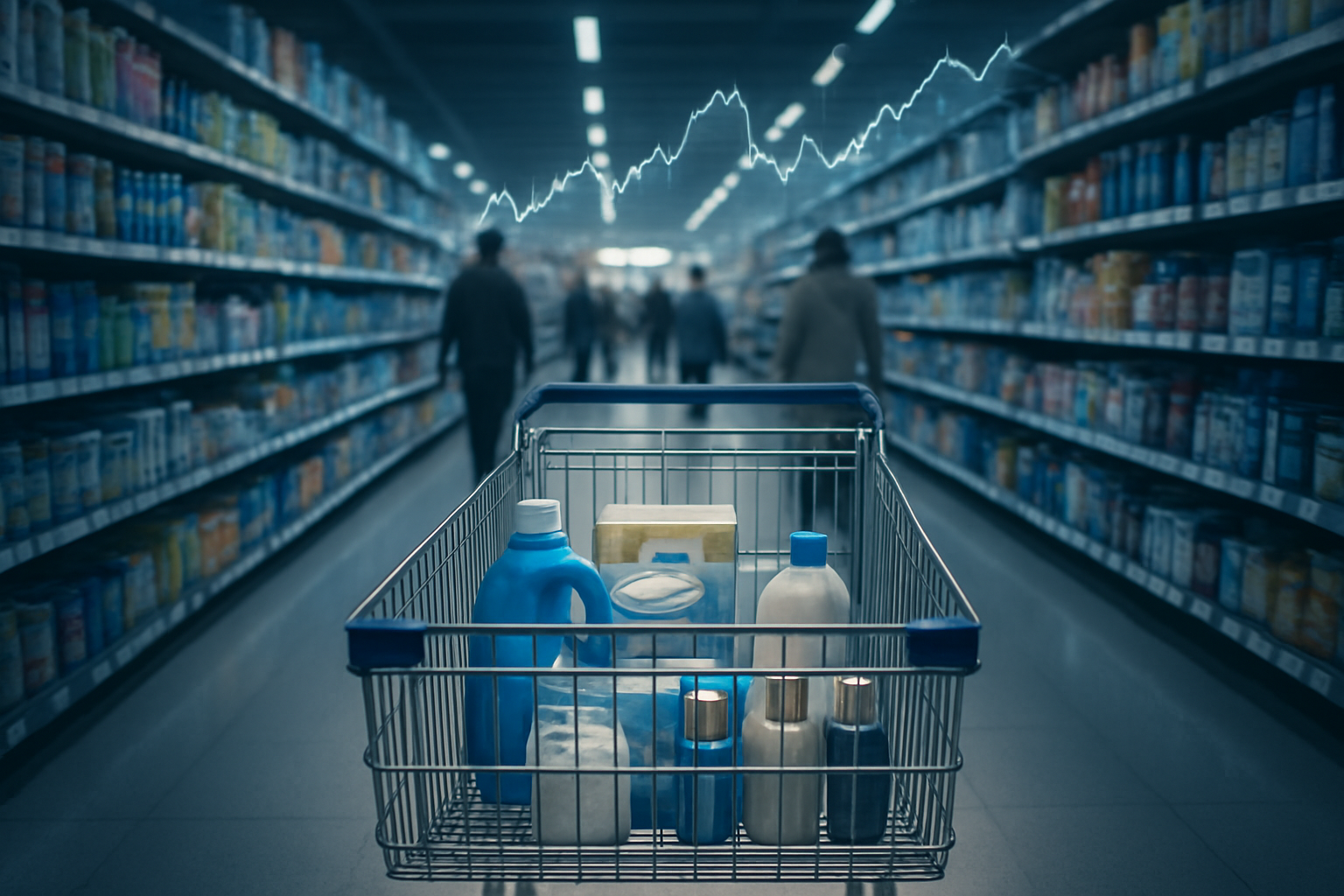
As of January 20, 2026, the consumer staples landscape is witnessing a pivotal moment for its undisputed leader, Procter & Gamble (NYSE: PG). Just weeks after the company underwent a historic leadership transition, the market is bracing for a high-stakes second-quarter earnings report. P&G is currently navigating a complex "scissors" effect: on one side, it is attempting to push premium innovation to justify higher price tags; on the other, it faces a global consumer base that is increasingly weary of inflationary pressures and a looming $500 million headwind from newly implemented trade tariffs.
The immediate implications are clear: the era of "easy" price-driven growth that characterized the 2023-2024 recovery has largely evaporated. While the company’s most recent official financial data from the first quarter of fiscal 2026 showed a resilient 2% organic sales growth, that growth was entirely dependent on a 1% price increase and a 1% favorable product mix. Global volume—the raw number of boxes of Tide and packs of Pampers leaving shelves—remained flat, signaling that the "P&G premium" may finally be testing the limits of consumer elasticity.
In its most recent quarterly performance reported in late 2025, Procter & Gamble managed to beat earnings expectations with a core EPS of $1.99, a 3% increase year-over-year. However, the internal mechanics of that beat revealed a company in the midst of a significant structural pivot. While the Beauty segment saw a robust 6% organic growth—driven largely by high-end innovations in hair care—the Fabric & Home Care and Baby Care divisions were notably stagnant. In Europe and parts of North America, the company has seen consumers shift away from "mid-tier" products, either trading up to ultra-premium performance items or trading down to "value" formats.
A key development leading up to this month's anticipated report was the conclusion of Jon Moeller’s tenure as CEO. On January 1, 2026, Shailesh Jejurikar officially took the helm as President and CEO, becoming the first person of Indian origin to lead the company. Jejurikar inherits a multi-year "Supply Chain 3.0" restructuring plan that includes the elimination of approximately 7,000 non-manufacturing roles—roughly 15% of that workforce—aimed at saving $1.5 billion to fund further marketing and R&D.
The timeline for these changes has been aggressive. Throughout the final months of 2025, P&G began exiting low-margin businesses, such as its laundry bar operations in India and the Philippines, and transitioned to a distribution-only model in Pakistan. These moves were designed to insulate the bottom line from currency volatility and high operating costs, but they also created a 30 to 50 basis point headwind on total sales growth that investors are still digesting.
Initial market reactions to this transition have been cautiously optimistic, with the stock maintaining a premium valuation relative to its peers. However, the focus has shifted entirely to the January 22, 2026, earnings call, where Jejurikar will have to address how the company plans to offset the aforementioned $400 million to $500 million in tariff-related costs that have emerged as a significant inflationary threat since the start of the new calendar year.
The current economic climate creates a landscape of distinct winners and losers. Within the P&G portfolio, the "winners" are clearly the premium health and beauty brands. SK-II and Olay (NYSE: PG) have seen a surprising resurgence in Greater China, which grew 5% in the last reported quarter. This suggests that despite broader economic malaise in Asia, the affluent consumer is still willing to pay for perceived "scientific" superiority in skincare. Conversely, the "losers" are P&G’s family care brands, such as Luvs and Bounty, which are facing intense "promotional heat" from private-label competitors.
Direct competitors like Kimberly-Clark (NYSE: KMB) and Unilever (NYSE: UL) stand to benefit if P&G is forced to raise prices further to combat tariff costs. If P&G pushes the price of Pampers too high, Kimberly-Clark's Huggies could find an opening to reclaim market share through aggressive discounting. Unilever, which has been undergoing its own simplification strategy, may also find an advantage in its broader geographical footprint, which is slightly less exposed to the specific North American tariff pressures currently weighing on P&G.
Retail giants like Walmart (NYSE: WMT) find themselves in a complex position. On one hand, higher prices at P&G can lead to higher dollar sales for the retailer; on the other, Walmart has been vocal about its desire to keep prices low to drive foot traffic. If P&G insists on further hikes, Walmart may increase the shelf space dedicated to its "Great Value" private-label brands, which directly compete with P&G's entry-level offerings. This "battle for the shelf" is likely to intensify in the first half of 2026 as both parties fight to protect their margins.
P&G's current predicament is a bellwether for the entire consumer staples sector. For years, these companies were the "safe havens" for investors, able to pass on any cost increase to the consumer. But the current trend suggests a "bifurcation" of the market. High-income consumers are continuing to spend, while middle-and-low-income households are adopting sophisticated "value-seeking" strategies, such as buying in bulk or switching to generic brands for non-essential items. This fits into a broader industry trend where "mass-tige" (mass prestige) is the only category seeing reliable volume growth.
Historically, this mirrors the late-inflationary cycles of the 1970s and early 1980s, where volume growth eventually stalled as price hikes became unsustainable. P&G is attempting to break this cycle through "Supply Chain 3.0," utilizing AI and localized manufacturing to reduce the time it takes to get products to market. If successful, this could set a new industry standard for how global giants handle logistical disruptions and trade wars, potentially forcing competitors to accelerate their own automation and restructuring plans.
The regulatory and policy environment also looms large. The $500 million tariff headwind is not just a P&G problem; it is a signal of a broader shift toward protectionism that could hit other sectors like beauty and cosmetics hard. Estée Lauder (NYSE: EL), for instance, shares many of P&G's supply chain risks. As P&G navigates these policies, its success or failure in maintaining margins without losing volume will be a closely watched case study for the Federal Reserve and trade policymakers alike.
In the short term, the market will be laser-focused on P&G's guidance for the remainder of fiscal 2026. The current forecast of "flat to 4%" growth for both sales and EPS leaves a lot of room for interpretation. If the company stays at the bottom end of that range, it could signal a "consumer recession" is finally taking hold. A strategic pivot toward even more aggressive cost-cutting or further divestitures of underperforming brands may be required if the tariff impact exceeds management's current $500 million estimate.
Long-term, the Jejurikar era will likely be defined by "digital-first" innovation. P&G is increasingly moving toward subscription models and direct-to-consumer digital commerce to bypass traditional retail hurdles. The success of premium digital-first launches, like the Tide evo tiles, will determine if P&G can truly decouple its growth from the traditional "volume vs. price" trap. The challenge will be doing this while managing a global workforce that is currently being thinned by 7,000 roles, a move that carries significant execution risk.
Procter & Gamble remains the ultimate defensive stock, but even the best defenses can be breached by the combined forces of "sticky" inflation, trade volatility, and shifting consumer loyalties. The core takeaway from the latest data is that P&G is no longer just a "soap and diaper" company; it is a high-tech manufacturing and branding machine that is betting its future on the idea that consumers will always pay more for a product that clearly works better.
Moving forward, the market will transition from watching what P&G sells to how it sells it. Investors should keep a sharp eye on "volume growth" in the upcoming January 22 report. If volume remains flat or turns negative while pricing stays positive, it will be a clear sign that the company’s "superiority" strategy is hitting a ceiling. Furthermore, any adjustment to the $15 billion planned return to shareholders—including $10 billion in dividends—would be a major red flag regarding the company's cash flow confidence.
As we move deeper into 2026, P&G stands as a litmus test for the global economy. If it can successfully navigate the transition to a new CEO while absorbing half a billion dollars in new costs, it will prove that its "Supply Chain 3.0" and "Superiority" strategies are more than just corporate buzzwords. For now, the consumer giant is walking a tightrope, and the winds of inflation and trade policy are only blowing harder.
This content is intended for informational purposes only and is not financial advice