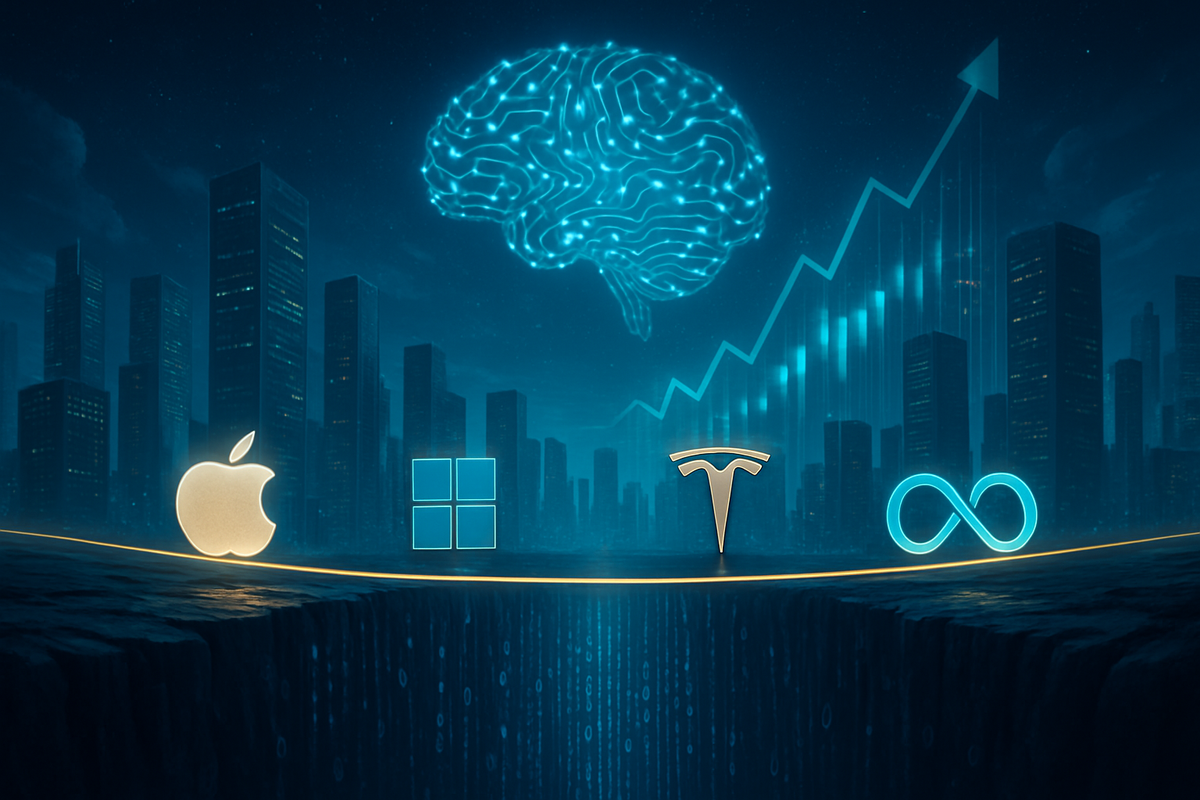
As the calendar turns to the final week of January 2026, the global financial markets are bracing for a high-stakes gauntlet of earnings reports from the heavyweights of the "Magnificent 7." Over the next four days, four of the world’s most influential technology firms—Meta Platforms Inc. (NASDAQ: META), Microsoft Corporation (NASDAQ: MSFT), Tesla Inc. (NASDAQ: TSLA), and Apple Inc. (NASDAQ: AAPL)—will pull back the curtain on their fourth-quarter performance. This pivotal week arrives at a moment of extreme tension: the S&P 500 (NYSEARCA:SPY) enters the reporting period having achieved three consecutive years of double-digit gains, yet it remains tethered to a narrow band of mega-cap leaders that now account for an unprecedented 35% of the index’s total weight.
The immediate implications for the broader market are profound. With the "Great Rotation" toward small-cap stocks gaining steam earlier this month, any sign of slowing growth or "AI fatigue" from the tech giants could trigger a systemic correction. Conversely, if these firms can prove that their multi-billion-dollar capital expenditures are finally yielding tangible returns through agentic AI and next-generation hardware, they may provide the rocket fuel needed to propel the market through its latest bout of choppy volatility.
The Gauntlet Begins: A Timeline of High Expectations
The earnings marathon kicks off on Wednesday, January 28, with a double-header from Meta and Microsoft. For Meta Platforms Inc. (NASDAQ: META), the narrative has shifted from "efficiency" to "superintelligence." Analysts are looking for revenue of approximately $58.33 billion, a 21% year-over-year increase, driven by a surge in production for its Ray-Ban AI glasses and the successful integration of its agentic AI model. However, the shadow of a $100 billion infrastructure budget for 2026 looms large. Investors, who have been remarkably patient with CEO Mark Zuckerberg’s "Capital Inferno," are now demanding proof that AI agents are converting into higher ad yields and subscription revenue.
Simultaneously, Microsoft Corporation (NASDAQ: MSFT) will report its results, with the market laser-focused on Azure’s 36% projected growth. The Redmond giant is currently grappling with capacity constraints in its data centers, making its updates on capital expenditure and the rollout of "Agent 365" critical. While Microsoft has historically been viewed as a safe haven, the looming legal battle between Elon Musk and OpenAI—set for trial in March 2026—has introduced a fresh layer of uncertainty regarding Microsoft’s long-term intellectual property rights over the models that power its software suite.
The week concludes on Thursday, January 29, with Apple Inc. (NASDAQ: AAPL) and Tesla Inc. (NASDAQ: TSLA). Apple is expected to report a revenue powerhouse of $138.25 billion, fueled by a "Pro-heavy" iPhone 17 mix. The requirement for 12GB of RAM to run advanced Apple Intelligence features has pushed consumers toward higher-margin models, boosting average selling prices to record levels. Meanwhile, Tesla faces a much steeper climb. Following the expiration of the federal EV tax credit in September 2025, the automaker saw a sharp 16% decline in vehicle deliveries. The market’s reaction will likely hinge on whether CEO Elon Musk can pivot the narrative toward the record profitability of Tesla’s Energy Storage segment and the upcoming Robotaxi rollout.
Winners, Losers, and the High Stakes of Tech Leadership
In this high-valuation environment, the margin for error has evaporated. Meta appears to be entering the week as a potential "winner," largely due to its successful hardware pivot. Unlike competitors who struggled with bulky headsets, Meta’s lightweight AI glasses have reportedly doubled their production output for the 2026 cycle. This hardware success provides a physical gateway for their AI ecosystem, a feat that has eluded even Apple, which has reportedly scaled back production on its Vision Pro line due to lukewarm consumer adoption of high-end spatial computing.
On the other end of the spectrum, Tesla finds itself in a precarious "loser" position for the quarter. The EPS consensus of $0.44 represents a staggering 40% year-over-year decline. The loss of tax incentives has revealed a softening in core EV demand that even aggressive price cuts have struggled to solve. While Nvidia Corporation (NASDAQ: NVDA) and Broadcom Inc. (NASDAQ: AVGO) continue to benefit from the infrastructure build-out, Tesla’s transition from a car company to an AI and robotics firm is being tested by the harsh reality of current balance sheets. If Tesla cannot provide a concrete timeline for its Optimus robotics line, it risks losing its "Magnificent" status to rising semiconductor stars.
Apple and Microsoft remain the steady anchors, but their challenges are structural. Apple’s reclamation of a 22% market share in China is a significant victory, yet the underwhelming demand for its ultra-thin "iPhone 17 Air" suggests that hardware innovation may be hitting a plateau. For Microsoft, the challenge is valuation. Trading at over 28 times its 2026 earnings, the company must deliver a "beat and raise" of significant proportions to satisfy a market that is increasingly looking for reasons to diversify into the Russell 2000.
A Historical Echo: Concentration and the Regulatory Pincer
The current market environment mirrors the "Nifty Fifty" era of the 1970s and the 2000 Dot-com bubble, yet with a modern twist. The top 10 stocks in the S&P 500 now command nearly 40% of the index’s weight, a level of concentration that far exceeds the 26% seen at the peak of the 1990s tech boom. While today’s leaders like Alphabet Inc. (NASDAQ: GOOGL) and Amazon.com Inc. (NASDAQ: AMZN) are significantly more profitable than their 2000-era counterparts, the systemic risk is higher. A single earnings miss from this cohort can—and often does—drag the entire index into the red, regardless of how the other 493 stocks perform.
Furthermore, 2026 has ushered in a "Constitutional Crisis" regarding AI regulation. The implementation of the EU AI Act’s strict "Code of Practice" and the start of California’s SB 53 transparency laws on January 1st have created a complex compliance maze. At the same time, the U.S. federal government is actively challenging these state laws in court, arguing for a deregulated national framework. This regulatory friction adds a hidden cost to the "Magnificent 7" that isn't always captured in quarterly EPS figures but could impact long-term margins as firms are forced to build human oversight "kill switches" and bias mitigation systems into their core products.
The Road Ahead: Agentic AI and the March Toward AGI
Looking beyond this week’s numbers, the market is entering a phase of strategic pivots. The shift from "Chatbots" to "Agentic AI"—systems that can autonomously execute complex tasks across platforms—is the next frontier. Microsoft and Meta are currently leading this charge, but the transition requires a massive increase in energy consumption and data center investment. Analysts will be listening closely for updates on "Superintelligence Infrastructure" and how these companies plan to navigate the looming energy shortages that have become a bottleneck for AI expansion in 2025.
The short-term focus will remain on the Musk vs. OpenAI trial scheduled for March 16, 2026. This legal battle could redefine the ownership of Artificial General Intelligence (AGI) and potentially disrupt the exclusive partnerships that have defined the AI race so far. Investors should prepare for a period of "information discovery," where the primary driver of stock prices shifts from interest rate expectations to the actual utility and ROI of the AI models currently being deployed.
The Final Verdict for Investors
This earnings week is more than just a reporting cycle; it is a referendum on the AI era’s second phase. The key takeaways for investors are clear: concentration remains at historic highs, and the market is increasingly bifurcated between the "infrastructure winners" and those struggling with consumer demand shifts. While the S&P 500 has been resilient, the "choppy but firm" action of January 2026 suggests that the easy gains of the last three years are over.
Moving forward, the market will likely reward companies that can prove they are monetizing AI at the software level rather than just spending on hardware. Watch for Apple’s Services growth and Meta’s advertising margins as the "canaries in the coal mine." As we move into the spring, the focus will shift from the boardrooms to the courtrooms, where the future of AI regulation and ownership will be decided. For now, the "Magnificent 7" still hold the keys to the kingdom, but the locks are getting harder to turn.
This content is intended for informational purposes only and is not financial advice.