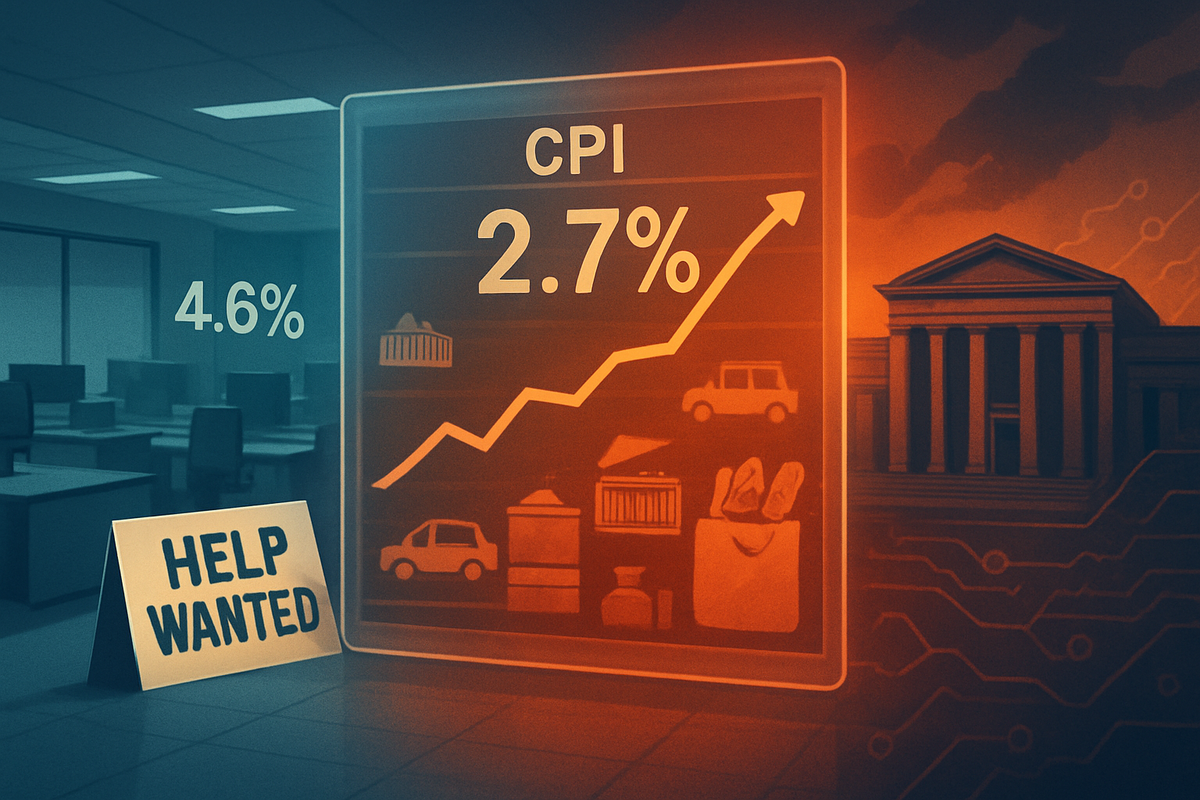
As the sun rises on 2026, the American economy finds itself at a precarious crossroads. On Wednesday, January 7, 2026, the ADP National Employment Report sent shockwaves through the financial markets, revealing that private employers added a meager 41,000 jobs in December 2025. This figure not only missed the consensus forecast of 47,000 but also highlighted a stark cooling from the robust hiring seen just eighteen months ago. With the unemployment rate hovering at a four-year high of 4.6%, the narrative of a "resilient labor market" is rapidly being replaced by concerns over a potential structural slowdown.
The immediate implications of this data are profound. The Federal Reserve, which spent the better part of 2025 attempting to orchestrate a "soft landing," now faces a conflicting set of signals. While the labor market is clearly showing signs of distress, inflation remains stubbornly "sticky" at 2.7%, well above the central bank’s 2% target. This "stagflation-lite" environment is complicating the Federal Open Market Committee's (FOMC) path, as they must now weigh the risks of a deepening employment slump against the possibility that aggressive rate cuts could reignite price pressures—especially with a new regime of aggressive tariffs taking effect.
Labor Market Cracks and the Inflationary Backlog
The December jobs data represents the culmination of a volatile quarter defined by both policy shifts and administrative hurdles. The 41,000-job gain reported by ADP is the latest in a string of disappointing figures that began to emerge following the 43-day government shutdown in late 2025. That shutdown created a massive data backlog at the Bureau of Labor Statistics (BLS), leaving investors and policymakers flying partially blind for weeks. The current "low-hire, low-fire" environment suggests that while mass layoffs have not yet materialized, the engine of job creation has stalled as businesses grapple with the dual pressures of high borrowing costs and rising input prices from the new "Baseline Reciprocal Tariffs."
Key players in this unfolding drama include Federal Reserve Chair Jerome Powell, whose term is set to expire in May 2026, and an incoming administration that has aggressively pushed the "One Big Beautiful Bill Act" (OBBBA). The OBBBA, signed into law in mid-2025, was designed to buffer the economy with tax cuts for tips and overtime, yet the "tariff pass-through" effects on consumer goods are keeping the Consumer Price Index (CPI) from falling further. Initial market reactions to the January 7 data were swift: Treasury yields dipped as traders bet on more aggressive Fed intervention, while the S&P 500 saw a rotation out of growth-sensitive sectors and into defensive havens.
Winners and Losers in the 2026 Rotation
The current economic climate has created a "K-shaped" divergence among public companies. In the financial sector, JPMorgan Chase & Co. (NYSE: JPM) has emerged as a primary beneficiary. The bank is successfully navigating the "higher-for-longer" neutral rate environment, and its massive scale allows it to absorb the OBBBA’s new tax incentives for domestic loan portfolios. Similarly, the utility sector is experiencing a renaissance. NextEra Energy, Inc. (NYSE: NEE) and Constellation Energy Corp (NASDAQ: CEG) are winning as they provide the essential power for the ongoing AI data center boom, offering investors both defensive stability and structural growth.
Conversely, the "Magnificent Seven" and major retailers are facing significant headwinds. Apple Inc. (NASDAQ: AAPL) has seen its margins squeezed by a 25% tariff on hardware manufactured in India and even steeper levies on Chinese components. Nvidia Corp (NASDAQ: NVDA) also remains volatile; while demand for its chips is insatiable, the 32% tariff on Taiwan-manufactured semiconductors is increasing the cost of capital for its primary customers. In the retail space, Walmart Inc. (NYSE: WMT) is struggling to maintain its fiscal 2026 profit forecasts as it absorbs the costs of the 10% baseline reciprocal tariff, finding it difficult to pass these costs onto a consumer base that is already feeling the pinch of 4.6% unemployment.
Policy Clashes: OBBBA vs. The Tariff Regime
The broader significance of the current data lies in the unprecedented tug-of-war between fiscal stimulus and trade protectionism. The OBBBA is expected to inject between $100 billion and $150 billion into the economy through tax refunds in early 2026. This fiscal "bazooka" is intended to support domestic consumption and incentivize "Made in America" manufacturing. However, this stimulus is colliding head-on with a trade policy that includes 25% tariffs on imports from Mexico and 35% on Canada. This has created a "policy trap" where the Fed’s traditional tools may be less effective.
Historically, the Phillips Curve suggested an inverse relationship between unemployment and inflation, but 2026 is proving to be an outlier. The breakdown of global supply chains and the shift toward domestic-centric manufacturing are keeping prices high even as demand for labor softens. This mirrors some of the supply-side shocks seen in the 1970s, though today’s economy is bolstered by far more advanced technology and a more flexible workforce. The regulatory landscape is also in flux, with a pending Supreme Court ruling on the legality of broad-based executive tariffs looming over the market like a Damoclean sword.
The Path to the January FOMC Meeting
Looking ahead, the short-term focus remains on the FOMC meeting scheduled for January 27–28, 2026. Markets are currently pricing in an 84% probability that the Fed will hold rates steady at 3.50%–3.75%. The central bank is likely to adopt a "wait-and-see" approach, hoping for "cleaner" data once the government shutdown backlog is fully cleared. However, if the official BLS report on January 9 confirms the ADP's weakness, the pressure for a "dovish pivot" will become deafening.
Strategic pivots will be required for companies reliant on international supply chains. We are likely to see an acceleration of "friend-shoring" to countries that have secured "framework agreements" with the U.S., such as the UK and Japan, to avoid the 10% baseline tariff. For investors, the long-term scenario involves a transition to a "new neutral" where interest rates remain higher than the post-2008 era, but lower than the 2023 peaks, as the economy adjusts to a more localized, tariff-protected manufacturing base.
Summary and Investor Outlook
The surprise jobs data of early 2026 has served as a wake-up call for a market that may have been too optimistic about a painless transition to lower inflation. The key takeaway is that the labor market is no longer the indestructible engine it once was, and "sticky" inflation—driven by trade policy rather than just consumer demand—is limiting the Federal Reserve's room for maneuver. The "Great Rotation" into quality, defensive, and domestic-heavy stocks is likely to continue as the "Magnificent Seven" era of undisputed dominance faces its toughest regulatory and economic challenge yet.
Moving forward, investors should watch for the official BLS employment figures on January 9 and the CPI release on January 13. These data points will determine whether the Fed stays the course or is forced into an emergency cut to prevent 4.6% unemployment from spiraling into a recession. The 2026 landscape is one of high volatility but significant opportunity for those positioned in domestic infrastructure and high-quality financials.
This content is intended for informational purposes only and is not financial advice.