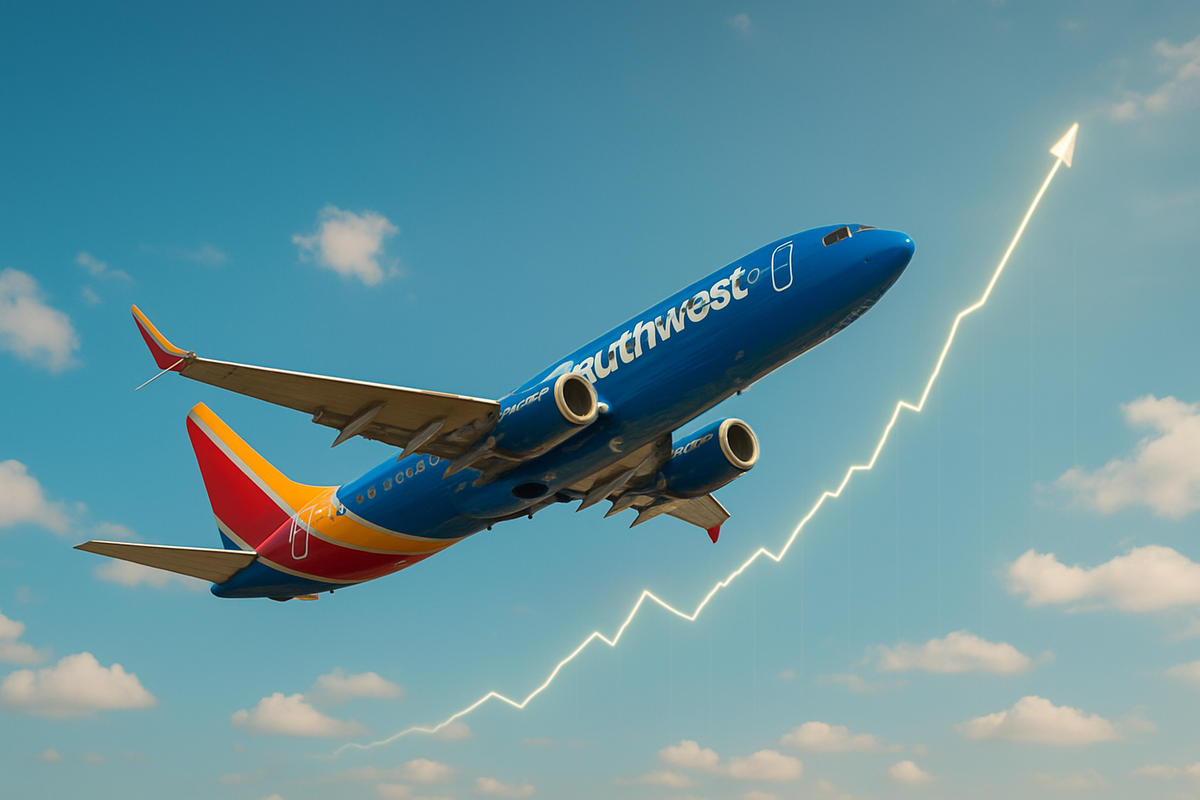
In a dramatic shift of sentiment that has electrified the aviation sector, Southwest Airlines (NYSE: LUV) received a massive vote of confidence today as analysts at JPMorgan issued a rare "double upgrade" for the carrier. The move, which vaulted the stock from "Underweight" directly to "Overweight," comes at a critical juncture as the Dallas-based airline prepares to report its fourth-quarter earnings and embark on the most significant business model transformation in its 55-year history.
The market response was immediate and decisive. Shares of Southwest Airlines (NYSE: LUV) surged nearly 4% in early trading on January 9, 2026, breaking through a multi-year technical resistance level to hit a fresh 52-week high of $44.61. This breakout signals that institutional investors are finally buying into the airline’s plan to abandon its "open seating" heritage in favor of assigned seats, premium cabins, and a more traditional revenue-management strategy aimed at capturing higher-margin travelers.
A $60 Price Target: The Math Behind the Upgrade
The catalyst for today’s market movement was a comprehensive research note from JPMorgan analyst Jamie Baker, who hiked his price target for Southwest from $36.00 to a Wall Street-high of $60.00. Baker’s thesis centers on an "EPS surprise" that he believes the broader market is currently underestimating. While the consensus among analysts had been hovering around a $3.00 earnings per share (EPS) forecast for fiscal year 2026, JPMorgan is now projecting that Southwest could deliver as much as $5.00 per share as its new revenue initiatives take hold.
This upgrade marks the culmination of a turbulent 18-month period for Southwest. Following intense pressure from activist investors at Elliott Management throughout 2024 and 2025, the airline’s leadership committed to a radical overhaul of its "LUV" brand. The timeline leading to today’s breakout included the September 2025 announcement of assigned seating and the subsequent rollout of "Southwest Premium"—a new class of service offering extra legroom. Analysts now believe these changes, combined with a new "Basic Economy" tier, will allow the airline to segment its customer base more effectively and compete directly with legacy carriers for lucrative business travelers.
Initial market reactions suggest that the "Southwest Turnaround" is no longer a speculative play but a fundamental reality. The stock’s ability to clear the $40.35 resistance level—a ceiling that had capped gains for much of late 2025—indicates a significant shift in technical momentum. With the stock now trading well above its 50-day and 200-day moving averages, technical analysts are pointing to a "Golden Cross" formation that could support a primary bullish trend throughout the first quarter of 2026.
Winners and Losers in the Premium Pivot
The primary winner in this scenario is undoubtedly Southwest Airlines (NYSE: LUV) itself, which has successfully navigated internal leadership changes and external activist pressure to emerge with a clearer strategic vision. However, the ripple effects extend to the broader aerospace ecosystem. Aircraft manufacturer Boeing (NYSE: BA) stands to benefit as Southwest continues to modernize its fleet with 737 MAX aircraft designed to accommodate the new cabin configurations. The partnership with Turkish Airlines, set to begin in early 2026, also positions Southwest as a more formidable player in the international code-sharing market, potentially boosting traffic through its major hubs.
On the other side of the ledger, legacy competitors such as Delta Air Lines (NYSE: DAL) and United Airlines (NASDAQ: UAL) may face new headwinds. For years, Delta and United have enjoyed a near-monopoly on the "premium domestic" segment, charging high fares for extra legroom and assigned seats. As Southwest enters this space with its massive domestic network and historically lower cost structure, a "premium price war" could emerge, potentially squeezing margins for the incumbents who have grown accustomed to little competition in the high-yield cabin.
Ultra-low-cost carriers (ULCCs) like Spirit Airlines (NYSE: SAVE) and Frontier Group Holdings (NASDAQ: ULCC) are also in a precarious position. As Southwest introduces its own "Basic Economy" product, the price gap between a full-service Southwest flight and a bare-bones ULCC flight narrows. This puts further pressure on the budget airlines to justify their existence in an environment where even the "friendly" carrier is now fighting for every dollar of the price-sensitive market.
The End of the Low-Cost Era and the Rise of the Hybrid
The double upgrade of Southwest is more than just a stock call; it is a signifier of a broader industry trend toward "premiumization." The historical divide between "low-cost carriers" and "legacy carriers" is rapidly dissolving into a "hybrid" model. Southwest’s move to assigned seating represents the final nail in the coffin for the pure-play low-cost model in the United States, as airlines realize that passengers are increasingly willing to pay for certainty and comfort, even on short-haul flights.
This event also serves as a case study in the power of activist intervention. The role of Elliott Management in forcing these changes cannot be overstated. By challenging the "status quo" management style that had defined Southwest for decades, the activists catalyzed a modernization effort that many analysts believe was ten years overdue. This sets a precedent for other established companies in the transportation sector: historical brand identity will not protect a company from market demands for higher capital returns and modernized service offerings.
Furthermore, the regulatory environment is watching closely. As Southwest shifts its model, the Department of Transportation (DOT) has been increasingly vocal about "junk fees" and transparency in airline pricing. Southwest’s challenge will be to implement its new tiered pricing and seating fees without drawing the ire of regulators who have recently praised the airline for its consumer-friendly policies, such as "Bags Fly Free."
What to Watch: The January 29 Earnings Catalyst
Looking ahead, the next major milestone for Southwest is its fourth-quarter 2025 earnings report, scheduled for January 29, 2026. While the JPMorgan upgrade has set the stage, the airline must now deliver on the numbers. Investors will be looking for specific guidance regarding the 2026 fiscal year to see if management validates the $5.00 EPS bull case. Any deviation from these high expectations could lead to short-term volatility as the market recalibrates.
In the short term, the physical modification of the Southwest fleet will be the primary operational challenge. Retrofitting hundreds of aircraft with new seats and premium sections while maintaining a high-utilization schedule is a logistical tightrope. Any delays in this rollout could dampen the revenue benefits expected in the second half of 2026. Long-term, the success of the Turkish Airlines partnership will serve as a bellwether for Southwest’s international ambitions and its ability to compete as a global brand rather than just a domestic workhorse.
Final Assessment: A New Flight Path for LUV
The double upgrade from JPMorgan and the subsequent technical breakout mark a "coming of age" moment for the new Southwest Airlines. The transition from a quirky, open-seating carrier to a sophisticated, multi-class airline is being met with open arms by a market hungry for growth and margin expansion. By breaking through the $44 resistance level, Southwest has signaled that the "turnaround story" is transitioning into an "execution story."
Investors should watch for three key indicators in the coming months: the pace of cabin retrofits, the initial take-rate of the new premium seating options, and any shifts in the competitive pricing environment from Delta and United. While the risks of a business model transformation are always present, the technical and fundamental alignment seen this week suggests that Southwest is well-positioned to reclaim its spot as a leader in airline profitability.
For the first time in years, the "LUV" for Southwest on Wall Street appears to be backed by more than just sentiment—it is backed by a cold, hard calculation of earnings potential in a new era of aviation.
This content is intended for informational purposes only and is not financial advice.