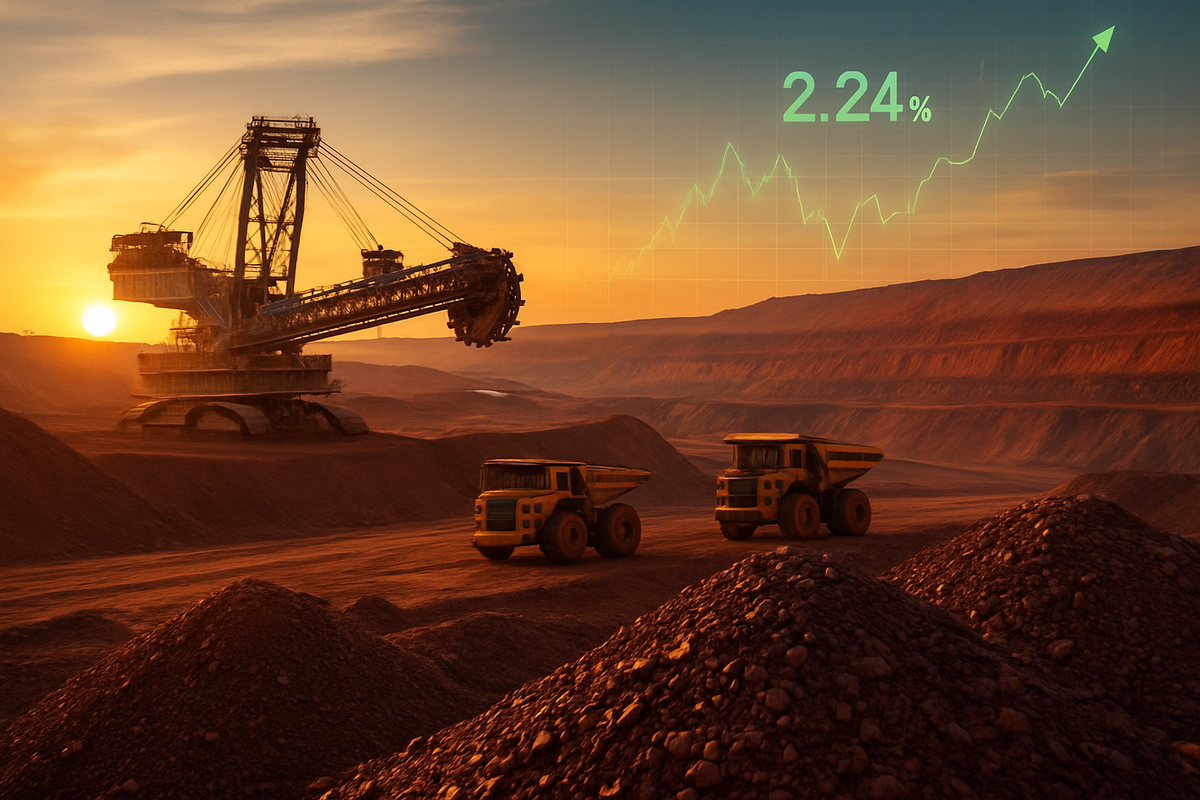
The global iron ore market has kicked off 2026 with a decisive show of strength, as benchmark prices climbed 2.24% in late January and the opening days of February. This rally, which has pushed the steel-making ingredient to its highest levels in eighteen months, signals a potential turning point for industrial demand. Investors are increasingly optimistic that the prolonged slump in the global manufacturing sector may finally be giving way to a sustained recovery, fueled by aggressive fiscal measures in Asia and a stabilizing interest rate environment in the West.
This recent uptick is more than just a statistical blip; it reflects a fundamental shift in market sentiment. As iron ore futures on the Singapore Exchange (SGX) and the Dalian Commodity Exchange move past the $110 per metric ton mark, the immediate implications are clear: industrial giants are restocking at a pace not seen in nearly two years. For the broader market, this surge acts as a bellwether for global economic health, suggesting that the "hard landing" fears of previous years are being replaced by expectations of a commodity-intensive growth phase.
The Catalyst: Stimulus, Seasons, and the $110 Breakthrough
The 2.24% price jump observed as of February 2, 2026, is the culmination of a series of strategic economic shifts that began in early January. On January 10, 2026, the Chinese government announced a landmark fiscal stimulus package that specifically targeted infrastructure and advanced manufacturing. Unlike previous smaller-scale interventions, this pivot was seen by market analysts as a "decisive" move to revitalize domestic consumption and clear the inventory overhang in the industrial sector. This policy shift provided the fundamental floor that the market had been searching for since mid-2025.
Following the stimulus announcement, a flurry of activity hit the Dalian Commodity Exchange, where the most-traded iron ore contracts saw heavy volume from institutional buyers. This coincided with the traditional pre-Lunar New Year restocking cycle, during which Chinese steel mills aggressively build up inventories to maintain production during the holiday period. The timeline of this rally was further accelerated by supply-side constraints; seasonal maintenance and localized weather disruptions in Australia's Pilbara region temporarily slowed the flow of ore, creating a "perfect storm" of rising demand and tightening supply that forced prices upward.
Key stakeholders, including major port operators and global trading houses, have noted that the buying is not merely speculative. Real-time data from Chinese ports showed a steady drawdown of stockpiles through the final week of January, confirming that physical demand is indeed supporting the paper rally. Initial industry reactions have been cautiously bullish, with several major investment banks revising their Q1 2026 price targets toward the $115–$120 range, citing the unexpected resilience of industrial orders.
The Titans of Tonnage: Winners and Losers in the Current Rally
The primary beneficiaries of this price surge are the "Big Three" miners, specifically Rio Tinto (NYSE: RIO) and Vale (NYSE: VALE). Rio Tinto, in particular, is positioned to capitalize on this momentum as it begins the critical ramp-up of its Simandou project in Guinea. With iron ore prices holding above $110, the high-grade output from Simandou becomes even more lucrative. The company has guided for 2026 sales between 343 and 366 million tons, and the current price environment provides a significant buffer for the high capital expenditures associated with its new African infrastructure.
Vale (NYSE: VALE) has adopted a slightly different strategy, focusing on "value over volume." While it has revised its 2026 production guidance downward to 335–345 million tons, the 2.24% price increase significantly boosts its margins on its high-grade Brazilian ore. Furthermore, Vale’s strategic pivot toward the Indian market—which is expected to see a massive expansion in steel output by 2030—is looking increasingly prescient. By diversifying its export base away from a purely China-centric model, Vale is hedging against regional volatility while still reaping the rewards of the current global price lift.
On the other side of the ledger, the "losers" in this scenario are the mid-stream steel manufacturers. Companies like ArcelorMittal (NYSE: MT) and United States Steel Corporation (NYSE: X) may face margin compression if they cannot pass on the increased raw material costs to end-users in the automotive and construction sectors. While demand is rising, the rapid 2.24% spike in ore costs acts as an immediate headwind for mills that are already navigating high energy costs and decarbonization mandates.
A Structural Shift: Beyond the Seasonal Cycle
The significance of this event extends far beyond a simple seasonal price fluctuation. It signals a shift in the global industrial trend from the "property-led" demand of the last decade to an "infrastructure and energy transition" demand model. The stimulus in China is increasingly focused on the "new three" industries: electric vehicles, lithium-ion batteries, and renewable energy infrastructure—all of which require significant amounts of specialized steel. This suggests that iron ore demand is becoming decoupled from the struggling residential real estate market, a transition that many analysts thought would take much longer to materialize.
Historically, iron ore rallies of this magnitude have often been followed by regulatory scrutiny, particularly from Chinese authorities concerned about inflation. However, the 2026 landscape is different; policymakers are currently more concerned with deflationary pressures and are likely to tolerate higher commodity prices if they reflect genuine industrial recovery. This event also highlights the growing importance of the "India factor." As Vale and other miners shift focus to the subcontinent, the traditional iron ore price dynamics—once dictated almost entirely by the Port of Tianjin—are becoming more fragmented and globalized.
Furthermore, the entry of Simandou ore into the market represents the first major new supply source in years. The fact that prices are rising despite this new supply coming online suggests that the market's "appetite for grade" is outweighing concerns about oversupply. Investors are prioritizing the high-Fe content ore that allows for lower-carbon steel production, a trend that is permanently altering the pricing tiers of the commodity.
The Road Ahead: 2026 and the Simandou Factor
Looking forward to the remainder of 2026, the short-term trajectory of iron ore will depend heavily on the actual realization of China’s stimulus goals. If the infrastructure projects planned for the spring do not break ground as expected, the 2.24% gain could prove to be a "false start" before a seasonal correction. However, the long-term outlook remains underpinned by the massive infrastructure requirements of the global energy transition. Major miners are already pivoting their strategies, moving away from simple volume expansion and toward "green ore" processing and logistics optimization to maintain profitability in a high-cost environment.
Market opportunities are emerging in the technology of mining itself. As Rio Tinto and Vale navigate the complexities of 2026, their investment in automated hauling and green hydrogen-based smelting will be critical. The "Simandou Factor" will be the primary supply-side story to watch; if the 650km railway in Guinea faces delays, the current supply tightness could intensify, potentially sending prices toward $130. Conversely, a smooth ramp-up would likely stabilize the market near the $100 level, providing a sustainable environment for both miners and manufacturers.
Final Assessment: A Market in Transition
The 2.24% surge in iron ore prices as of early February 2026 serves as a loud signal that the industrial heart of the global economy is beating faster. The combination of targeted Chinese stimulus, a strategic pivot by major miners like Rio Tinto and Vale, and the burgeoning demand from India has created a robust foundation for the commodity. While volatility remains a constant companion in the metals market, the current trend suggests a move toward a more stable, value-driven era for iron ore.
For investors, the key takeaways are clear: watch the data from the Simandou ramp-up and the pace of Indian steel expansion. These will be the twin engines of the market for the next 24 months. While the immediate price jump is a positive sign for the miners, the lasting impact will be determined by how well the global industrial sector can absorb these costs while transitioning to a lower-carbon future. The market is moving forward with renewed momentum, but the "quality over quantity" mantra will define the winners of the 2026 commodity cycle.
This content is intended for informational purposes only and is not financial advice.