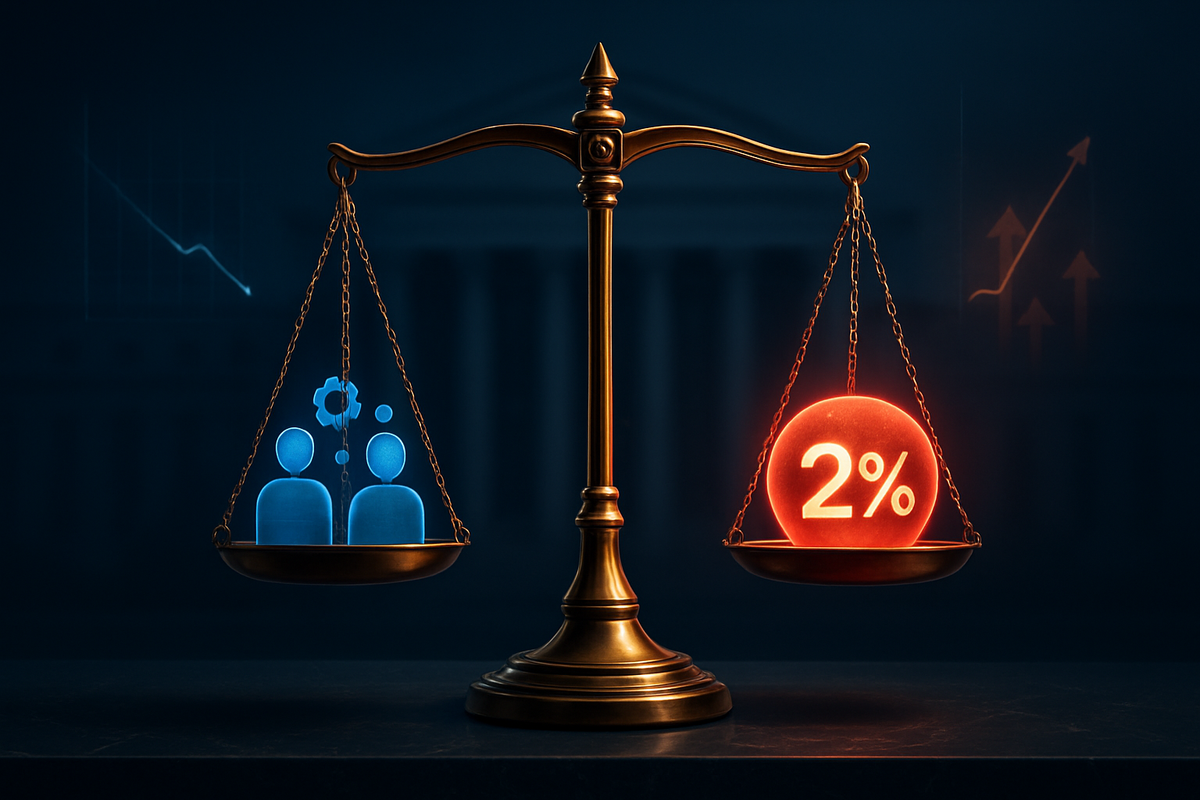
In a move that underscores the delicate balance of modern monetary policy, the Federal Reserve concluded its first meeting of 2026 on January 28 by electing to hold the federal funds rate steady at 3.50%–3.75%. This decision comes at a pivotal moment for the U.S. economy, as the central bank weigh a significantly cooling labor market against its long-standing commitment to returning inflation to a strict 2% target.
The immediate market implication of this "hawkish hold" has been one of cautious recalibration. While equity markets initially dipped on the news that a rate cut was not imminent, the Fed's confirmation of a projected path for two additional cuts later in 2026 provided a necessary safety net for investor sentiment. The decision reflects a central bank that is no longer just fighting a fire on the inflation front but is now increasingly wary of the "cold front" moving into the American workforce.
A Stance of Strategic Patience
The January decision was the culmination of a tense period of data monitoring throughout the winter of 2025. Following three modest rate cuts in the latter half of 2025, many market participants expected the Fed to continue its easing cycle to provide a cushion for a labor market that showed signs of exhaustion. Specifically, the Bureau of Labor Statistics reported that December 2025 saw only 50,000 jobs added to the economy—the lowest non-farm payroll print in years, excluding pandemic anomalies. This "low-hire" environment has pushed the unemployment rate to 4.4%, a level that historically signals a potential shift toward a more pronounced downturn.
Despite this softening, Federal Reserve Chair Jerome Powell maintained that the committee remains "resolute" in its inflation fight. Core Personal Consumption Expenditures (PCE), the Fed's preferred inflation metric, remains stuck in the 2.7%–2.8% range. This "sticky" inflation, fueled by high services costs and resilient consumer spending in some sectors, has prevented a unanimous consensus for further cuts. In a rare display of internal friction, the January vote was 10-2, with Governors Christopher Waller and Stephen Miran dissenting in favor of a 25-basis-point cut to preemptively defend the labor market.
The timeline leading to this decision has been marked by a shift in narrative. Throughout 2025, the "soft landing" was the primary goal. However, by January 2026, the conversation has moved toward the risks of a "stagnant landing," where inflation remains above target while growth slows. The Fed’s current stance of "strategic patience" suggests that while they acknowledge the 50,000-job warning sign, they are not yet ready to declare victory over price instability.
Winners and Losers in a Stabilizing Rate Environment
For the financial giants, the Fed’s decision to hold rates steady is a double-edged sword. JPMorgan Chase & Co. (NYSE: JPM) has emerged as a primary beneficiary of this "higher-for-longer" stabilization. By maintaining rates at current levels, the bank continues to reap substantial Net Interest Income (NII), which hit a record $103 billion projection for the 2026 fiscal year. While lower rates would typically stimulate lending, JPM’s massive scale and diversified revenue streams allow it to thrive in an environment where borrowing costs remain high but predictable.
Conversely, the real estate and construction sectors continue to feel the squeeze. Lennar Corporation (NYSE: LEN) has seen its stock struggle as mortgage rates hover near the 6% mark. Although the company has pivoted to an "asset-light" manufacturing model to preserve margins, the hold on rates delays the much-anticipated "fading lock-in effect." Homeowners remain reluctant to trade up and abandon lower-rate mortgages from years past, keeping housing supply tight and Lennar’s delivery targets under pressure.
In the technology sector, the impact is more nuanced. Apple Inc. (NASDAQ: AAPL) recently reported record-breaking revenue of $143.8 billion, driven largely by its AI-integrated iPhone 17 cycle. For a cash-rich company like Apple, the Fed's decision is less about borrowing costs and more about consumer sentiment. If the labor market continues to soften and the Fed stays the course on rates, the "wealth effect" could dampen the upgrade cycles that Apple relies on for its double-digit growth forecasts.
The Shift Toward a New Dual Mandate Reality
The current economic landscape fits into a broader trend of "structural normalization" following the volatility of the early 2020s. For the past decade, the Fed has often had the luxury of focusing on one side of its dual mandate—either fighting unemployment or curbing inflation. In early 2026, the bank is facing a return to the classic balancing act. The 50,000-job growth figure for December is a stark reminder that the labor market is no longer "tight," but rather "fragile."
Historically, when job growth falls below the 100,000 threshold for sustained periods, the Fed has been quick to pivot to aggressive easing. However, the 2% inflation target has become a significant psychological and policy anchor. Policymakers are haunted by the "stop-go" mistakes of the 1970s, where premature easing led to a resurgence of inflation. This historical precedent is clearly weighing on the FOMC today, leading to the current cautious approach.
Furthermore, the rise of AI-driven productivity is the "wild card" in this cycle. Many economists argue that the economy can sustain higher interest rates because productivity gains—led by firms like Apple and Google—are allowing companies to maintain earnings even as labor costs rise or hiring slows. This technological buffer may be what allows the Fed to keep rates at 3.50% even as the job market cools, a scenario that would have been impossible in previous decades.
Navigating the Path to Two Cuts
The Fed’s roadmap for the remainder of 2026 now hinges on two projected interest rate cuts. This projection suggests that the central bank expects the labor market to remain soft enough to keep wage-push inflation at bay, but not so weak that it collapses into a recession. In the short term, market participants should expect heightened volatility around the March and May FOMC meetings, as every tenth of a percent in inflation and every thousand jobs added will be scrutinized for clues on the timing of the first cut.
A potential strategic pivot could occur if the job market data for Q1 2026 continues to disappoint. If payroll gains stay below the 50,000 mark through February, the "wait-and-see" approach may be abandoned in favor of an early spring cut. Conversely, if consumer spending remains robust despite high rates, the Fed might find itself forced to delay the two projected cuts until late in the year, risking a harder landing for the economy in 2027.
Looking Ahead: What Investors Must Watch
The January 2026 Fed decision marks a transition from the era of "crushing inflation" to the era of "managing the slowdown." The key takeaway for investors is that the "Fed Put"—the idea that the central bank will always step in to save the market with lower rates—is back, but with a much higher strike price than in the 2010s. The central bank has signaled it will support the economy, but only after it is certain that the 2% inflation target is within reach.
As we move forward, the market’s trajectory will be determined by the resilience of the American consumer and the ability of corporations to maintain margins in a "low-hire" economy. Investors should pay close attention to corporate earnings guidance in the coming months, particularly from rate-sensitive sectors like homebuilding and high-growth technology.
In summary, the Fed has laid out a clear path: they are holding steady for now, with two cuts on the horizon. Whether they can successfully navigate that path without stumbling into a recession or allowing inflation to rekindle will be the defining story of the 2026 financial year.
This content is intended for informational purposes only and is not financial advice.