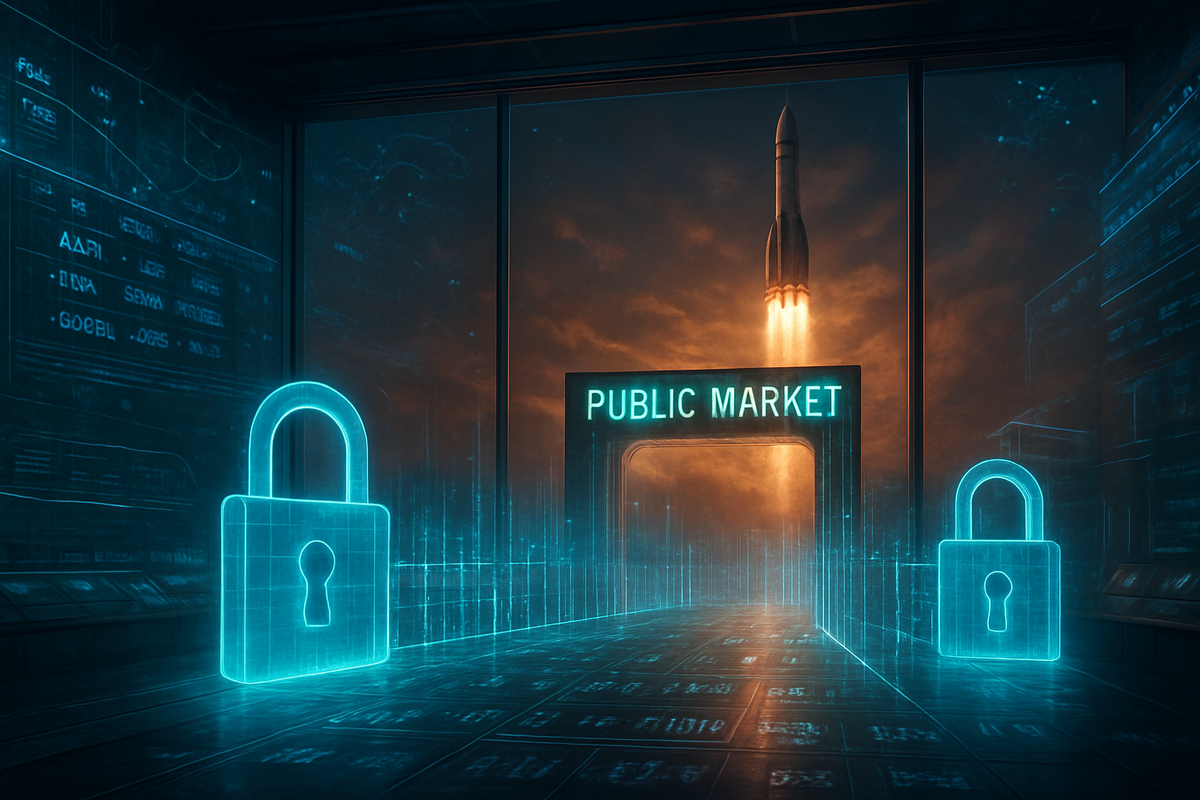
As of March 23, 2026, the financial world stands at a historic crossroads. After years of a stagnant "exit" environment, a $3 trillion backlog of high-quality private companies is currently attempting to force open the IPO window. However, this "Great Re-entry" is colliding with a brutal macroeconomic reality: a Federal Reserve that refuses to blink on interest rates and a sudden, sharp spike in geopolitical instability that has sent energy markets into a tailspin.
The immediate implications are profound. While the pipeline is headlined by "decade-defining" names like SpaceX and Databricks, the volatility of March 2026 has already forced several mid-cap candidates to retreat. For investors, the question is no longer when the market will open, but whether the current climate of "Operation Epic Fury" in the Middle East and a 3.5% floor on interest rates has permanently altered the valuation math for the next generation of public tech giants.
A Perfect Storm: Geopolitics and the Fed’s "Wait-and-See"
The current market tension reached a boiling point following the March 2026 Federal Open Market Committee (FOMC) meeting. Despite widespread hopes for a "spring thaw" in monetary policy, the Federal Reserve maintained the Fed Funds Rate at a steady 3.50% – 3.75%. Jerome Powell’s accompanying commentary was hawkish, citing "stubbornly persistent" service-sector inflation and a new supply-side shock from global energy markets. This has effectively killed the narrative of multiple rate cuts in 2026, forcing pre-IPO companies to model their long-term growth against a significantly higher cost of capital than they faced during their venture rounds in the early 2020s.
Compounding this monetary pressure is the geopolitical crisis known as "Operation Epic Fury." Ongoing conflict involving Iran has severely disrupted transit through the Strait of Hormuz, pushing crude oil prices north of $100 per barrel for the first time in years. This "oil shock" has rippled through the S&P 500, sending the VIX (Volatility Index) toward the 26.0 level—a historical "danger zone" for new listings. The timeline of the 2026 IPO season, which began with high optimism in January, has now shifted into a "defensive crouch" as major underwriters like Goldman Sachs (NYSE: GS) and Morgan Stanley (NYSE: MS) advise clients to wait for a period of sustained market calm.
Key players in this drama include Elon Musk’s SpaceX, which reportedly filed confidential paperwork with the SEC on March 1, 2026, for a potential June debut. The strategy for SpaceX is to leverage its unified structure—incorporating both the high-margin Starlink satellite business and its heavy-lift launch capabilities—to command a valuation between $1.5 trillion and $1.75 trillion. Market reactions have been mixed; while institutional appetite for a "monopoly on the stars" is ravenous, retail sentiment is tempered by the fear that a failed launch or further geopolitical escalation could tank a debut of this magnitude.
Winners and Losers in the "Quality Flight"
In this high-stakes environment, a clear divergence has emerged between the "haves" and the "have-nots." The primary winners are companies with "agentic AI" revenue and proven cash flow. Databricks, currently targeting a $134 billion valuation, stands out as a potential victor. With an annual recurring revenue (ARR) of $5.4 billion and a growth rate of 50%, it is being viewed as the primary challenger to Snowflake (NYSE: SNOW). Investors are fleeing speculative "story stocks" and piling into infrastructure plays that provide the backbone for enterprise AI, positioning Databricks as a "must-own" asset despite the high-rate environment.
Conversely, the "losers" are the smaller, energy-dependent tech firms and those with weak balance sheets that missed the 2024-2025 funding windows. High interest rates have made the "growth at all costs" model obsolete. Companies in the consumer fintech space, like Chime or Klarna, are facing intense scrutiny over their margins as borrowing costs for their customers remain elevated. Even a giant like Stripe—which recently completed a $159 billion secondary tender offer—is choosing to remain private for now, effectively using its massive scale to "buy time" while smaller competitors are forced into down-rounds or fire sales.
Public incumbents like Microsoft (NASDAQ: MSFT) and Amazon (NASDAQ: AMZN) are also benefiting from the IPO delay. As long as the "Mega IPOs" remain on the sidelines, the massive pools of institutional capital that would have gone into new listings remain concentrated in the "Magnificent" tech leaders. This "crowding trade" has kept the indices afloat even as the broader market breadth weakens under the weight of $100 oil.
From 2021 Speculation to 2026 Industrialism
The 2026 IPO environment marks a definitive end to the "ZIRP (Zero Interest Rate Policy) Era" dynamics seen during the 2021 boom. We are now seeing a shift toward "Space-Industrial" and "Enterprise-AI" listings that represent tangible infrastructure rather than just software-as-a-service (SaaS) convenience. This trend mirrors the historical precedent of the mid-1950s, where the market transitioned from post-war consumerism to the heavy industrial and aerospace investments of the early Cold War. Today, the "Cold War" is digital and orbital, with SpaceX and OpenAI representing the new "General Motors" of the 21st century.
Regulatory scrutiny has also evolved. The SEC, now operating under 2026 guidelines that emphasize AI transparency and carbon footprint reporting, is placing a higher burden of proof on IPO candidates. This has created a "bottleneck of quality," where only the most sophisticated legal and financial teams can navigate the filing process. The potential ripple effect is a "two-tier" market: a handful of mega-caps that achieve successful listings and a vast "shadow market" of unicorns that are eventually acquired by the cash-rich tech titans like Alphabet (NASDAQ: GOOGL).
The geopolitical dimension of the 2026 pipeline cannot be overstated. With "Operation Epic Fury" highlighting the vulnerability of terrestrial supply chains, investors are increasingly looking at orbital assets (like Starlink) as "disruption-proof" infrastructure. This has led to a strategic pivot among venture capitalists, who are now prioritizing "defense-tech" and "hard-tech" over traditional social media or e-commerce ventures.
What Lies Ahead: The June Window and Beyond
The next 90 days will be the ultimate test for the 2026 pipeline. The "June Window" is widely viewed as the make-or-break moment for SpaceX. If the geopolitical tensions in the Middle East de-escalate and the Fed signals a definitive pause at its May meeting, we could see a flurry of listings led by Elon Musk’s aerospace giant and the long-awaited debut of Fanatics, which has been quietly shoring up its executive suite. However, if oil prices remain above $110, expect the "logjam" to persist into 2027.
Strategically, companies like Databricks may choose to leverage their recent $1.8 billion debt raises to wait out the volatility, essentially "self-funding" their way through the storm. We may also see an increase in "synthetic IPOs" or massive tender offers, similar to the Stripe model, where companies provide liquidity to employees without the regulatory and market-maker headaches of a public listing. The "Agentic AI" boom remains the wild card; any significant breakthrough in AI productivity could create a "fear of missing out" (FOMO) that overrides even the most hawkish Fed stance.
A New Era of Market Discipline
The 2026 Mega IPO pipeline is a testament to the resilience of American innovation, but it is also a sober reminder that the "easy money" era is over. Investors should walk away from this March volatility with one key takeaway: Profitability is the only true hedge against geopolitics. The companies that will successfully navigate this environment are those that provide essential infrastructure—whether that is orbital internet, AI data architecture, or global payments—and do so with sustainable margins.
Moving forward, the market will likely remain "window-driven." Investors should keep a close eye on the VIX and Brent Crude prices as the primary lead indicators for IPO timing. If the VIX drops below 18.0 and oil stabilizes, the $3 trillion logjam will break, potentially leading to the most lucrative period for new listings in history. Until then, the theme for 2026 remains "Patience over Participation." Watch the Fed's dot plot and the headlines from the Strait of Hormuz; they are the true gatekeepers of the 2026 market.
This content is intended for informational purposes only and is not financial advice.