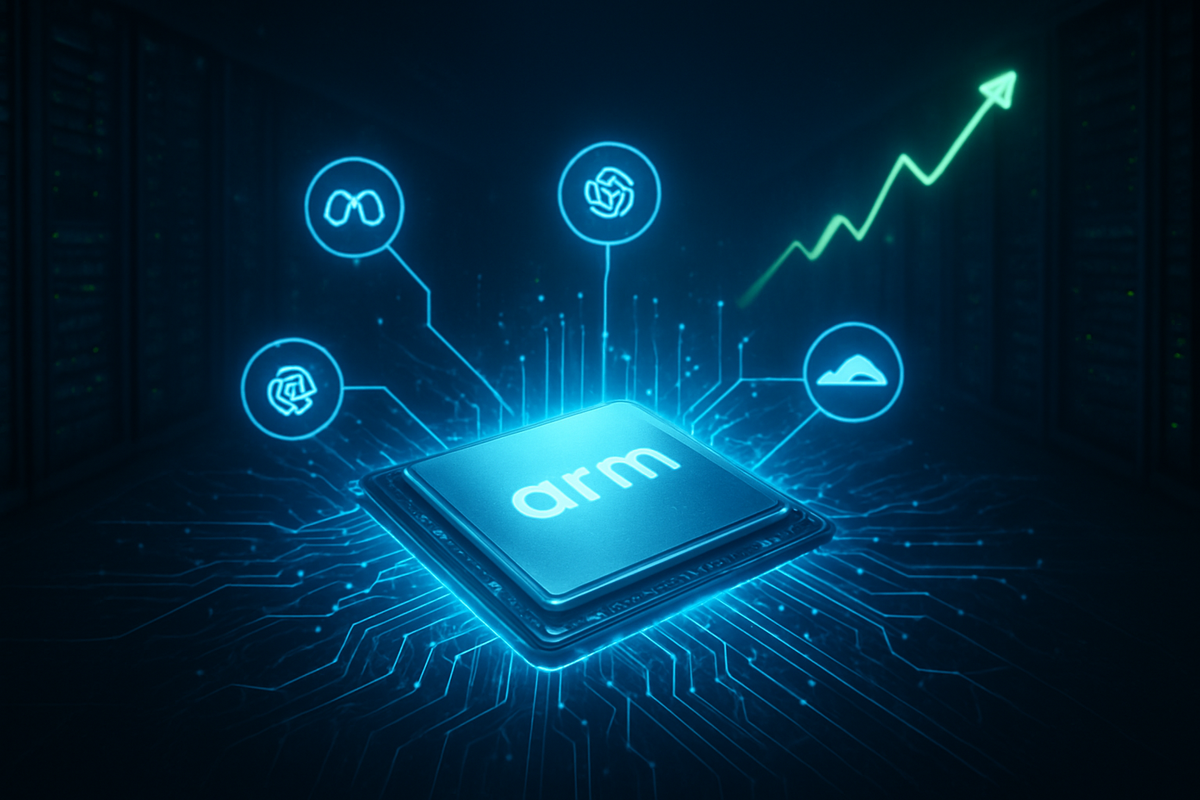
London & New York — Shares of Arm Holdings (NASDAQ: ARM) skyrocketed by 16% over the combined trading sessions of March 25 and 26, 2026, marking a historic turning point for the British chip architect. The rally follows a series of bombshell announcements detailing the company’s "genetic mutation" from a passive intellectual property (IP) licensor into a direct manufacturer and seller of its own high-performance "AGI CPU" silicon. This strategic pivot, once considered a radical gamble, has been validated by a landmark partnership with Meta Platforms (NASDAQ: META) and massive deployments with AI pioneers OpenAI and Cloudflare (NYSE: NET).
The surge reflects a fundamental repricing of Arm’s value proposition. For decades, Arm was the "Switzerland" of the semiconductor industry, providing neutral blueprints to rivals. Today, it stands as a direct powerhouse in the data center, projecting that its new direct-silicon segment alone will generate $15 billion in annual revenue by the early 2030s—a figure that would have dwarfed the company’s entire market cap just years ago.
The Birth of the AGI CPU: From Blueprints to Production
The catalyst for the 16% stock surge was the official unveiling of the Arm "AGI CPU," the company’s first branded physical processor designed specifically for the era of Artificial General Intelligence. Built on the cutting-edge Neoverse V3 architecture and manufactured using TSMC’s (NYSE: TSM) 3-nanometer process, the AGI CPU represents a departure from Arm’s 35-year history of only selling "recipes" for chips. The company has moved into a three-tier business model: maintaining its legacy IP licensing, offering Compute Subsystems (CSS), and now, selling fully-branded production silicon directly to hyperscalers.
The timeline leading to this week’s surge began in late 2024, when Arm quietly assembled a "blue-chip" engineering team to move beyond design. By mid-2025, rumors of a proprietary "AI Agent" chip began to circulate. The culmination occurred this week with the announcement that Meta Platforms has served as the lead development partner for the AGI CPU. Unlike traditional processors, the AGI CPU is optimized for "Agentic AI"—autonomous systems that require massive data orchestration and memory management rather than just raw mathematical throughput. Initial benchmarks suggest the AGI CPU delivers twice the performance-per-watt of traditional x86 server chips, a critical metric for power-starved data centers.
Winners, Losers, and the End of Neutrality
The immediate winners of Arm’s transformation are the hyperscalers and AI labs seeking to break the "CPU bottleneck" in their infrastructure. Meta Platforms is integrating the AGI CPU alongside its own MTIA (Meta Training and Inference Accelerator) chips to power the next generation of its Llama models. Similarly, OpenAI has signed a multi-year agreement to deploy Arm silicon to enhance inference efficiency, while Cloudflare has begun a global rollout of the AGI CPU across its edge network to support low-latency AI workflows.
However, Arm’s move creates a complex landscape for its traditional partners. Intel (NASDAQ: INTC) and Advanced Micro Devices (NASDAQ: AMD) are the most direct losers, as Arm now competes head-to-head for the "host CPU" socket in the data center. Even NVIDIA (NASDAQ: NVDA), which has long utilized Arm designs for its Grace CPUs, now finds its primary architecture provider becoming a "co-opetitor" in the high-end server market. While NVIDIA remains the king of the GPU, Arm is successfully arguing that the "brain" of the AI server—the CPU—is just as vital for the coming wave of autonomous AI agents.
A Fundamental Shift in the Semiconductor Ecosystem
Arm’s "mutation" fits into a broader industry trend of vertical integration. As AI models become more specialized, generic hardware is no longer sufficient. By designing and selling its own silicon, Arm can capture significantly more margin—earning thousands of dollars per physical chip rather than the few dollars in royalties it previously collected per license. This move echoes the vertical strategies of Apple (NASDAQ: AAPL) and Tesla (NASDAQ: TSLA), but on a foundational, industry-wide scale.
The regulatory implications of this shift are also surfacing. For years, Arm’s neutrality was the shield that protected it from antitrust concerns. Now that it is a direct competitor to its customers, regulators in the UK, EU, and US are likely to scrutinize whether Arm gives its own silicon segment preferential access to the latest architectural innovations. Historically, the semiconductor market hasn't seen a shift of this magnitude since Intel’s rise in the 1980s, suggesting that we are entering a new era of "Silicon Sovereignty" where the lines between designer and manufacturer are permanently blurred.
The Roadmap to 2030: What Investors Must Watch
Looking ahead, Arm has committed to a rigorous 12-to-18-month release cadence for its proprietary chips, with a 2-nanometer version already in the pipeline for 2027. The primary challenge will be execution; shifting from a design firm to a hardware vendor involves massive logistics, supply chain management, and capital expenditure risks. Investors should closely monitor the "attach rate" of the AGI CPU in upcoming quarterly reports, as well as any signs of friction with long-term licensees who may feel sidelined by Arm’s new direction.
In the short term, the market will be looking for further partnership announcements with other cloud titans like Amazon (NASDAQ: AMZN) or Alphabet (NASDAQ: GOOGL). If Arm can prove that its direct silicon is the gold standard for running "Agentic" workflows, the $15 billion revenue target for its new segment by the early 2030s may actually prove to be conservative. The strategic pivot is no longer a "potential" future; it is the current reality driving Arm's valuation toward the trillion-dollar club.
Conclusion: A New Identity for a New Era
Arm’s 16% surge on March 25-26, 2026, is more than just a reaction to strong sales; it is a celebration of a successful corporate evolution. By shedding its identity as a mere "librarian" of chip designs and becoming a "master builder" of AI hardware, Arm has secured its place at the center of the AGI revolution. The partnership with Meta and the adoption by OpenAI and Cloudflare provide the "social proof" necessary to convince the market that this mutation was not only necessary but highly profitable.
As we move forward, the semiconductor industry will be defined by this move. Investors should watch for the impact on legacy x86 providers and the potential for Arm to expand its direct silicon offerings into the PC and automotive markets. For now, Arm is no longer just the architecture of the world; it is increasingly the hardware of the future.
This content is intended for informational purposes only and is not financial advice.