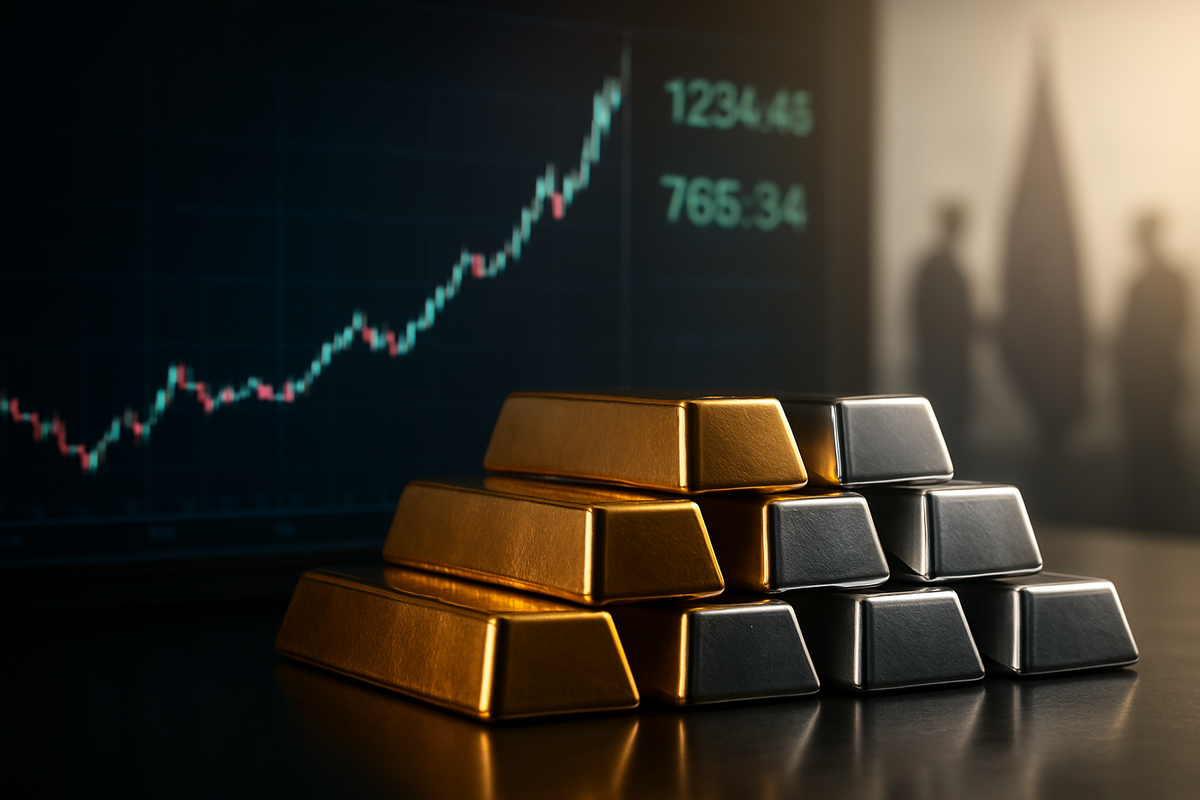
The global commodities market witnessed a dramatic reversal on Thursday, March 26, 2026, as gold and silver prices staged a powerful recovery following a week of historic volatility. Spot gold climbed a remarkable 4.2% to settle at $4,556.55 per ounce, while silver outpaced its yellow counterpart with a 6.8% surge, hitting $72.67 per ounce. This sharp rebound effectively halted a terrifying downward spiral that many analysts had labeled the "worst correction in 40 years," a liquidation event that saw billions in paper wealth evaporate in a matter of days.
The primary catalyst for this sudden shift in sentiment appears to be a significant diplomatic breakthrough in the Middle East. Reports from Geneva indicate that high-level officials from the United States and Iran have reached a tentative framework to de-escalate maritime tensions in the Persian Gulf and re-establish a "hotline" for crisis management. This easing of geopolitical friction has allowed risk appetite to return to the markets, while simultaneously weakening the U.S. dollar and cooling oil prices—a "Goldilocks" scenario for precious metals after a period of intense selling pressure.
A Breakthrough in Geneva Ends the Great Correction
The rally on March 26 marks a definitive turning point after a week of panic selling. Just six days prior, the precious metals complex suffered a collapse reminiscent of the 1983 crash, triggered by a combination of aggressive central bank tightening and a perceived peak in regional conflict risks. However, the narrative shifted overnight as news broke of the "Geneva Accord," a diplomatic surprise that many market participants had deemed impossible just a month ago. The agreement purportedly includes a commitment from Tehran to curtail drone activity in international shipping lanes in exchange for the release of frozen humanitarian assets.
The timeline leading to this rebound was fraught with tension. Throughout early March 2026, gold prices had been weighed down by a "super-strong" U.S. dollar and fears that a regional war would necessitate a massive liquidation of reserves by Middle Eastern sovereign wealth funds to cover military expenditures. When the anticipated escalation failed to materialize and was instead replaced by diplomacy, the "fear trade" unwound, but the "inflation hedge" trade took its place. The U.S. Dollar Index (DXY) fell 1.2% on the news, making gold significantly cheaper for international buyers and triggering a massive short-covering rally.
Institutional investors, who had moved to the sidelines during the previous week’s 15% correction, were seen aggressively re-entering the market. "What we saw today was the exhaustion of the bears," noted one senior commodities strategist. "The 'worst correction in 40 years' created a generational entry point, and the de-escalation between Washington and Tehran provided the perfect fundamental cover for the big money to rotate back into hard assets." As oil prices stabilized near $85 a barrel—down from the $120 "war premium" levels seen earlier this year—the reduced cost of production for miners further sweetened the deal for equity investors.
Mining Giants and the "Silver Lining" for Equities
The rebound in spot prices translated into an immediate windfall for the world’s leading mining corporations. Newmont Corporation (NYSE: NEM), the world's largest gold producer, saw its shares jump 9.5% in midday trading as investors cheered the stabilization of its primary product. Barrick Gold (NYSE: GOLD) followed suit, gaining 8.2% as the company benefited from the twin tailwinds of higher gold prices and lower energy costs at its high-altitude operations in Nevada and Africa. For these seniors, the previous week’s correction had been a stress test of their balance sheets; today's rally serves as a validation of their long-term value.
The silver sector, often more volatile and sensitive to industrial demand than gold, saw even more explosive growth. Pan American Silver (NASDAQ: PAAS) and First Majestic Silver (NYSE: AG) both recorded double-digit gains, as silver’s ascent to $72.67 per ounce revitalized profit margin projections that had looked grim just 48 hours earlier. Analysts point out that silver’s dual role as a monetary metal and a key component in the burgeoning green energy infrastructure (solar and EVs) makes it particularly sensitive to the "de-escalation" trade, as normalized trade routes ensure the steady flow of industrial silver to manufacturing hubs in Asia and Europe.
However, the news was not universally positive across all sectors. Major defense contractors and some "safe-haven" currency funds saw a rotation out of their positions. As the "war premium" faded from the market, investors shifted capital from geopolitical hedges into growth-oriented commodities. Financial institutions heavily weighted in short-term U.S. Treasuries also felt the pinch of a weakening dollar, though the broader S&P 500 remained resilient as the prospect of regional peace lowered the overall "risk-off" posture of global portfolio managers.
Broader Market Trends and the Historical Shadow of 1983
This rally fits into a broader 2026 trend of "Commodities Realignment." Following the extreme volatility of the mid-2020s, markets have become increasingly sensitive to the interplay between the U.S. dollar and geopolitical stability. Today's price action mirrors the historical precedents of the early 1980s, but with a modern twist: while the 1983 correction was driven by a collapse in inflation, the 2026 "Great Correction" appears to have been a technical "shakeout" within a larger, secular bull market for hard assets.
The easing of US-Iran tensions also has significant implications for global trade policy. A more stable Persian Gulf reduces the "insurance premium" on global shipping, which may eventually lead to a cooling of headline inflation. Ironically, this could lead the Federal Reserve to reconsider its hawkish stance, further weakening the dollar and providing a secondary floor for gold and silver prices. The ripple effect is being felt in other commodities as well, with copper and platinum following the lead of the precious metals, suggesting a broad-based move away from fiat-currency volatility toward tangible resources.
Furthermore, this event highlights the changing nature of gold as a reserve asset. In 2026, central bank demand remains at historic highs, but the "worst correction in 40 years" proved that even the most robust bull markets are susceptible to liquidity crunches. The fact that gold found support at $4,556.55 suggests that the psychological floor for the metal has shifted significantly higher over the last decade, reflecting a global economy that is increasingly wary of traditional paper-backed debt instruments.
The Path Forward: Stability or a Temporary Lull?
Looking ahead, the sustainability of this rally depends heavily on the durability of the Geneva Accord. In the short term, technical analysts expect gold to test the $4,700 resistance level as momentum-following algorithms flip from "sell" to "buy." Silver, having broken the $70 barrier with conviction, could be headed toward the psychological $80 mark if industrial demand remains steady. However, the market remains "on a hair-trigger," and any sign of a breakdown in US-Iran communications could quickly re-introduce the volatility seen last week.
Strategic pivots are already underway among institutional desks. Many are moving toward "barbell strategies"—holding physical gold and silver to hedge against systemic risk while maintaining positions in high-beta mining stocks like Hecla Mining (NYSE: HL) to capture upside from the rebound. The potential for a long-term "peace dividend" in the Middle East could also lead to a surge in infrastructure spending, further boosting the industrial case for silver and other base metals.
The most likely scenario for the remainder of 2026 is one of "volatile consolidation." While the worst of the 40-year correction appears to be over, the market must now digest the massive price swings of March. Investors should prepare for a landscape where geopolitical news continues to drive 5-10% weekly swings, making "buy-and-hold" strategies more challenging but creating significant opportunities for those who can navigate the macro-economic crosscurrents.
Summary and Investor Takeaways
The events of March 26, 2026, will likely be remembered as the day the precious metals market stared into the abyss and blinked. The sharp rebound to $4,556.55 for gold and $72.67 for silver signals an end to a period of historic panic, replaced by a cautious optimism fueled by a rare diplomatic success between the United States and Iran. With a weaker dollar and easing oil prices providing the fundamental backdrop, the "Great Correction" may ultimately be seen as a necessary cleansing of speculative excess.
For the forward-looking investor, the key takeaway is the resilience of hard assets in the face of shifting geopolitical realities. The mining sector, led by stalwarts like Agnico Eagle Mines (NYSE: AEM) and Wheaton Precious Metals (NYSE: WPM), remains a leveraged way to play this recovery. Moving forward, the market will be hyper-focused on the implementation of the Geneva Accord and the Federal Reserve's response to a potentially weakening dollar. While the immediate crisis has passed, the 2026 commodities supercycle is far from over.
This content is intended for informational purposes only and is not financial advice.