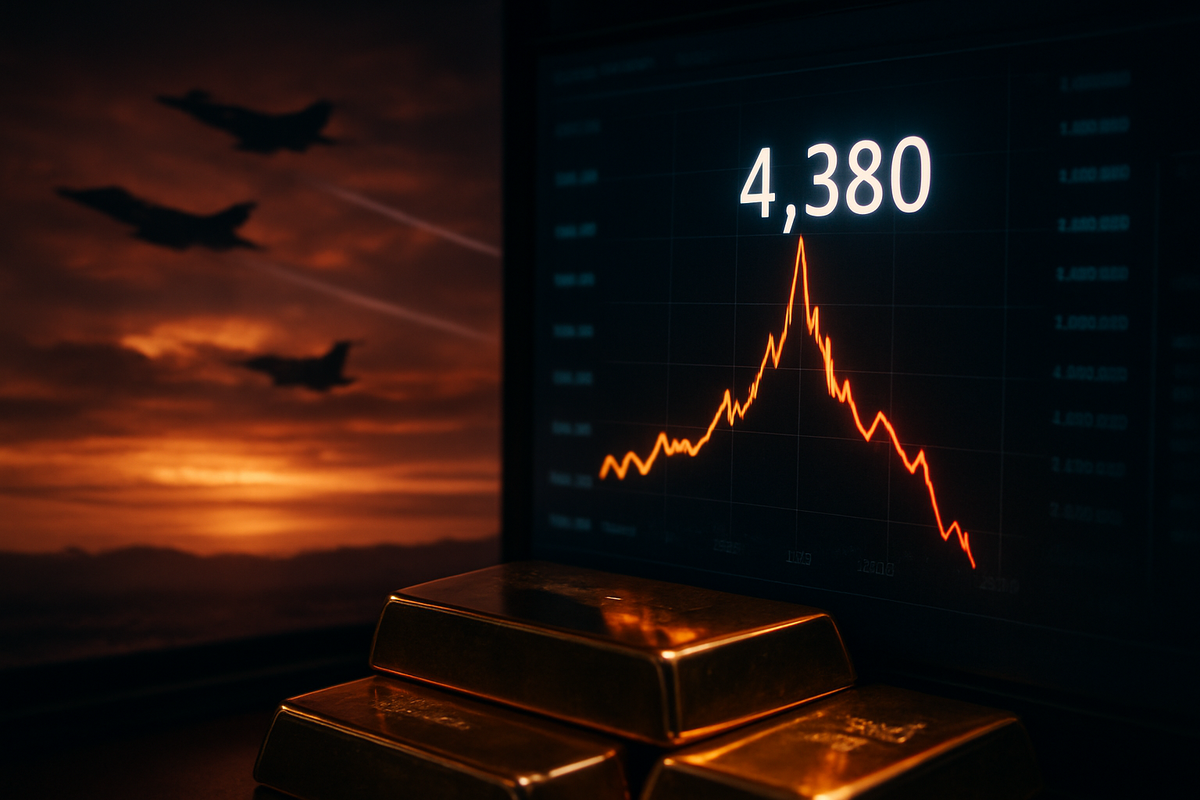
The global financial landscape was jolted this week as gold prices surged to a historic all-time high of $4,380 per ounce on Monday, March 2, 2026. The move, driven by a dramatic military escalation in the Middle East and the sudden death of Iran’s Supreme Leader, represented a ultimate flight-to-safety for institutional and retail investors alike. However, the peak proved fleeting; as of Wednesday, March 4, the precious metal has begun a sharp retreat as market participants engage in aggressive de-risking and profit-taking.
The volatility underscores a "perfect storm" of geopolitical instability and overextended market positioning. While the immediate catalyst was military, the underlying fragility of the trade was foreshadowed weeks ago. With "long gold" identified as the single most crowded trade in the February Global Fund Manager Survey, the rapid ascent to $4,380 appears to have triggered a liquidity flush, leaving many investors scrambling to rebalance their portfolios in an increasingly unpredictable environment.
The Decapitation Strike: Operation Epic Fury and the Path to $4,380
The march toward $4,380 began in earnest over the weekend. On Saturday, February 28, 2026, a coalition force launched "Operation Epic Fury," a massive, multi-pronged military campaign aimed at neutralizing Iranian nuclear capabilities and leadership nodes. The operation, which involved significant stealth assets and cyber-warfare, reached a fever pitch late Sunday night when international intelligence confirmed the killing of Iran’s Supreme Leader, Ayatollah Ali Khamenei, during a precision strike on a high-security compound in Tehran.
As Asian markets opened on Monday, March 2, the shockwaves were instantaneous. Gold, which had been consolidating near the $4,000 mark for much of February, gaps higher by nearly $300 in the first hour of trading. By mid-day in New York, spot gold touched the $4,380 level—a milestone that many analysts didn't expect to see until late 2027. The spike was accompanied by a simultaneous 12% jump in Brent crude oil prices, as reports emerged that the Strait of Hormuz had been effectively closed by the Islamic Revolutionary Guard Corps (IRGC) in a retaliatory move.
The reaction was not merely a retail panic but a systemic institutional pivot. For months, hedge funds had been building massive "safe-haven" bunkers in gold, anticipating a breakdown in Middle Eastern diplomacy. When the breakdown finally occurred with the unprecedented death of the Supreme Leader, the automated buying programs of major sovereign wealth funds and "CTA" (Commodity Trading Advisor) funds hit the market with overwhelming force, driving the price to its vertical peak before the momentum finally exhausted itself by Tuesday morning.
A Decoupling of Miners and the Rise of the Defense Sector
The record-shattering gold price has created a complex web of winners and losers across the public markets. Paradoxically, the world’s largest gold miners did not participate in the rally with the same vigor as the physical metal. Newmont (NYSE: NEM) and Barrick Gold (NYSE: GOLD) both saw their share prices dip on Monday and Tuesday, even as the commodity they produce hit record highs. Investors appear wary of the "crowded trade" phenomenon; as institutional players looked to raise cash to cover margin calls in the plummeting broader equity markets, gold mining stocks became a primary source of liquidity.
Furthermore, Newmont and Barrick are facing significant headwinds from rising All-In Sustaining Costs (AISC). With energy prices spiking due to the Strait of Hormuz closure, the cost of operating massive open-pit mines has skyrocketed, threatening to eat into the margins that the $4,380 gold price should have expanded. This "margin squeeze" during a period of peak prices has left many gold-centric investors frustrated by the lack of equity performance.
Conversely, the defense sector has emerged as the clear beneficiary of the heightened hostilities. Lockheed Martin (NYSE: LMT) saw its stock climb to a new record of $692.00 on Monday, as its F-35 platforms were the primary tools used in Operation Epic Fury. Similarly, RTX Corporation (NYSE: RTX), formerly Raytheon, experienced a surge in demand for its missile defense systems, such as the Patriot and THAAD, which are currently being deployed to protect regional allies from Iranian drone swarms. For these companies, the escalation represents a multi-year shift in procurement priorities for Western governments, cementing their status as essential geopolitical hedges.
Historical Precedents and the Crowded Trade Risk
The current volatility is being compared by many veteran traders to the "Great Inflation Peak" of 1980 or the initial shock of the Russia-Ukraine conflict in 2022. However, the magnitude of the $4,380 peak is unprecedented. The February Global Fund Manager Survey, conducted just weeks before Operation Epic Fury, revealed that 50% of global institutional managers were "long gold," making it the most crowded trade in the market. This high level of consensus often precedes a "bull trap," where a sudden spike is met with a wave of selling as the majority of buyers have already committed their capital.
The wider significance of this event extends beyond the price of bullion. The killing of a sovereign leader of Iran’s stature is a "Black Swan" event that rewires the risk premiums for all global assets. We are seeing a breakdown of the traditional correlation between gold and interest rates. Usually, rising rates (driven by inflation concerns) would suppress gold, but in the face of "Epic Fury," the metal has become a pure geopolitical barometer. The policy implications are equally severe, as central banks in the G7 must now weigh the need for higher rates to combat energy-driven inflation against the risk of a systemic credit crunch caused by regional war.
The Horizon: De-risking and Strategic Pivots
Looking ahead, the market is entering a phase of extreme uncertainty. The immediate "fear trade" that drove gold to $4,380 has cooled, but the long-term ramifications of a leadership vacuum in Iran are only beginning to be felt. In the short term, gold is likely to find a new floor—perhaps near the $4,150 level—as the "crowded" positions are flushed out and more stable, long-term investors step in.
Strategic pivots are already underway. Wealth managers are shifting from "pure-play" gold exposure toward diversified defense and energy baskets. If the conflict in the Middle East evolves into a protracted regional war involving multiple state actors, the demand for gold will likely return, but with a focus on physical delivery rather than paper futures. Investors should also watch for a potential "Gold-Oil" decoupling; if the Strait of Hormuz remains closed, the inflationary pressure could become so great that even gold's safe-haven status is tested by a desperate need for USD liquidity.
Summary: What to Watch in the Coming Months
The rise of gold to $4,380 on March 2, 2026, will be remembered as a defining moment in the modern financial era. It marked the intersection of a "crowded trade" and a historic geopolitical rupture. While the retreat from the peak suggests a temporary exhaustion of buying power, the underlying causes of the volatility—Operation Epic Fury and the radical shift in Middle Eastern power dynamics—are far from resolved.
As we move through the rest of March 2026, investors should keep a close eye on three key indicators:
- The Strait of Hormuz Status: Any prolonged closure will sustain energy-driven inflation, keeping a high floor under gold prices.
- Institutional Positioning: Watch for the March Fund Manager Survey to see if the "crowded trade" has truly cleared.
- Defense Backlogs: Continued orders for Lockheed Martin (NYSE: LMT) and RTX Corporation (NYSE: RTX) will signal how long the market expects this period of "hot war" to last.
The age of $4,000+ gold is here to stay, but as the events of this week have shown, the path will be anything but a straight line.
This content is intended for informational purposes only and is not financial advice.