The Australian share market witnessed one of its most turbulent sessions in recent history on March 4, 2026, as a dramatic escalation in Middle Eastern hostilities sent shockwaves through global commodity corridors. The S&P/ASX 200 Materials Index plummeted 4.2%, marking a sweeping sell-off that erased billions in market capitalization from the nation’s most storied resources giants. The rout was triggered by overnight reports of direct military strikes involving Iran, which subsequently led to a declared blockade of the Strait of Hormuz—a vital artery for global energy and mineral transit.
This sharp contraction represents the most significant single-day decline for the materials sector since the infamous 'Liberation Day' tariff announcement in April 2025. As investors scramble for the exits, the dual specters of soaring energy-driven inflation and a sudden "de-risking" of equity portfolios have cast a long shadow over the mining industry. With the cost of shipping insurance skyrocketing and global supply chains once again under siege, the "lucky country" is finding its resource-heavy economy increasingly exposed to the whims of geopolitical volatility.
The Hormuz Blockade and the 4.2% Slide
The catalyst for the March 4 carnage began late Monday night with reports of joint military operations targeting key infrastructure within Iran. By the time the Australian market opened on Tuesday morning, Tehran had responded by declaring the Strait of Hormuz a restricted zone, effectively halting the flow of 20% of the world’s petroleum and liquefied natural gas. The immediate reaction in the commodities market was a "price-shock" paradox: while Brent crude oil spiked by nearly 12%, the broader materials sector—reliant on stable shipping costs and Chinese industrial demand—fell into a tailspin.
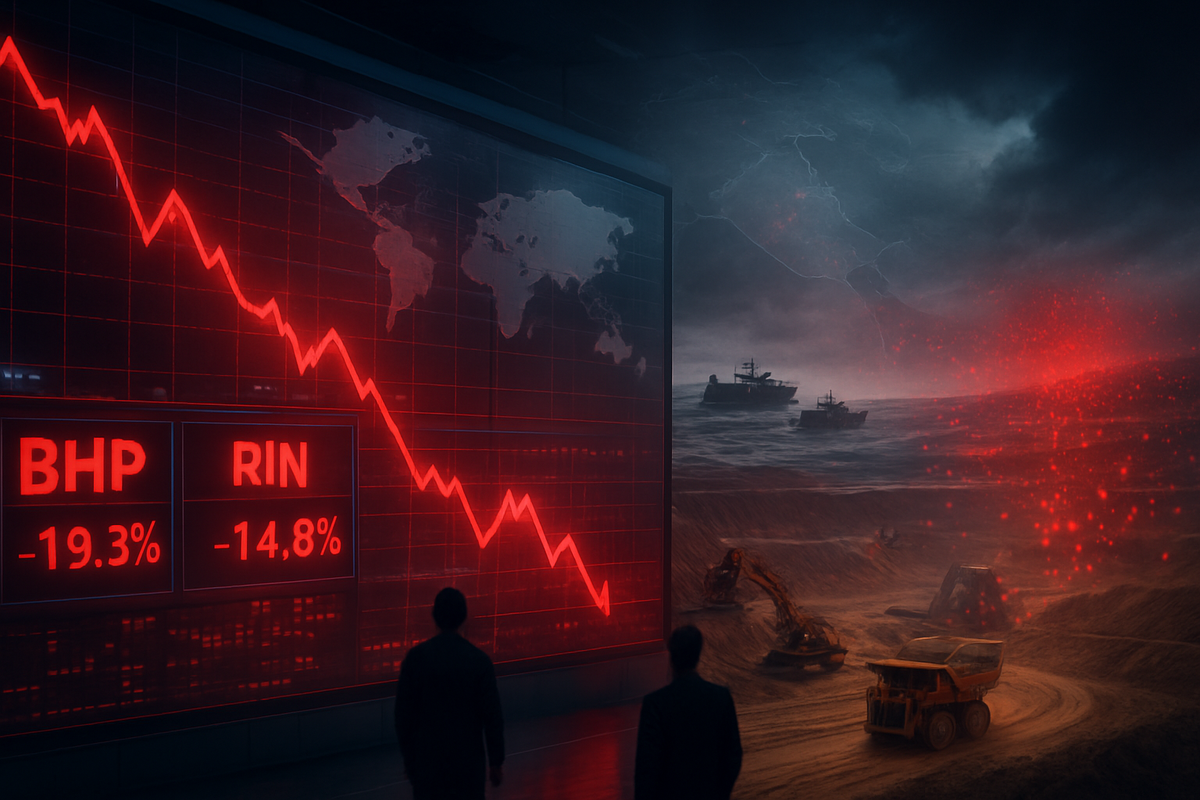
The S&P/ASX 200 Materials Index, the benchmark for the local mining industry, struggled from the opening bell, eventually settling at a 4.2% loss for the session. Traders described the atmosphere as "orderly but aggressive selling," as institutional funds moved to reduce exposure to companies with high energy dependencies. The timeline of the rout was swift; within the first hour of trade, nearly 80% of the companies within the index were trading in the red, with the heaviest losses concentrated among iron ore and base metal producers.
Key stakeholders, including the Minerals Council of Australia and various commodity analysts, have noted that the escalation has triggered "war risk" insurance protocols for shipping. This effectively adds an immediate surcharge to every dry bulk carrier leaving Western Australian ports. As bunker fuel prices tracked the spike in oil, the cost of moving a tonne of iron ore to North Asian ports surged by an estimated 15% in just twenty-four hours, severely compressing the margins of even the most efficient producers.
Major Miners Caught in the Crossfire
The industry’s "Big Three" bore the brunt of the institutional exodus. BHP Group (ASX:BHP), the world’s largest miner, saw its shares tumble 4.1% as investors fretted over its significant coal and iron ore logistics chain. While BHP remains a powerhouse of diversified assets, the sudden increase in diesel costs—a primary input for its massive Pilbara operations—has led analysts to revise short-term earnings projections downward.
Rio Tinto (ASX:RIO) fared slightly better but still ended the day down 3.5%. Rio’s heavy reliance on stable maritime trade with China makes it particularly sensitive to the blockade of the Strait of Hormuz, not just for its own shipping, but for the wider impact on Chinese manufacturing energy costs. Similarly, Fortescue (ASX:FMG) experienced a volatile session, with its stock price swinging wildly before finishing 4.7% lower. As a "pure-play" iron ore producer, Fortescue lacks the commodity diversification that might otherwise hedge against such a specific geopolitical shock.
Conversely, the day’s "winners"—if they can be called that in such a sea of red—were found in the gold sector. Evolution Mining (ASX:EVN) and Newmont Corporation (ASX:NEM) initially saw significant gains as investors sought the traditional safety of bullion, which briefly surged past $5,300 per ounce. However, even these gains were partially pared back late in the day as a broader market liquidity crunch forced some investors to sell profitable gold positions to cover margin calls elsewhere in their portfolios. Woodside Energy (ASX:WDS) was one of the few large-cap stocks to finish in positive territory, gaining 2.2% as the oil price spike directly inflated the value of its uncontracted LNG cargoes.
A Ghost of 'Liberation Day' and the Inflation Trap
For many seasoned market participants, the March 4 rout felt hauntingly familiar. Analysts have drawn direct comparisons to the "Liberation Day" tariff announcement of April 2, 2025, when the U.S. government introduced a sweeping 10% universal baseline tariff coupled with aggressive reciprocal duties. That event caused a 12.4% weekly plunge in the U.S. markets and a similar contagion effect in Australia. The 2026 mining rout is seen as the second act of this protectionist and volatile era, where global trade is no longer assumed to be fluid or safe.
The wider significance of this event lies in its impact on the macro-economic backdrop of 2026. Prior to this week, there were growing hopes that global inflation had finally been tamed. However, the closure of the Strait of Hormuz threatens to reignite energy inflation, which in turn pressures central banks to keep interest rates "higher for longer." For the materials sector, this is a double-edged sword: rising costs of production combined with a potential slowdown in global construction as borrowing costs remain elevated.
Furthermore, this event accelerates the "de-risking" trend that has been building since the 2025 trade wars. Large institutional investors are increasingly pivoting away from cyclical commodities toward "strategic" and "sovereign" assets. The historical precedent for this—most notably the 1970s oil shocks—suggests that mining stocks may face a prolonged period of multiple compression as the "geopolitical risk premium" is permanently baked into their valuations.
The Road Ahead: Strategic Pivots and Supply Chain Resilience
Looking forward, the immediate concern for the Australian mining sector is the duration of the Middle East conflict. If the Strait of Hormuz remains closed for more than 14 days, analysts at major investment banks predict a "Tier 1" supply chain crisis. Miners will likely need to implement radical cost-cutting measures or seek government subsidies for energy-intensive processes. We may also see a strategic pivot toward domestic energy security, with companies like Fortescue (ASX:FMG) potentially accelerating their green hydrogen and renewable energy initiatives to decouple their operations from the volatile diesel market.
In the short term, the market will be looking for a response from Beijing. If the Chinese government announces a fresh round of infrastructure stimulus to offset the energy shock to its economy, iron ore prices—and by extension, the share prices of BHP Group (ASX:BHP) and Rio Tinto (ASX:RIO)—could see a rapid recovery. However, in a world of high inflation and trade barriers, the efficacy of traditional stimulus is increasingly being questioned by market skeptics.
Final Assessment: A Lasting Impact on the Resource Sector
The March 4 rout is more than just a bad day on the trading floor; it is a stark reminder that the era of "easy globalization" is firmly in the rearview mirror. The 4.2% drop in the S&P/ASX 200 Materials Index serves as a clear signal that the mining sector is now the front line for geopolitical and inflationary risk. Investors must now weigh the traditional dividends and growth of the resources sector against a backdrop of increasing freight costs, insurance premiums, and potential supply chain ruptures.
Moving forward, the key indicators to watch will be the "war risk" premiums in the shipping industry and the movements of the U.S. Dollar. A strengthening dollar, often a result of geopolitical flight-to-quality, will continue to put pressure on commodity prices quoted in the greenback. For the Australian investor, the focus remains on resilience and diversification. While the "Big Three" miners remain essential pillars of the economy, their vulnerability to global shocks has never been more apparent.
As we navigate the coming months, the lasting impact of this rout will likely be a permanent shift in how resource stocks are valued. The "Liberation Day" tariffs of 2025 proved that trade is political; the "Red Tuesday" of March 2026 has proved that geography is destiny.
This content is intended for informational purposes only and is not financial advice.