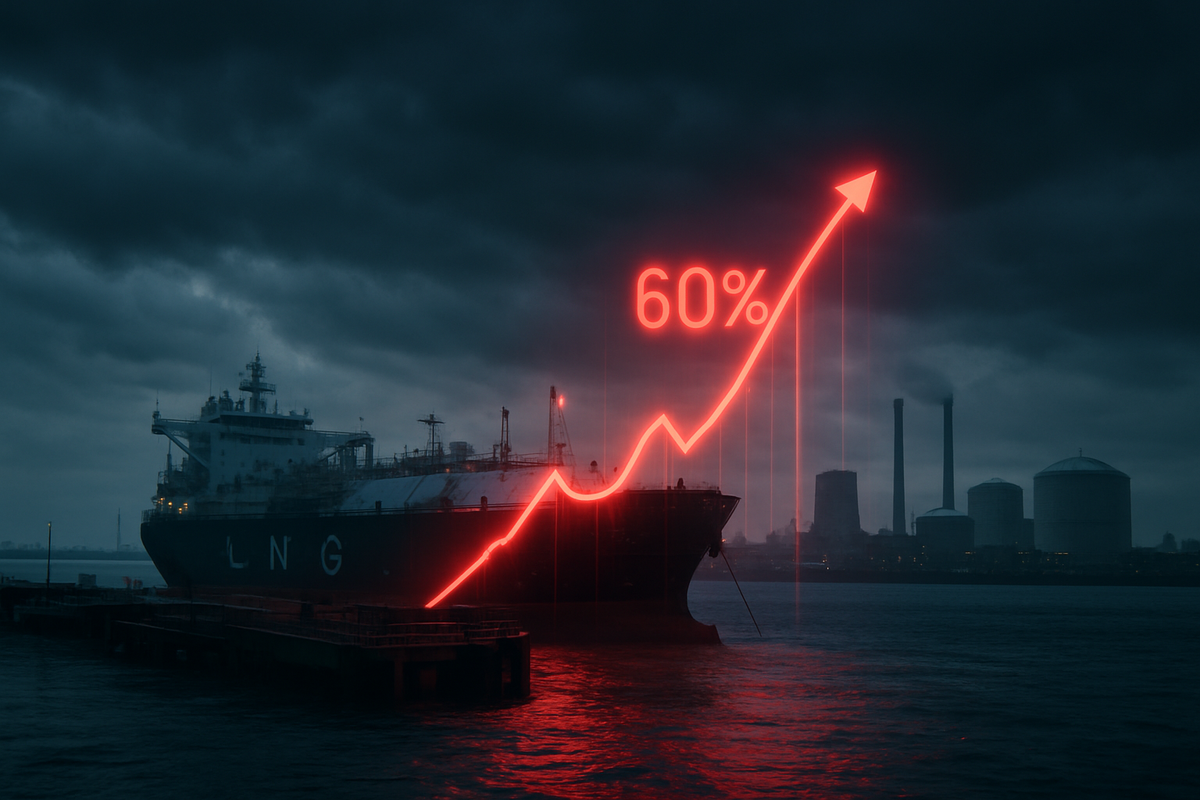
LONDON — European energy markets have been rocked by a violent price upheaval as the World Bank officially confirmed a nearly 60% surge in natural gas prices for the month of March 2026. This "March Shock" has dismantled two years of relative energy stability, driven by a rapid military escalation in the Middle East that effectively severed the primary maritime artery for global liquefied natural gas (LNG).
The crisis, which culminated in a near-total blockade of the Strait of Hormuz and targeted strikes on critical infrastructure in Qatar, has forced the European Union into a state of emergency. With storage levels sitting at precarious seasonal lows, the sudden absence of Qatari and Emirati shipments has triggered a frantic global bidding war for available cargoes, sending ripples through industrial supply chains and casting a long shadow over the continent’s economic recovery.
The Siege of Hormuz and the "Qatar Shock"
The volatility began in late February 2026, following a breakdown in nuclear negotiations and a series of high-stakes naval skirmishes in the Persian Gulf. On February 28, the conflict escalated into full-scale regional war—dubbed "Operation Epic Fury" by coalition forces—which led to the Iranian military declaring a "no-go zone" across the Strait of Hormuz. By March 4, tanker traffic through the world’s most critical energy chokepoint had ground to a halt. While the initial market reaction saw crude oil prices breach the $110 mark, the true catastrophe for Europe lay in the "Qatar Shock" that followed.
In mid-March, drone strikes targeted the Ras Laffan Industrial City in Qatar, a primary hub for global LNG exports. The damage forced several massive liquefaction "trains" offline, removing approximately 17% of global LNG export capacity from the market in a single week. QatarEnergy, a vital partner in Europe’s post-Russian diversification strategy, was forced to declare force majeure on its contracts. Consequently, the Dutch TTF benchmark—the primary indicator for European gas—skyrocketed from €32/MWh in late February to a peak near €70/MWh by March 31, representing a 59.4% monthly gain.
Corporate Winners and the Industrial Fallout
The market reaction has been starkly bifurcated, creating a landscape of clear corporate winners and struggling industrial giants. Cheniere Energy (NYSE: LNG) emerged as a primary beneficiary, with its shares hitting an all-time high of $299 in late March. Analysts at Morgan Stanley (NYSE: MS) noted that Cheniere’s ability to capture record spot premiums on its uncontracted volumes and sign new long-term agreements with desperate European buyers has positioned it as the new "lender of last resort" for gas. Similarly, Norway’s Equinor (NYSE: EQNR) saw its stock rise as it solidified its status as Europe’s bedrock pipeline supplier, with its unhedged production reaping massive windfalls.
Conversely, the "March Shock" has dealt a devastating blow to energy-intensive industries. Chemicals giant BASF (OTC: BASFY) has entered what analysts describe as "survival mode," announcing price hikes of up to 30% and production freezes at its flagship Ludwigshafen site. The fertilizer sector is facing an even more acute crisis; Yara International (OTC: YARIY) was forced to implement 25% production curtailments across Europe as the price of natural gas—the primary feedstock for ammonia—made operations economically unviable. Utilities are also under extreme duress; Uniper (OTC: UNPRF) shares plunged 14.5% in early April as the market assessed the staggering multi-billion dollar cost required to refill winter storage reserves at current prices.
A New Vulnerability: From Pipelines to Maritime Chokepoints
This crisis highlights a fundamental shift in European energy security since the 2022 invasion of Ukraine. While the 2022 crisis was defined by "concentration risk"—a heavy reliance on Russian pipelines—the 2026 "March Shock" has exposed the continent's new "maritime vulnerability." By diversifying away from Gazprom (OTC: OGZPY) in favor of global LNG, Europe has effectively traded pipeline dependency for exposure to maritime chokepoints and global commodity competition.
Unlike the 2022 crisis, where supply was cut by a single actor, the 2026 disruption is a logistical one. The EU is no longer just competing for a finite resource; it is competing for the route to that resource. This has prompted a rapid regulatory response. On February 3, 2026, the EU passed Regulation (EU) 2026/261, which mandates the permanent elimination of Russian gas by 2027. However, the March crisis has forced policymakers to reconsider the role of naval and diplomatic strategy in energy policy, shifting the focus from "energy sovereignty" to "geopolitical logistics."
The Road Ahead: Storage and Strategic Pivots
As of mid-April 2026, a tentative two-week ceasefire has been brokered in the Middle East, allowing for the clearing of mines and a slow resumption of tanker traffic. However, the damage to the Ras Laffan complex will take months to repair, and the psychological impact on the market is likely to be permanent. In the short term, the European Union faces a "storage race." With inventories currently at just 29%, well below the five-year average, the cost of refilling these reserves for the 2026-2027 winter could exceed €100 billion if prices do not retreat significantly.
In the long term, this shock is expected to accelerate the "electrification of everything." During the height of the March peak, Europe’s doubled solar capacity and expanded wind fleets acted as a critical buffer, saving billions in potential gas purchases. Investors should expect a surge in capital expenditure toward domestic green hydrogen and long-duration energy storage as companies seek to insulate themselves from the volatility of the global LNG market.
Conclusion: A Turning Point for Global Markets
The 2026 "March Shock" serves as a definitive end to the era of cheap, reliable energy imports for Europe. The 60% surge in prices is not merely a temporary spike but a symptom of a restructured global order where energy security is inextricably linked to maritime security. The World Bank’s data reflects a world where volatility is the new baseline, and the "Qatar Shock" has proven that no supply source is entirely immune to geopolitical disruption.
For investors, the coming months will require a focus on resilience. Watch for the summer storage refill rates and the speed of Qatari infrastructure repairs as primary indicators of price stability. While the immediate threat of a total blockade may have receded, the structural vulnerability of the European energy grid remains. Moving forward, the true value in the energy sector may no longer be found in those who simply possess the molecules, but in those who can guarantee their safe and reliable delivery.
This content is intended for informational purposes only and is not financial advice.