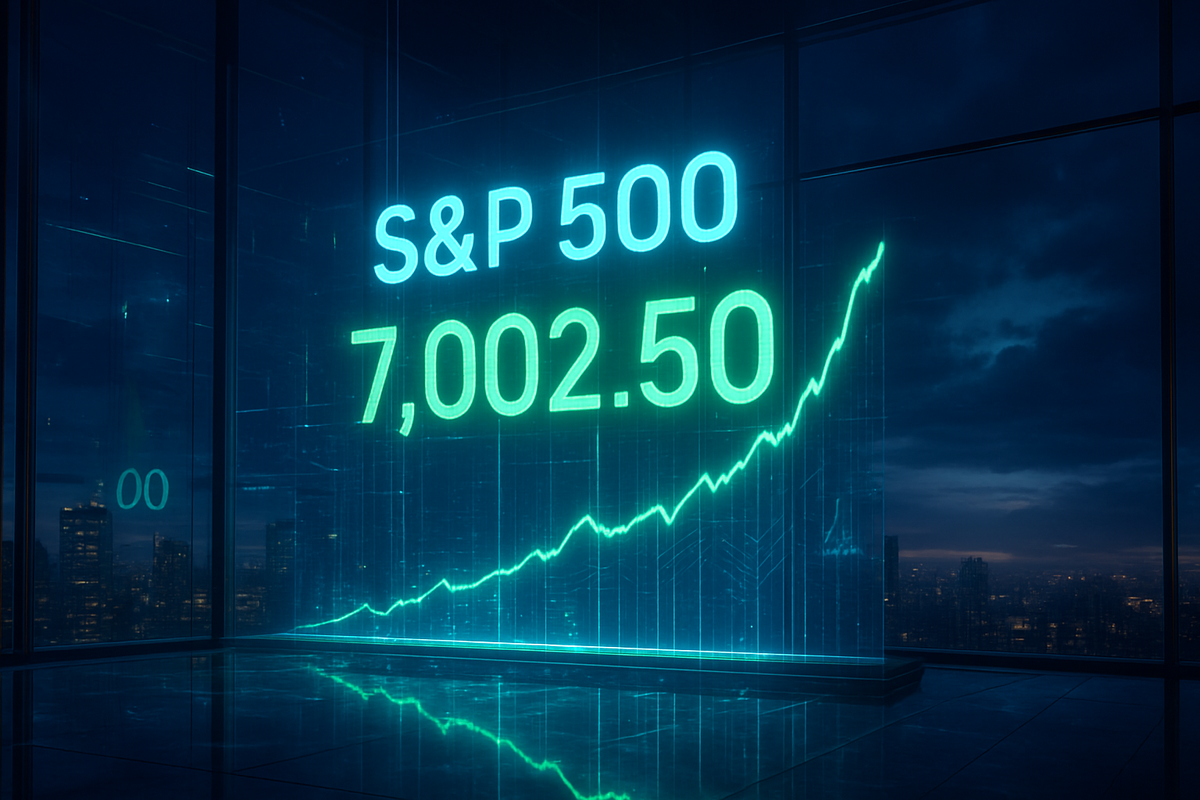
The S&P 500 (^GSPC) etched a new chapter in financial history this week, briefly cresting the psychologically formidable 7,000-point barrier to hit an intraday high of 7,002. This milestone, occurring in the final trading days of March and leading into early April 2026, marks the fastest 1,000-point ascent in the index's history, driven by a relentless "AI Super-Cycle" that has redefined corporate valuations over the last eighteen months.
However, the jubilant mood on Wall Street proved fleeting. Almost as soon as the index breached the 7,000 ceiling, late-week volatility took hold, sending the benchmark back into a consolidation zone below the milestone. A combination of shifting Federal Reserve leadership and renewed geopolitical tensions in the Middle East has introduced a wave of profit-taking, leaving investors to wonder if the 7,000 level is a new foundation or a temporary peak.
The Ascent to 7,002: A Timeline of Momentum
The journey to this week's 7,002 high began in earnest in late 2024, when the S&P 500 first crossed the 6,000-point mark. While that rally was fueled by post-election stability and resilient consumer spending, the push from 6,000 to 7,000 has been almost exclusively powered by the industrialization of Artificial Intelligence. Since January 2026, the index has flirted with the 7,000 level multiple times, but it wasn't until this week that a surge in mega-cap tech buying provided the final nudge needed to break the "Gamma Wall"—a concentration of options positioning that had previously acted as a hard ceiling.
Key stakeholders in this rally have been the institutional "AI bulls" who have bet heavily on the "Big Four" technology spenders. The intraday breach of 7,002 was sparked by mid-week optimism surrounding generative AI integration across enterprise software, but the momentum stalled as Friday approached. The late-week reversal was triggered by a "triple threat" of market anxieties: a spike in Brent crude prices following disruptions in the Strait of Hormuz, persistent core inflation data remaining at 2.6%, and the looming departure of Federal Reserve Chair Jerome Powell, whose term ends in May.
The Engines of Growth: Meta and Alphabet Lead the Charge
The primary catalysts for the push to 7,000 were Meta Platforms Inc. (NASDAQ: META) and Alphabet Inc. (NASDAQ: GOOGL). Meta, which spent much of 2025 aggressively expanding its "Superintelligence Labs," saw its stock surge as investors rewarded its massive capital expenditure. The company’s projected 2026 CapEx of $115–$135 billion, once a source of skepticism, is now viewed as a necessary moat. Meta’s AI-driven ad targeting tools, specifically Advantage+, have significantly boosted revenue, making it a cornerstone of the modern "S&P 7,000" portfolio.
Alphabet Inc. (NASDAQ: GOOGL) has seen a similar resurgence. After navigating a period of perceived vulnerability to AI startups in 2024, the company’s launch of Gemini 3 and its custom AI chip, Ironwood, have solidified its dominance. Google Cloud has transitioned into the company's primary growth engine, reporting year-over-year growth exceeding 30%. However, these gains are now being tested by the broader market volatility; while Meta and Alphabet provided the fuel to reach 7,002, they also became the primary targets for profit-taking as the week closed, with both stocks retreating from their own 52-week highs.
The Psychological Weight of 7,000 and the AI Super-Cycle
The 7,000 level represents more than just a number; it is a "psychological anchor" that validates the higher price-to-earnings multiples seen in the current era. Historically, such round numbers act as magnets for both buyers and sellers, creating what analysts call a "Sisyphus Moment" where the market repeatedly attempts to scale the peak only to roll back. The significance of 7,002 lies in its role as a litmus test for the "AI Super-Cycle." Unlike the dot-com bubble of 2000, current valuations are backed by record-breaking net incomes from companies like Microsoft (NASDAQ: MSFT) and NVIDIA (NASDAQ: NVDA), yet the speed of the ascent to 7,000 has sparked renewed debates about market "acrophobia"—the fear of heights.
This milestone also highlights a growing divide in the market. While the tech-heavy components of the index are flourishing, traditional sectors such as utilities and consumer staples have lagged, struggling with the "higher-for-longer" interest rate environment maintained by the Fed. The ripple effect of the S&P 500 hitting 7,000 has forced many active fund managers to chase performance, contributing to the "melt-up" dynamics observed earlier in the week, even as underlying economic indicators like the 10-year Treasury yield remain stubbornly high.
The Road Ahead: Fed Transitions and Earnings Pressure
As the market digests the brief breach of 7,000, all eyes are turning to the Federal Reserve’s April 28-29 meeting. The transition of leadership from Jerome Powell to his expected successor, Kevin Warsh, has introduced a layer of policy uncertainty. Warsh is perceived by some as more hawkish on inflation but potentially more aggressive on structural reforms, a combination that could either stabilize the dollar or send bond markets into a tailspin. Short-term, the S&P 500 is expected to consolidate between 6,800 and 7,000 as it awaits the next catalyst.
The upcoming Q1 2026 earnings season will be the ultimate arbiter of whether 7,000 was a premature peak or a sign of things to come. If the massive CapEx spending from the mega-caps continues to translate into bottom-line growth, a sustained move toward 7,100 could occur by early summer. However, if energy prices remain above $100 per barrel due to geopolitical shocks, the "supply-side inflation" could force the Fed to keep rates at 3.6% or higher, potentially capping the S&P 500's upside for the remainder of the year.
Closing the Chapter on the 7,000 Breach
The S&P 500's brief visit to 7,002 is a testament to the transformative power of the AI era and the sheer scale of the companies leading it. For investors, the key takeaway is that while the "ceiling" has been touched, the room for error has narrowed. The market has moved from a "growth at any cost" phase into a "show me the money" phase, where mega-cap giants must justify their trillion-dollar valuations with every quarterly report.
Moving forward, investors should watch for the resolution of the Fed leadership transition and the stability of the energy markets. While the headline of "S&P 7,000" grabbed the world's attention this week, the real story lies in the late-week volatility that followed—a reminder that even in a super-cycle, the laws of economic gravity still apply. As the market enters the second quarter of 2026, the 7,000 level will likely remain the most important technical and psychological battlefield for global finance.
This content is intended for informational purposes only and is not financial advice.