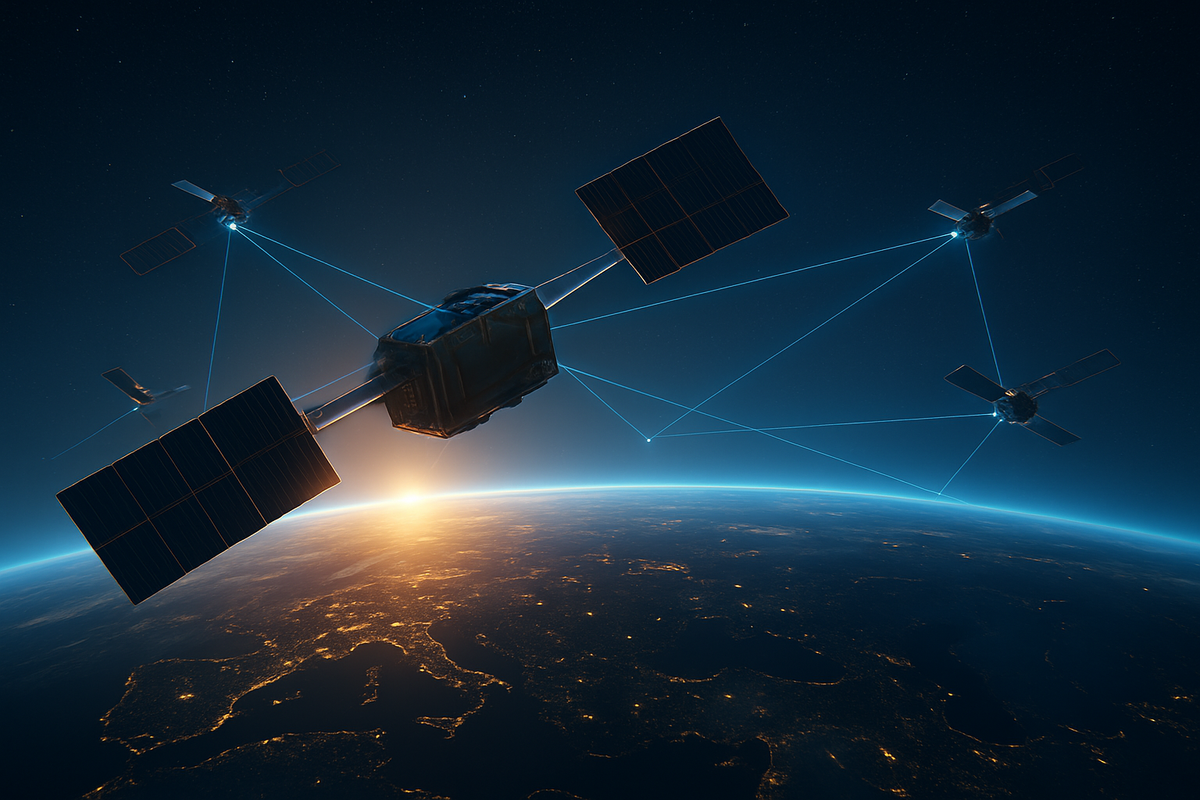
SEATTLE — In a milestone that fundamentally reshapes the global telecommunications landscape, Amazon (NASDAQ: AMZN) has officially initiated the commercial beta phase of Project Kuiper. As of April 8, 2026, the tech giant has begun onboarding a select group of enterprise, telecommunications, and government clients to its Low Earth Orbit (LEO) satellite network. This move signals Amazon’s transition from a massive infrastructure project to a functional global utility, setting the stage for what internal projections suggest will be a $20 billion annual revenue stream by 2030.
The launch of the enterprise beta program comes at a critical juncture for the satellite internet industry. With over 1,500 satellites currently in orbit, Amazon is rapidly approaching its FCC-mandated deadline to have half of its constellation deployed by July 2026. The initial service offers data speeds of up to 400 Mbps for standard enterprise terminals, while specialized high-demand units for the maritime and aviation sectors are reportedly achieving speeds exceeding 1 Gbps. This phase is not merely a technical test but a strategic deployment aimed at securing high-margin contracts before the service opens to the general public in late 2026.
From Prototypes to Production: The Road to Orbit
The journey to this week’s commercial launch has been defined by an unprecedented logistics and manufacturing blitz. Following the successful testing of its KuiperSat prototypes in late 2023, Amazon invested billions into a state-of-the-art satellite production facility in Kirkland, Washington. By mid-2025, this facility reached its peak cadence, churning out five satellites per day. This aggressive manufacturing schedule was paired with a historic "multilaunch" procurement strategy, utilizing rockets from United Launch Alliance (ULA), Arianespace, and Jeff Bezos’s own Blue Origin.
Key stakeholders have closely watched the deployment of the Vulcan Centaur and New Glenn rockets, which have been the primary workhorses for the constellation's build-out. To ensure it remained on schedule for the 2026 FCC milestone, Amazon even turned to its primary rival, SpaceX, for several Falcon 9 launches—a move that underscored the urgency of the Kuiper timeline. The current beta phase involves heavyweight strategic partners, including Verizon (NYSE: VZ) in the United States and Vodafone (NASDAQ: VOD) in Europe and Africa, who are integrating Kuiper’s backhaul capabilities into their existing 5G infrastructures to reach remote regions.
Initial market reactions have been cautiously optimistic, with Amazon’s stock showing resilience as the company demonstrates its ability to execute on a capital-intensive hardware project. Industry analysts suggest that the integration of Kuiper with Amazon Web Services (AWS) is the "secret sauce" that could give Amazon a competitive edge. By offering "edge-to-cloud" connectivity where remote data is beamed directly into AWS data centers via private satellite links, Amazon is providing a level of security and integration that traditional terrestrial providers struggle to match.
Winners and Losers in the New Space Race
The primary winner in this event is undoubtedly Amazon (NASDAQ: AMZN), which has successfully diversified its revenue beyond e-commerce and cloud computing. If the $20 billion revenue target is met by 2030, Project Kuiper would represent one of Amazon’s most successful "Other Bets," rivaling the early growth trajectory of AWS. Furthermore, enterprise partners like Caterpillar (NYSE: RIO) and Rio Tinto (NYSE: RIO) stand to gain significant operational efficiencies. These industrial giants are using the Kuiper beta to facilitate autonomous fleet management and real-time telemetry in some of the most remote mining sites on Earth.
Conversely, traditional terrestrial telecommunications companies that have failed to innovate in remote connectivity may face headwinds. While companies like Verizon (NYSE: VZ) have chosen to partner with Amazon, others may find their "rural coverage" moats evaporating as high-speed satellite internet becomes a commodity. Additionally, the launch puts direct pressure on SpaceX’s Starlink. While Starlink currently enjoys a first-mover advantage with a larger constellation, Amazon’s deep pockets and existing enterprise relationships through AWS pose the most significant threat to SpaceX’s market share in the B2B and government sectors.
The aerospace supply chain is also seeing a localized boom. Companies involved in satellite component manufacturing and ground station infrastructure are reaping the rewards of Amazon's massive Capex. However, the sheer volume of launches required for Kuiper and its competitors has led to a "launch bottleneck," potentially hurting smaller satellite startups that are being priced out of secondary payload spots on major rockets like the Vulcan or New Glenn.
A Broader Shift in Global Connectivity
The commencement of Kuiper’s commercial service fits into a broader industry trend toward the "democratization of data." For decades, high-speed internet was a privilege of geography; Project Kuiper, alongside Starlink, effectively decouples connectivity from physical infrastructure. This has massive implications for global GDP, as previously "dark" regions of the world are brought into the digital economy. Amazon’s focus on Africa through its Vodafone partnership suggests that the company views emerging markets not just as a philanthropic endeavor, but as a massive untapped subscriber base.
From a regulatory standpoint, the success of Project Kuiper will likely trigger new debates over orbital debris and "space traffic management." With thousands of new satellites entering LEO, the FCC and international bodies like the ITU (International Telecommunication Union) are under pressure to update safety protocols. Amazon’s commitment to de-orbiting its satellites at the end of their life cycle is a step toward sustainability, but the sheer density of these "mega-constellations" remains a point of concern for astronomers and environmentalists alike.
Historically, this event is being compared to the build-out of the transcontinental railroad or the initial rollout of fiber-optic cables in the 1990s. The difference here is the speed of deployment. While it took decades to wire the world with fiber, Amazon and SpaceX are "wiring" the world from above in less than ten years. This rapid shift is forcing a re-evaluation of national security and data sovereignty, as governments grapple with the reality of foreign-owned satellite networks providing the backbone for their domestic communications.
The Horizon: What Comes Next for Kuiper?
In the short term, investors should look for the expansion of the beta program into the consumer sector. While the current focus is on high-value enterprise clients, Amazon is expected to leverage its massive "Prime" subscriber base to offer discounted or bundled satellite internet packages by 2027. This could lead to a massive land grab for residential customers in rural North America and Europe. The success of this transition will depend on the affordability of the ground terminals—a hardware challenge that Amazon has spent years trying to solve with its low-cost phased array antennas.
Strategic pivots may also emerge as Amazon explores the "Lunar Economy." With Blue Origin’s growing capabilities and the infrastructure established by Project Kuiper, Amazon is well-positioned to provide communications for future moon missions and orbital habitats. The technology developed for Kuiper—specifically the inter-satellite laser links—could become the blueprint for a "Solar System Internet," although such developments remain a decade or more away.
Challenges remain, however. Maintaining a constellation of over 3,000 satellites requires constant replenishment launches, creating a perpetual cycle of capital expenditure. Amazon must prove that the high margins of enterprise contracts can offset these ongoing costs. Any significant delay in the launch schedule of New Glenn or any failures in the current Vulcan launch manifests could stall Amazon’s momentum and give competitors room to solidify their dominance.
Final Wrap-up: A New Chapter for the Digital Giant
The launch of Project Kuiper’s enterprise beta marks the end of Amazon's "silent phase" in space and the beginning of its era as a global telecommunications power. By leveraging its existing AWS ecosystem and a robust network of global partners, Amazon has created a compelling value proposition that goes beyond simple internet access. The $20 billion revenue goal by 2030 is ambitious, but it reflects the massive scale of the opportunity as the world moves toward universal connectivity.
For the market, this event signifies that the LEO satellite industry is no longer a monopoly. The competition between Amazon and SpaceX will likely drive down costs for consumers and drive up innovation in satellite technology. Investors should closely monitor Amazon’s quarterly Capex reports and the success of its upcoming FCC milestones in July 2026. These will be the primary indicators of whether Kuiper can maintain its current trajectory.
As we move into the second half of 2026, the focus will shift from "how many satellites are in the sky" to "how many customers are on the network." Amazon has built the infrastructure; now, it must prove it can manage a global utility at scale. If successful, Project Kuiper won't just be another business unit—it will be the literal backbone of the next generation of the internet.
This content is intended for informational purposes only and is not financial advice.