 (NewsUSA)
 - Next-generation robotics and advanced manufacturing are key to preserving American leadership in technology and AI, but the United States has fallen behind China in this essential arena, according to a new report from the Special Competitive Studies Project (SCSP), a nonprofit and nonpartisan initiative with a goal of making recommendations to strengthen America's long-term competitiveness in AI.
In the report, The Robot Deficit: Diagnosing the U.S.-China Competition in Robotics for Advanced Manufacturing, SCSP outlines how the competition for leadership in the robotics space has shifted as China has rapidly accelerated its activity in this space.
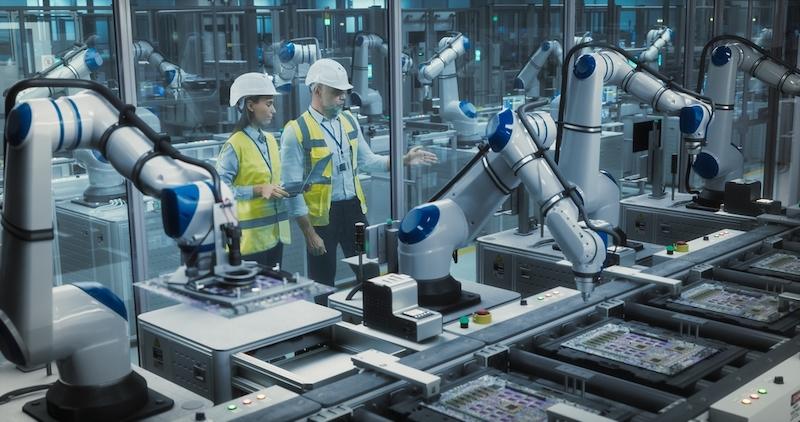
Attention to robotics is essential as the United States strives to improve its domestic manufacturing capacity, according to SCSP experts. Humans simply can’t manufacture the leading-edge products that will support dominance in technology, such as semiconductors and quantum devices, at the necessary scale. “In these domains, the ability to automate is synonymous with the ability to produce,” the experts noted in their new report.
Although the United States maintains a lead in cutting-edge innovation leadership and capabilities regarding software prowess, it has fallen short on developing the robotic automatic necessary to manufacture the components of technology—the semiconductors and quantum devices that can’t be manufactured at scale by humans.
According to the report, the U.S. needs to address four key areas:
Industrial Capacity. The U.S. currently trails China in manufacturing scale, supply chains, and raw materials. The U.S. reliance on imported components is a potential disadvantage to building automation tools in the event of a trade disruption or conflict.
Market Ecosystem. In 2024, China accounted for 54% of all global industrial robot installations. By contrast, the U.S. dominates venture capital funding but favors high-margin software over physical hardware. Changes are needed to expand industrial scaling.
Talent Pipeline. The good news: The United States attracts the top 1% of global elite researchers. However, experts predict that more than 2 million manufacturing jobs in will go unfilled, leaving a critical structural labor gap. China is working to reverse the brain drain and keep talent at home, while also launching significant academic programs in robotics.
National Leverage. Robotics in the United States remains highly fragmented because of a combination of bureaucratic bottlenecks and the lack of a comprehensive national plan.
Potential solutions to the deficit in robotics involve the government and industry working together, with measures including tax incentives for robotics, federally funded programs, and a dedicated government office to prioritize robotics and advanced manufacturing. Whether these plans succeed remains to be seen.
Visit scsp.ai to learn more.
The need for robotics manufacturing capacity is a strategic asset that the United States needs to rebuild, yet structural bottlenecks make such an objective unsustainable with current infrastructure.