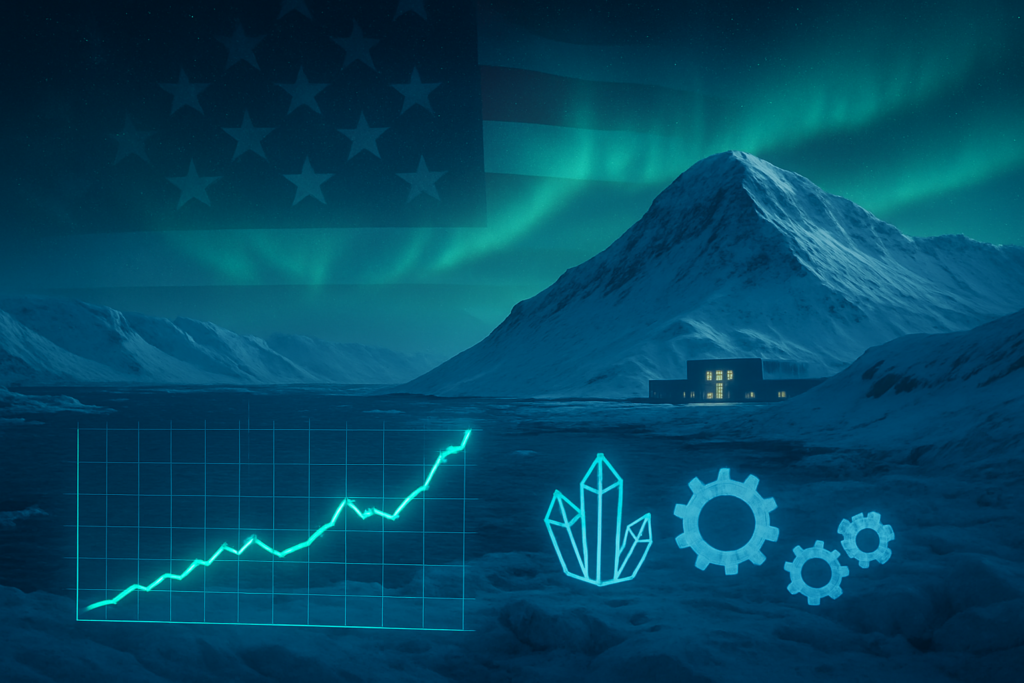
As of January 21, 2026, the world of prediction markets is fixated on an audacious geopolitical wager: the "Greenland Gamble." On the decentralized platform Polymarket, traders are currently pricing in a 20% to 23% probability that the United States will successfully acquire Greenland by the end of 2026. This surge in betting activity follows a series of aggressive diplomatic and economic maneuvers by the second Trump administration, which has effectively tied the island's sovereignty to the future of transatlantic trade.
The market has become a focal point for political analysts and investors alike, as it represents a real-time sentiment gauge on President Donald Trump’s "transactional" foreign policy. Just this morning, during a keynote address at the World Economic Forum in Davos, Switzerland, the President reiterated his intent to "once again discuss the acquisition of Greenland," framing it as a necessity for American national security and a hedge against Chinese expansion in the Arctic. With over $13.8 million in trading volume, the Greenland market is no longer a fringe curiosity; it is a high-stakes arena where the future of international borders is being traded in real-time.
The Market: What's Being Predicted
The primary vehicle for this speculation is the Polymarket contract titled "Will the U.S. acquire Greenland by the end of 2026?" The rules for resolution are stringent. To trigger a "Yes" payout, there must be a formal transfer of sovereignty—such as a signed treaty, ratified legislation by both the U.S. and Denmark, or a clear legal instrument of sale—on or before December 31, 2026. Notably, the market explicitly excludes scenarios where the U.S. merely secures additional military basing rights, long-term leases, or "joint administration" agreements that do not involve a total change in territorial ownership.
The odds have undergone a dramatic transformation over the last few months. In late 2025, the market hovered in the low single digits, with most participants viewing the proposal as a relic of Trump’s first term. However, the probability spiked following the January 17, 2026, announcement of a tiered tariff system targeting European nations. Liquidity in the market remains robust, with individual "whale" positions reaching hundreds of thousands of dollars, suggesting that some institutional-level traders believe the Danish government’s resolve may have a price.
Why Traders Are Betting
The 20% probability is largely driven by what traders call the "Tariff Bazooka." On January 17, President Trump announced via Truth Social that a 10% tariff would be imposed on eight European nations—including Denmark, France, and Germany—beginning February 1, 2026. He warned that these rates would jump to 25% by June if a "Complete and Total purchase" of Greenland was not finalized. For traders, this creates a binary outcome: either Denmark yields to economic pressure, or the U.S. risks a full-scale trade war with the European Union.
Beyond trade leverage, the strategic importance of Greenland’s mineral wealth is fueling the "Yes" side of the trade. Companies like Critical Metals Corp (Nasdaq: CRML) have seen their stock prices skyrocket—CRML is up 154% since the start of the year—as the U.S. Export-Import (EXIM) Bank signaled interest in a $120 million loan for the Tanbreez rare-earth project. Similarly, Greenland Resources Inc. (TSX: MOLY) has become a proxy for the island's value, as its Malmbjerg Molybdenum Project is central to the manufacture of high-strength defense steel. Traders betting "Yes" believe that the U.S. administration views Greenland not just as land, but as a critical supply chain asset that is "too big to leave to the Danes."
Broader Context and Implications
The "Greenland Gamble" highlights a growing trend in prediction markets: their use as a hedge against radical geopolitical shifts. If the U.S. were to actually acquire the territory, it would be the most significant expansion of American borders since the 1867 purchase of Alaska. However, the obstacles remain formidable. Danish Prime Minister Mette Frederiksen has repeatedly called the proposal "absurd," and the European Union has threatened to trigger its "Anti-Coercion Instrument," which would allow for massive retaliatory tariffs on American goods.
Historically, prediction markets have often been more accurate than traditional pundits because they force participants to "put their money where their mouth is." In this case, the 20% odds suggest that while the "sale" is unlikely, it is no longer impossible. The market reflects a world where traditional norms of sovereignty are being challenged by economic might. It also underscores a shift in how the public views Greenland—no longer as an autonomous territory of Denmark, but as a "real estate deal" in a new era of Great Power competition.
What to Watch Next
The immediate milestone for this market is February 1, 2026, the date the first 10% tariffs are scheduled to go into effect. If the Trump administration follows through with the implementation, traders expect the Polymarket odds to climb toward 30% as the economic pressure on Copenhagen intensifies. Conversely, any joint statement from NATO or a successful EU retaliatory package could send the "Yes" shares tumbling.
Another key factor is the internal politics of Greenland itself. Greenland’s Prime Minister, Jens-Frederik Nielsen, has maintained that the island is "not for sale." However, the U.S. has been increasing its "soft power" presence in the capital, Nuuk, through increased diplomatic staff and promises of massive infrastructure investment. Any shift in the Greenlandic Parliament’s stance toward "independence followed by a U.S. compact" would be a massive catalyst for market movement.
Bottom Line
The 20% probability of a Greenland acquisition represents a significant "Trump Premium"—a belief that the former developer's unorthodox and aggressive negotiating tactics can achieve what traditional diplomacy cannot. While the Danish government remains officially opposed, the massive volume on Polymarket suggests that a sizeable portion of the financial world is taking the threat of a trade-for-territory swap seriously.
Ultimately, the Greenland market serves as a fascinating case study in the power of prediction markets to quantify geopolitical risk. Whether the "Gamble" pays off or resolves to zero, the 20% odds currently reflect a world that is bracing for a fundamental reorganization of the Arctic. For now, the eyes of the world remain on the February 1st tariff deadline, which will likely serve as the first true test of this extraordinary 21st-century land deal.
This article is for informational purposes only and does not constitute financial or betting advice. Prediction market participation may be subject to legal restrictions in your jurisdiction.
PredictStreet focuses on covering the latest developments in prediction markets. Visit the PredictStreet website at https://www.predictstreet.ai/.