Beer company Boston Beer (NYSE: SAM) met Wall Street’s revenue expectations in Q1 CY2026, but sales fell by 4.4% year on year to $433.9 million. Its non-GAAP profit of $1.64 per share was 16.8% below analysts’ consensus estimates.
Is now the time to buy Boston Beer? Find out by accessing our full research report, it’s free.
Boston Beer (SAM) Q1 CY2026 Highlights:
- Revenue: $433.9 million vs analyst estimates of $435.7 million (4.4% year-on-year decline, in line)
- Adjusted EPS: $1.64 vs analyst expectations of $1.97 (16.8% miss)
- Adjusted EBITDA: -$162.5 million vs analyst estimates of $45.69 million (-37.4% margin, significant miss)
- Management lowered its full-year Adjusted EPS guidance to $9.50 at the midpoint, a 2.6% decrease
- Operating Margin: -43.9%, down from 7.4% in the same quarter last year
- Free Cash Flow was -$32.76 million compared to -$7.98 million in the same quarter last year
- Market Capitalization: $2.41 billion
“We were encouraged by early signs of improvement in the total beer category in the first quarter,” said Chairman, Founder and CEO Jim Koch.
Company Overview
Known for its flavorful beverages challenging the status quo, Boston Beer (NYSE: SAM) is a pioneer in craft brewing and a symbol of American innovation in the alcoholic beverage industry.
Revenue Growth
Reviewing a company’s long-term sales performance reveals insights into its quality. Even a bad business can shine for one or two quarters, but a top-tier one grows for years.
With $1.95 billion in revenue over the past 12 months, Boston Beer is a small consumer staples company, which sometimes brings disadvantages compared to larger competitors benefiting from economies of scale and negotiating leverage with retailers.
As you can see below, Boston Beer’s revenue declined by 2.1% per year over the last three years, a tough starting point for our analysis.
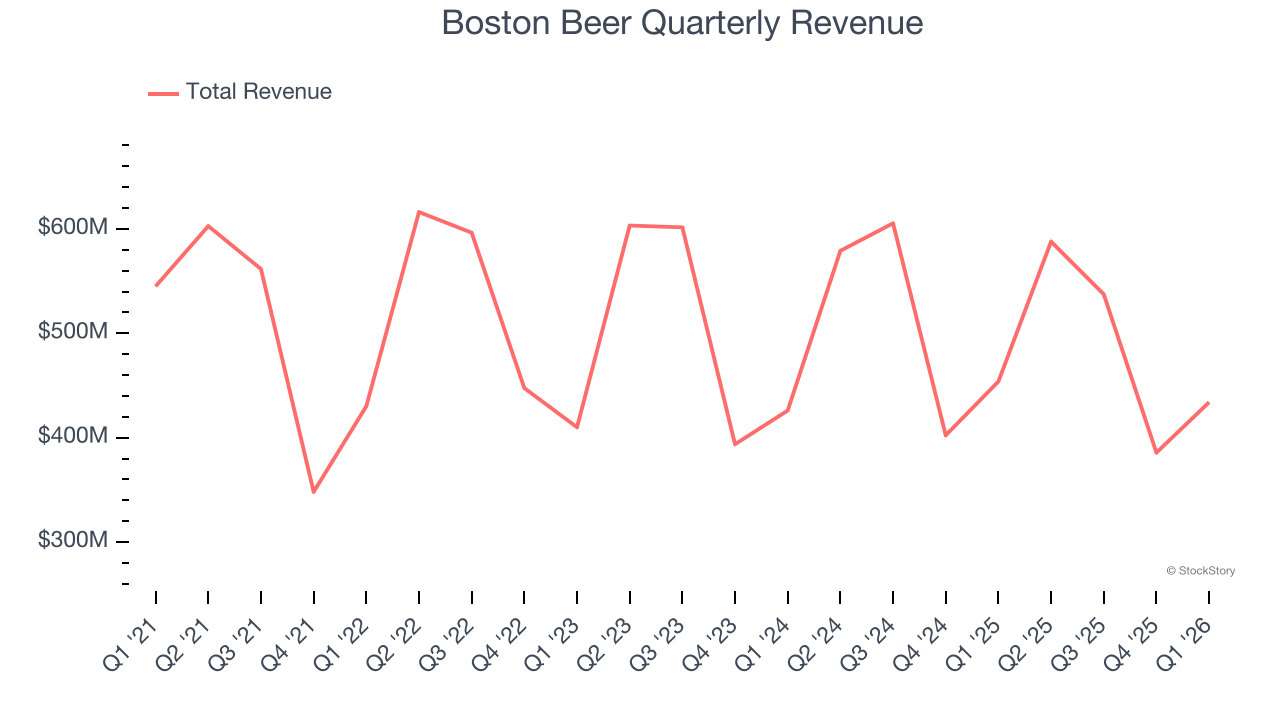
This quarter, Boston Beer reported a rather uninspiring 4.4% year-on-year revenue decline to $433.9 million of revenue, in line with Wall Street’s estimates.
Looking ahead, sell-side analysts expect revenue to grow 1.6% over the next 12 months. Although this projection suggests its newer products will catalyze better top-line performance, it is still below average for the sector.
WHILE YOU’RE HERE: The Next Palantir? One satellite company captures images of every point on Earth. Every single day. The Pentagon wants it. Hedge funds are using it to beat earnings. You’ve probably never heard of it.
This is what the early days of Palantir looked like before it became a $437 billion giant. Same playbook. Different technology. If you missed Palantir, you need to see this. Claim The Stock Ticker for Free HERE.
Cash Is King
Although earnings are undoubtedly valuable for assessing company performance, we believe cash is king because you can’t use accounting profits to pay the bills.
Boston Beer has shown robust cash profitability, driven by its attractive business model that enables it to reinvest or return capital to investors. The company’s free cash flow margin averaged 9.4% over the last two years, quite impressive for a consumer staples business. The divergence from its underwhelming operating margin stems from the add-back of non-cash charges like depreciation and stock-based compensation. GAAP operating profit expenses these line items, but free cash flow does not.
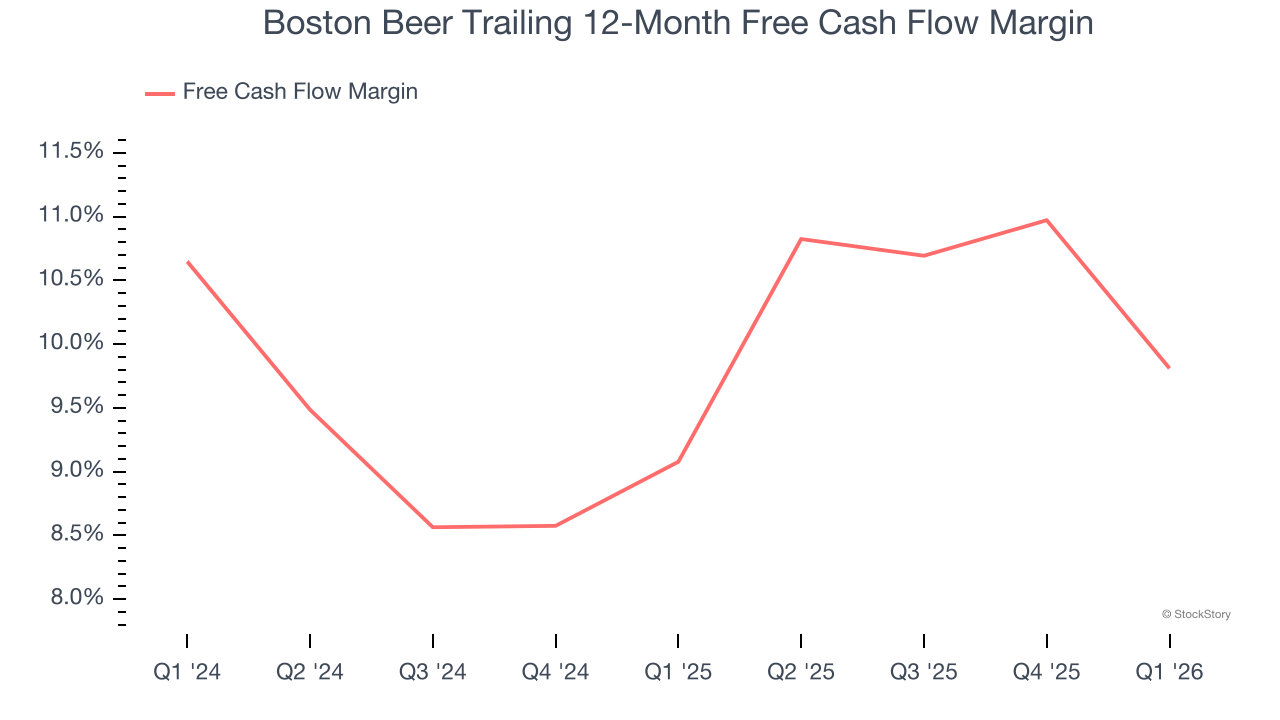
Boston Beer burned through $32.76 million of cash in Q1, equivalent to a negative 7.5% margin. The company’s cash burn increased from $7.98 million of lost cash in the same quarter last year. These numbers deviate from its longer-term margin, indicating it is a seasonal business that must build up inventory during certain quarters.
Key Takeaways from Boston Beer’s Q1 Results
We struggled to find many positives in these results. Its adjusted operating income missed and its EBITDA fell short of Wall Street’s estimates. Overall, this was a weaker quarter. The stock traded down 3.4% to $229 immediately after reporting.
Boston Beer may have had a tough quarter, but does that actually create an opportunity to invest right now? If you’re making that decision, you should consider the bigger picture of valuation, business qualities, as well as the latest earnings. We cover that in our actionable full research report which you can read here (it’s free).