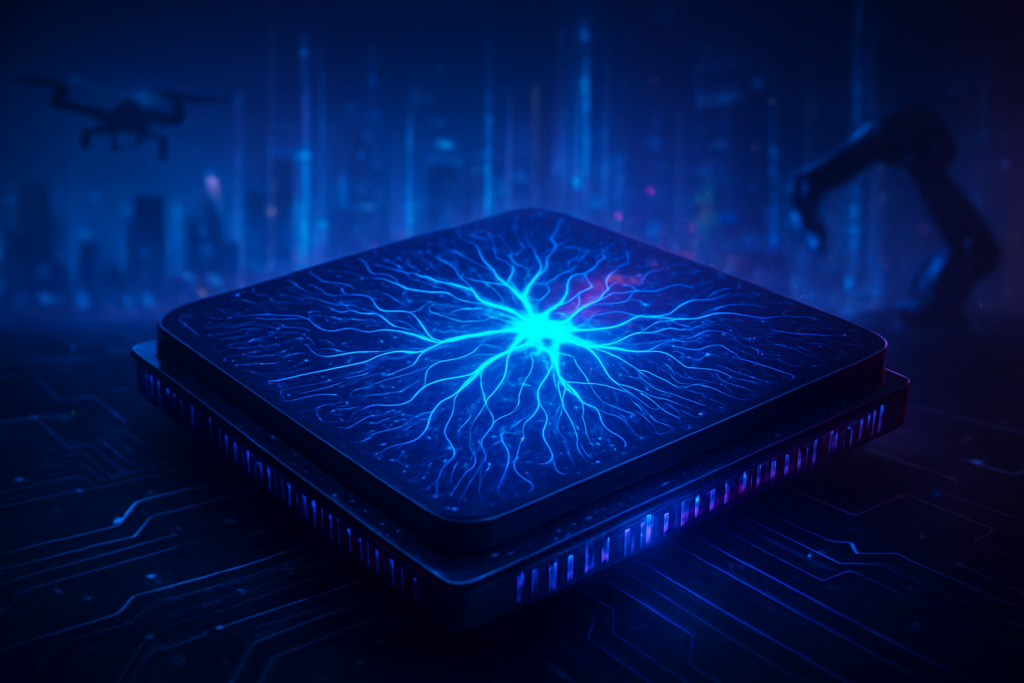
The artificial intelligence industry is currently grappling with the staggering energy demands of traditional data centers. However, a paradigm shift is occurring at the "edge"—the point where digital intelligence meets the physical world. In a series of breakthrough announcements culminating in early 2026, Intel (NASDAQ: INTC) has unveiled its third-generation neuromorphic processor, Loihi 3, marking a definitive move away from power-hungry GPU architectures toward ultra-low-power, spike-based processing. This development, supported by high-profile collaborations with automotive leaders and aerospace agencies, signals that the era of "always-on" AI that mimics the human brain’s efficiency has officially arrived.
Unlike the massive, energy-intensive Large Language Models (LLMs) that define the current AI landscape, these neuromorphic systems are designed for sub-millisecond reactions and extreme efficiency. By processing data as "spikes" of information only when changes occur—much like biological neurons—Intel and its competitors are enabling a new class of autonomous machines, from drones that can navigate dense forests at 80 km/h to prosthetic limbs that provide near-instant sensory feedback. This transition represents more than just a hardware upgrade; it is a fundamental reimagining of how machines perceive and interact with their environment in real time.
A Technical Leap: Graded Spikes and 4nm Efficiency
The release of Intel’s Loihi 3 in January 2026 represents a massive leap in capacity and architectural sophistication. Fabricated on a cutting-edge 4nm process, Loihi 3 packs 8 million neurons and 64 billion synapses per chip—an eightfold increase over the Loihi 2 architecture. The technical hallmark of this generation is the refinement of "graded spikes." While earlier neuromorphic chips relied on binary (on/off) signals, Loihi 3 utilizes up to 32-bit graded spikes. This allows the hardware to bridge the gap between traditional Deep Neural Networks (DNNs) and Spiking Neural Networks (SNNs), enabling developers to run mainstream AI workloads with a fraction of the power typically required by a GPU.
At the core of this efficiency is the principle of temporal sparsity. Traditional chips, such as those produced by NVIDIA (NASDAQ: NVDA), process data in fixed frames, consuming power even when the scene is static. In contrast, Loihi 3 only activates the specific neurons required to process new, incoming events. This allows the chip to operate at a peak load of approximately 1.2 Watts, compared to the 300 Watts or more consumed by equivalent GPU-based systems for real-time inference. Furthermore, the integration of enhanced Spike-Timing-Dependent Plasticity (STDP) enables "on-chip learning," allowing robots to adapt to new physical conditions—such as a shift in a payload's weight—without needing to send data back to the cloud for retraining.
The research community has reacted with significant enthusiasm, particularly following the 2024 deployment of "Hala Point," a massive neuromorphic system at Sandia National Laboratories. Utilizing over 1,000 Loihi processors to simulate 1.15 billion neurons, Hala Point demonstrated that neuromorphic architectures could achieve 15 TOPS/W (Tera-Operations Per Second per Watt) on standard AI benchmarks. Experts suggest that the commercialization of this scale in Loihi 3 marks the end of the "neuromorphic winter," proving that brain-inspired hardware can compete with and surpass silicon-standard architectures in specialized edge applications.
Shifting the Competitive Landscape: Intel, IBM, and BrainChip
The move toward neuromorphic dominance has ignited a fierce battle among tech giants and specialized startups. While Intel (NASDAQ: INTC) leads with its Loihi line, IBM (NYSE: IBM) has moved its "NorthPole" architecture into production for 2026. NorthPole differs from Loihi by co-locating memory and compute to eliminate the "von Neumann bottleneck," achieving up to 25 times the energy efficiency of an H100 GPU for image recognition tasks. This competitive pressure is forcing major AI labs to reconsider their hardware roadmaps, especially for products where battery life and heat dissipation are critical constraints, such as AR glasses and mobile robotics.
Startups like BrainChip (ASX: BRN) are also gaining significant ground. In late 2025, BrainChip launched its Akida 2.0 architecture, which was notably licensed by NASA for use in space-grade AI applications where power is the most limited resource. BrainChip’s focus on "Temporal Event Neural Networks" (TENNs) has allowed it to secure a unique market position in "always-on" sensing, such as detecting anomalies in industrial machinery vibrations or EEG signals in healthcare. The strategic advantage for these companies lies in their ability to offer "intelligence at the source," reducing the need for expensive and latency-prone data transmissions to central servers.
This disruption is already being felt in the automotive sector. Mercedes-Benz Group AG (OTC: MBGYY) has begun integrating neuromorphic vision systems for ultra-fast collision avoidance. By using event-based cameras that feed directly into neuromorphic processors, these vehicles can achieve a 0.1ms latency for pedestrian detection—far faster than the 30-50ms latency typical of frame-based systems. As these collaborations mature, traditional Tier-1 automotive suppliers may find their standard ECU (Engine Control Unit) offerings obsolete if they cannot integrate these specialized, low-latency AI accelerators.
The Global Significance: Sustainability and the "Real-Time" AI Era
The broader significance of the neuromorphic breakthrough extends to the very sustainability of the AI revolution. With global energy consumption from data centers projected to reach record highs, the "brute force" scaling of transformer models is hitting a wall of diminishing returns. Neuromorphic chips offer a "green" alternative for AI deployment, potentially reducing the carbon footprint of edge computing by orders of magnitude. This fits into a larger trend toward decentralized AI, where the goal is to move the "thinking" process out of the cloud and into the devices that actually interact with the physical world.
However, the shift is not without concerns. The move toward brain-like processing brings up new challenges regarding the interpretability of AI. Spiking neural networks, by their nature, are more complex to "debug" than standard feed-forward networks because their state is dependent on time and history. Security experts have also raised questions about the potential for "adversarial spikes"—targeted inputs designed to exploit the temporal nature of these chips to cause malfunctions in autonomous systems. Despite these hurdles, the impact on fields like smart prosthetics and environmental monitoring is viewed as a net positive, enabling devices that can operate for months or years on a single charge.
Comparisons are being drawn to the "AlexNet moment" in 2012, which launched the modern deep learning era. The successful commercialization of Loihi 3 and its peers is being called the "Neuromorphic Spring." For the first time, the industry has hardware that doesn't just run AI faster, but runs it differently, enabling applications—like sub-watt drone racing and adaptive medical implants—that were previously considered scientifically impossible with standard silicon.
The Future: LLMs at the Edge and the Software Challenge
Looking ahead, the next 18 to 24 months will likely focus on bringing Large Language Models to the edge via neuromorphic hardware. BrainChip recently secured $25 million in funding to commercialize "Akida GenAI," aiming to run 1.2-billion-parameter LLMs entirely on-device with minimal power draw. If successful, this would allow for truly private, offline AI assistants that reside in smartphones or home appliances without draining battery life or compromising user data. Near-term developments will also see the expansion of "hybrid" systems, where a traditional processor handles general tasks while a neuromorphic co-processor manages the high-speed sensory input.
The primary challenge remaining is the software stack. Unlike the mature CUDA ecosystem developed by NVIDIA, neuromorphic programming models like Intel’s Lava are still in the process of gaining widespread developer adoption. Experts predict that the next major milestone will be the release of "compiler-agnostic" tools that allow developers to port PyTorch or TensorFlow models to neuromorphic hardware with a single click. Until this "ease-of-use" gap is closed, neuromorphic chips may remain limited to high-end industrial and research applications.
Conclusion: A New Chapter in Silicon History
The arrival of Intel’s Loihi 3 and the broader industry's pivot toward spike-based processing represents a historic milestone in the evolution of artificial intelligence. By successfully mimicking the efficiency and temporal nature of the biological brain, companies like Intel, IBM, and BrainChip have solved one of the most pressing problems in modern tech: how to deliver high-performance intelligence at the extreme edge of the network. The shift from power-hungry, frame-based processing to ultra-low-power, event-based "spikes" marks the beginning of a more sustainable and responsive AI future.
As we move deeper into 2026, the industry should watch for the results of ongoing trials in autonomous transportation and the potential announcement of "Loihi-ready" consumer devices. The significance of this development cannot be overstated; it is the transition from AI that "calculates" to AI that "perceives." For the tech industry and society at large, the long-term impact will be felt in the seamless, silent integration of intelligence into every facet of our physical environment.
This content is intended for informational purposes only and represents analysis of current AI developments.
TokenRing AI delivers enterprise-grade solutions for multi-agent AI workflow orchestration, AI-powered development tools, and seamless remote collaboration platforms. For more information, visit https://www.tokenring.ai/.