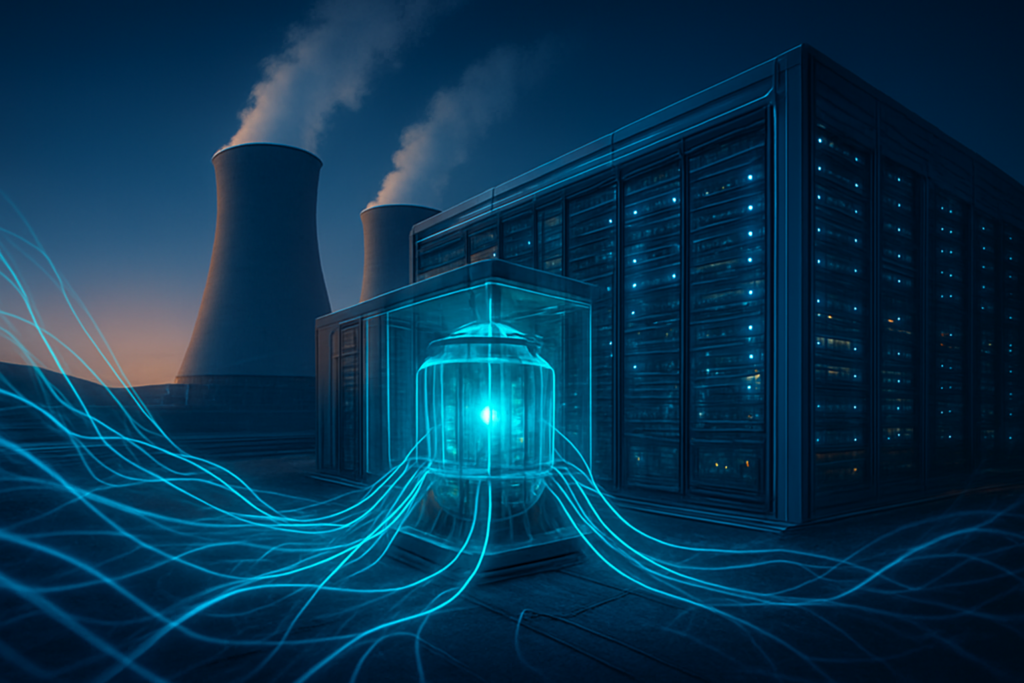
As the calendar turns to early 2026, the artificial intelligence revolution has reached a critical inflection point where the bottleneck is no longer just the availability of high-end GPUs, but the electrons required to power them. The "Nuclear Renaissance" is no longer a theoretical projection; it is a multi-billion-dollar reality driven by the insatiable energy demands of generative AI superclusters. In a historic shift from software-centric strategies to heavy industrial infrastructure, the world’s largest technology firms are now functioning as the primary financiers and stakeholders of a new era of carbon-free, baseload atomic power.
The immediate significance of this development lies in its scale and speed. Leading the charge, Microsoft (NASDAQ: MSFT) and Constellation Energy (NASDAQ: CEG) have accelerated plans to revive a dormant icon of American nuclear history, while Alphabet (NASDAQ: GOOGL) and Amazon (NASDAQ: AMZN) have pivoted toward Small Modular Reactors (SMRs). These moves signify a departure from the "green energy" strategies of the last decade, which focused on intermittent solar and wind. To maintain the 24/7 uptime required for model training and inference, the industry has effectively declared that the future of AI is nuclear.
Technical Foundations: From Three Mile Island to Small Modular Reactors
The technical centerpiece of this movement is the resurrection of Unit 1 at the Three Mile Island facility, officially renamed the Crane Clean Energy Center (CCEC). Under a 20-year Power Purchase Agreement (PPA) with Microsoft, the 835-megawatt (MW) plant is currently undergoing an intensive refurbishment. As of February 2, 2026, the project is tracking ahead of its initial 2028 schedule, with major components like main power transformers already installed. Unlike the neighboring Unit 2, which suffered a partial meltdown in 1979, Unit 1 has a history of exceptional performance and safety, and its restart provides a massive, immediate "baseload" of carbon-free energy dedicated entirely to Microsoft’s regional data centers.
Simultaneously, Google and Amazon are betting on a new generation of reactor technology: Small Modular Reactors (SMRs). Google’s partnership with Kairos Power utilizes a Fluoride Salt-cooled High-temperature Reactor (KP-FHR). This design is a radical departure from traditional light-water reactors, using a low-pressure molten fluoride salt coolant that allows for safer operation at near-atmospheric pressure. The reactors use TRISO (TRistructural ISOtropic) fuel—small pebbles that are virtually unmeltable—retaining fission products even under extreme temperatures. Google expects its first SMR to go online by 2030, with a fleet providing 500 MW by 2035.
Amazon, through its $500 million investment in X-energy, is championing the Xe-100 High-Temperature Gas-cooled Reactor (HTGR). These 80 MWe modules use helium gas as a coolant and are designed for factory fabrication, allowing them to be shipped to sites and assembled much like modular data centers. A key technical advantage of the Xe-100 is "online refueling," where fuel pebbles are continuously cycled through the core, eliminating the need for periodic shutdowns. This aligns perfectly with the requirement for 100% "always-on" power for AI inference clusters.
Market Implications: The New "Energy Arms Race"
The shift toward nuclear power has fundamentally altered the competitive landscape for hyperscalers. The market has realized that the company with the most reliable, cheapest, and cleanest energy will ultimately win the AI race. This has led to a "vertical integration" strategy where tech giants are no longer merely customers of utilities but active developers of grid infrastructure. Meta (NASDAQ: META) recently shocked the market in January 2026 by securing a record-breaking 6.6 Gigawatt (GW) commitment through a consortium including Oklo (NYSE: OKLO), Vistra (NYSE: VST), and TerraPower.
This development places traditional utilities in a complex position. While these massive contracts provide guaranteed revenue for plant restarts and new builds, they also risk siphoning clean energy away from the public grid, potentially driving up costs for residential consumers. For AI startups, the barrier to entry has risen once again; without the capital to underwrite a nuclear reactor, smaller labs may find themselves dependent on the infrastructure of the "Big Five" to run their massive models, further consolidating power within the incumbent tech giants.
Strategically, these investments provide a hedge against future carbon taxes and regulatory shifts. By locking in decades of fixed-price energy through PPAs or direct ownership, companies like Microsoft and Amazon are protecting their profit margins against the volatility of the natural gas and electricity markets. The ability to claim "100% carbon-free" operations while running the world’s most power-hungry supercomputers is a critical marketing and ESG (Environmental, Social, and Governance) advantage in an era of increasing climate scrutiny.
Wider Significance: AI Growth vs. Climate Realities
The "Nuclear Renaissance" represents the most significant shift in the global energy transition in the last 50 years. For decades, the tech industry relied on solar and wind credits to offset their carbon footprints. However, the sheer density of AI workloads—which require ten times more power per rack than traditional cloud computing—has rendered intermittent renewables insufficient for 24/7 reliability. This has forced a reconciliation between the environmental goals of Silicon Valley and the practical physics of power generation.
This trend also signals a major change in public and political perception of nuclear energy. The "not in my backyard" (NIMBY) sentiment that long plagued the industry is being eroded by the economic promise of AI-driven data centers, which bring high-paying jobs and tax revenue to local communities. The U.S. government has responded with streamlined regulatory pathways for SMRs, recognizing that AI dominance is now a matter of national security and economic competitiveness.
However, concerns remain. The rapid deployment of SMRs at scale has never been done before, and the supply chain for High-Assay Low-Enriched Uranium (HALEU) fuel remains fragile. Critics also point out that while nuclear is carbon-free, it still produces radioactive waste and requires significant water for cooling. Compared to previous AI milestones like the release of GPT-4, the "nuclear pivot" marks the moment when the digital world had to physically and permanently alter the hardware of the real world to survive.
Future Developments and Predicted Milestones
Looking toward the late 2020s, the next major milestone will be the successful commercial operation of the first SMR "four-pack" cluster. Experts predict that if X-energy or Kairos Power can prove their factory-built models are cost-effective, we will see a rapid proliferation of "behind-the-meter" nuclear plants. These reactors will be built directly adjacent to data centers, bypassing the aging and congested national grid entirely.
Furthermore, the focus is already shifting toward nuclear fusion. While still considered a "long shot" for the 2030s, companies like Helion—backed by Microsoft—are aiming to bridge the gap between fission and fusion. The immediate challenge, however, will be the Nuclear Regulatory Commission’s (NRC) ability to keep pace with the tech industry’s timeline. We expect to see a surge in "modular" regulatory approvals, where standardized reactor designs are pre-certified to speed up deployment across different states.
In the long term, AI itself may be the key to solving nuclear energy’s greatest challenges. Machine learning models are already being deployed to optimize reactor cores, predict maintenance needs with unprecedented accuracy, and even manage the complex plasma physics required for fusion. The relationship is becoming symbiotic: AI needs nuclear to run, and nuclear needs AI to become the most efficient energy source on Earth.
Summary and Final Assessment
The convergence of AI and nuclear power is a defining chapter in the history of technology. By reviving Three Mile Island and championing the next generation of modular reactors, Microsoft, Google, and Amazon have ensured that the AI boom is not stalled by an energy crisis. The transition from 2024’s "GPU shortage" to 2026’s "Nuclear Renaissance" highlights the massive physical footprint of what was once considered "the cloud."
Key takeaways for the coming months include the progress of the Crane Clean Energy Center’s restart and the first concrete pours for SMR test sites in Washington and Virginia. As we monitor these developments, it is clear that the AI revolution has become the single greatest catalyst for energy innovation in the 21st century. The world is watching to see if this marriage of 20th-century atomic physics and 21st-century digital intelligence can deliver a sustainable future for the world’s most transformative technology.
This content is intended for informational purposes only and represents analysis of current AI developments.
TokenRing AI delivers enterprise-grade solutions for multi-agent AI workflow orchestration, AI-powered development tools, and seamless remote collaboration platforms.
For more information, visit https://www.tokenring.ai/.