As healthcare providers prioritize efficiency, accuracy, and scalable patient care delivery, AI-enabled devices are increasingly viewed as essential operational infrastructure rather than emerging innovation.
NEWARK, DE / ACCESS Newswire / May 12, 2026 / According to the latest analysis by Future Market Insights, the AI-enabled Medical Devices Market is entering a transformational growth phase as artificial intelligence becomes embedded across nearly every category of modern healthcare technology. What was once viewed as an experimental enhancement to medical equipment is now evolving into a foundational capability driving diagnostic precision, workflow automation, patient monitoring, and treatment optimization across hospitals, clinics, ambulatory care centers, and home healthcare settings.
Healthcare systems worldwide are increasingly adopting AI-enabled devices to address mounting clinical pressures including physician shortages, rising chronic disease prevalence, growing imaging workloads, and the need for faster, more accurate diagnosis. AI-powered imaging systems, wearable monitoring platforms, surgical navigation tools, and predictive clinical decision support devices are now demonstrating measurable improvements in patient outcomes, operational efficiency, and healthcare accessibility.
As regulatory frameworks mature and approval pathways become more standardized, AI-enabled medical devices are rapidly moving from pilot-stage innovation into mainstream procurement strategies. Hospitals and healthcare networks are increasingly treating AI integration not as an optional premium feature but as a baseline requirement for next-generation medical device investments.
Detailed market forecasts, competitive benchmarking, and service trends:https://www.futuremarketinsights.com/reports/sample/rep-gb-26320
Quick Stats Snapshot
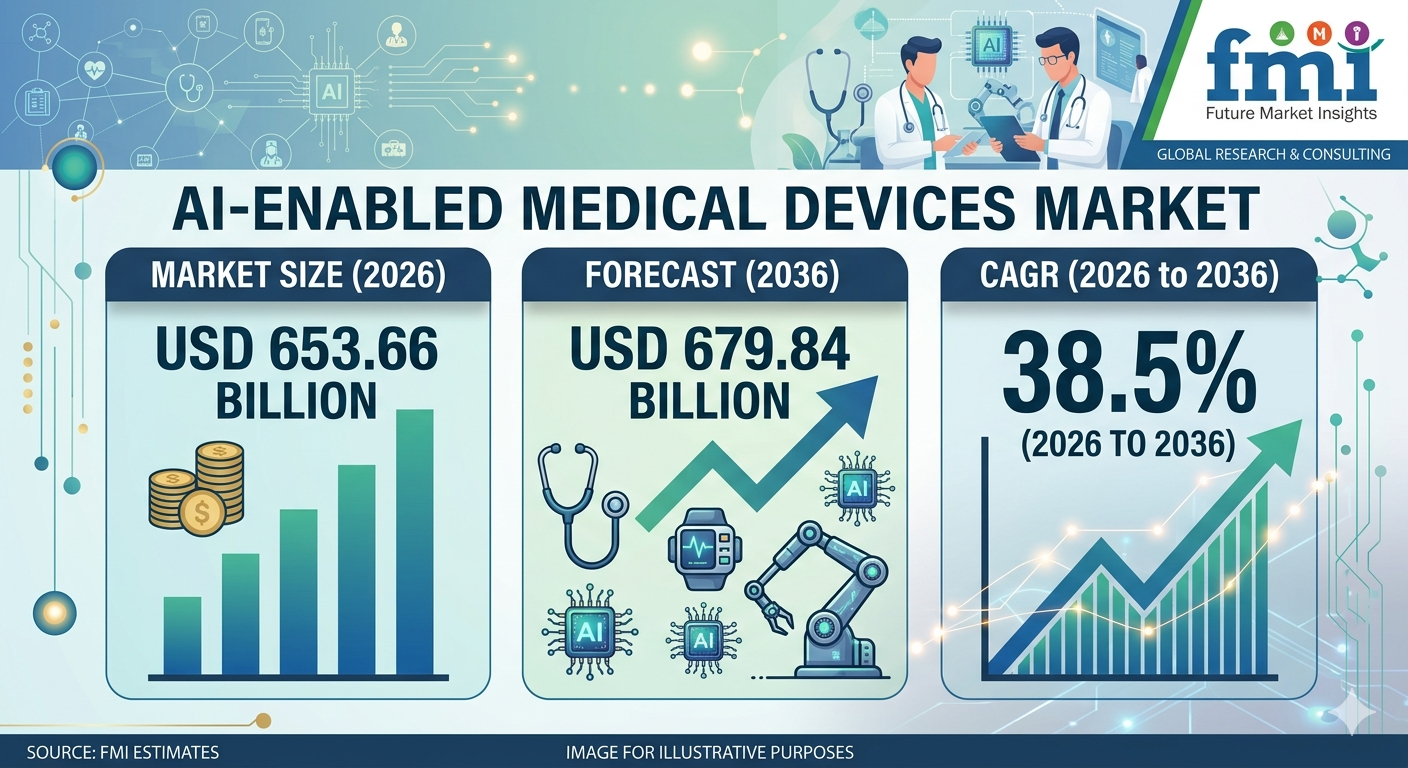
Market size (2026): USD 653.66 billion
Forecast (2036): USD 679.84 billion
CAGR (2026-2036): 38.5%
2025 baseline: USD 18.90 billion
Incremental opportunity: USD 653.66 billion
Leading component: Software (51.2% share)
Top technology: Machine Learning (35.7% share)
Largest therapeutic area: Radiology (35.0% share)
Fastest-growing markets: Brazil (33.4% CAGR) and USA (32.5% CAGR)
Market Size and Forecast: AI Transitions from Enhancement to Core Clinical Infrastructure
The AI-enabled medical devices market is projected to expand from USD 26.18 billion in 2026 to USD 679.84 billion by 2036, reflecting one of the fastest growth trajectories across the global healthcare technology sector.
This growth signals more than increased technology adoption. It represents a structural transformation in healthcare delivery, where AI is becoming embedded into diagnostic workflows, monitoring systems, imaging platforms, surgical devices, and clinical decision-making infrastructure.
As healthcare providers prioritize efficiency, accuracy, and scalable patient care delivery, AI-enabled devices are increasingly viewed as essential operational infrastructure rather than emerging innovation.
Growth Drivers: Why Demand Is Accelerating
Demand for Higher Diagnostic Accuracy: AI-powered imaging and diagnostic systems are demonstrating detection accuracy comparable to or exceeding specialist physician performance in selected applications across radiology, cardiology, ophthalmology, and oncology.
Hospitals are adopting AI-enabled devices to improve diagnostic throughput while reducing interpretation variability and clinical workload pressures.
Expansion of Remote Patient Monitoring: Healthcare systems are increasingly deploying AI-enabled wearable devices and connected monitoring platforms to support chronic disease management, hospital-at-home programs, and post-surgical recovery monitoring.These systems enable continuous patient surveillance with predictive alerts for early clinical deterioration.
Regulatory Framework Maturation: Regulatory agencies including the FDA, EU authorities, and global medical device regulators are establishing clearer pathways for AI-enabled medical device approval, accelerating commercialization and market confidence.Hundreds of AI medical device authorizations have already been granted globally across multiple therapeutic areas.
Shift Toward Value-Based Healthcare: Healthcare providers are prioritizing technologies capable of improving patient outcomes while reducing operational costs. AI-enabled devices align closely with value-based care objectives through workflow optimization and predictive analytics.
Challenges: Key Barriers Facing the Market
Clinical Validation Requirements: Healthcare providers increasingly require robust peer-reviewed clinical evidence before large-scale procurement of AI-enabled devices.Demonstrating measurable improvements in patient outcomes remains critical for adoption.
Integration Complexity: Hospital deployment often requires integration with electronic health records (EHRs), PACS imaging systems, and existing clinical workflows, creating technical implementation challenges.
Physician Adoption Resistance: Despite strong technological progress, adoption may be slowed by clinician concerns around workflow disruption, explainability of AI recommendations, and liability considerations.
Opportunities: Where Strategic Value Is Emerging
AI-powered Radiology Platforms: Radiology remains the most commercially mature AI medical device category, with strong demand for automated image analysis, abnormality detection, and urgent case prioritization tools.
Software-as-a-Medical-Device (SaMD): SaMD frameworks are enabling faster deployment and continuous improvement of AI algorithms independent of hardware replacement cycles, supporting subscription-based commercial models.
Home Healthcare Expansion: AI-enabled remote monitoring devices are expanding healthcare delivery beyond hospitals into home care and ambulatory settings.
Workflow Automation and Clinical Efficiency: Hospitals are increasingly investing in AI systems that improve workflow prioritization, automate repetitive tasks, and optimize clinical resource allocation.
Segmentation Insights: How the Market Is Structured
By Component: Software leads the market with a 51.2% share in 2026, driven by the central role of AI algorithms in diagnostic analysis, clinical decision support, and predictive monitoring.
By Technology: Machine Learning accounts for 35.7% of the technology segment, reflecting its foundational role in image recognition, pattern analysis, and predictive clinical modeling.
By Therapeutic Area: Radiology dominates with a 35.0% share due to the maturity of AI-powered imaging analysis across X-ray, CT, MRI, and ultrasound applications.
By End Use: Hospitals and clinics remain the primary adoption centers, although home care settings are emerging rapidly as AI-enabled remote monitoring expands.
Speak to Analyst: Customize insights for your business strategy: https://www.futuremarketinsights.com/customization-available/rep-gb-26320
Regional Analysis: Where Growth Is Concentrated
Brazil (33.4% CAGR): Brazil leads global growth due to expanding healthcare infrastructure, increased investment in advanced medical technology, and government-backed health digitization initiatives.
United States (32.5% CAGR): The USA continues to benefit from the world's largest healthcare spending base, mature FDA approval pathways, and aggressive hospital adoption of AI-enabled diagnostic technologies.
United Kingdom (31.5% CAGR): NHS digital transformation initiatives and AI-supported remote monitoring programs are driving strong demand across clinical settings.
Germany (30.6% CAGR): Germany's advanced medical device ecosystem and EU MDR regulatory clarity continue supporting rapid AI-enabled device integration.
Japan (29.7% CAGR): Japan's aging population and strong healthcare technology adoption culture are accelerating demand for AI-powered monitoring and diagnostic systems.
Competitive Landscape: AI Integration Defines Market Leadership
Competition is increasingly centered on clinical validation depth, interoperability, and integration across healthcare ecosystems.
Key participants include:
Siemens Healthineers
GE Healthcare
Philips Healthcare
Medtronic
Johnson & Johnson (Ethicon)
Stryker
Canon Medical Systems
Abbott Laboratories
Zimmer Biomet
Boston Scientific
Major device manufacturers are embedding AI across imaging systems, patient monitoring devices, surgical platforms, orthopedic technologies, and interventional equipment.
Strategic Implications for Decision-Makers
For Hospital Systems: AI-enabled device procurement is increasingly becoming part of broader digital transformation strategies focused on workflow efficiency and precision diagnostics.
For Medical Device Manufacturers: Competitive advantage will depend heavily on clinical evidence generation, interoperability, and scalable AI deployment frameworks.
For Investors: Companies capable of demonstrating validated clinical outcomes and recurring software revenue models are positioned for long-term growth leadership.
For Healthcare Regulators: Balancing innovation acceleration with patient safety oversight will remain central as AI-enabled medical devices expand across therapeutic applications.
Future Outlook: Toward AI-Augmented Healthcare Delivery
Over the next decade, the market is expected to evolve in three major directions:
AI as Standard Clinical Infrastructure: AI capabilities will increasingly become embedded by default across imaging systems, surgical devices, monitoring platforms, and diagnostic equipment.
Expansion of Predictive and Preventive Care: AI-enabled monitoring systems will play a growing role in early disease detection, chronic disease prediction, and preventive intervention models.
Convergence of Devices, Data, and Automation; Medical devices, clinical software platforms, and healthcare analytics ecosystems will become increasingly interconnected through AI-driven interoperability frameworks.
Unlock 360° insights for strategic decision making and investment planning: https://www.futuremarketinsights.com/checkout/26320
Executive Takeaways
AI-enabled medical devices are transitioning from emerging innovation to core healthcare infrastructure.
Market growth is driven by diagnostic accuracy improvement, workflow efficiency, and remote patient monitoring expansion.
Software and machine learning technologies remain the dominant growth engines across device categories.
Radiology continues to lead commercialization due to mature imaging AI applications and validated clinical performance.
Competitive leadership increasingly depends on clinical evidence, interoperability, and scalable AI integration capabilities.
For healthcare organizations navigating digital transformation, the direction is increasingly evident: AI-enabled medical devices are no longer supplemental technologies they are rapidly becoming the operational backbone of next-generation healthcare delivery.
Explore More Related Studies Published by FMI Research:
Medical Devices Market: https://www.futuremarketinsights.com/reports/medical-devices-market
Medical Devices Surface Active Coatings Market: https://www.futuremarketinsights.com/reports/medical-devices-surface-active-coatings-market
Medical Cleaning Devices Market: https://www.futuremarketinsights.com/reports/medical-cleaning-devices-market
Homecare Medical Devices Market: https://www.futuremarketinsights.com/reports/homecare-medical-devices-market
Portable Medical Devices Market: https://www.futuremarketinsights.com/reports/portable-medical-devices-market
About Future Market Insights (FMI)
Future Market Insights (FMI) is a leading provider of market intelligence and consulting services, serving clients in over 150 countries. Headquartered in Delaware, USA, with a global delivery center in India and offices in the UK and UAE, FMI delivers actionable insights to businesses across industries including automotive, technology, consumer products, manufacturing, energy, and chemicals.
An ESOMAR-certified research organization, FMI provides custom and syndicated market reports and consulting services, supporting both Fortune 1,000 companies and SMEs. Its team of 300+ experienced analysts ensures credible, data-driven insights to help clients navigate global markets and identify growth opportunities.
For Press & Corporate Inquiries
Rahul Singh
AVP - Marketing and Growth Strategy
Future Market Insights, Inc.
+91 8600020075
For Sales - sales@futuremarketinsights.com
For Media - Rahul.singh@futuremarketinsights.com
For web - https://www.futuremarketinsights.com/
For Web : https://www.factmr.com/
SOURCE: Future Market Insights, Inc.
View the original press release on ACCESS Newswire