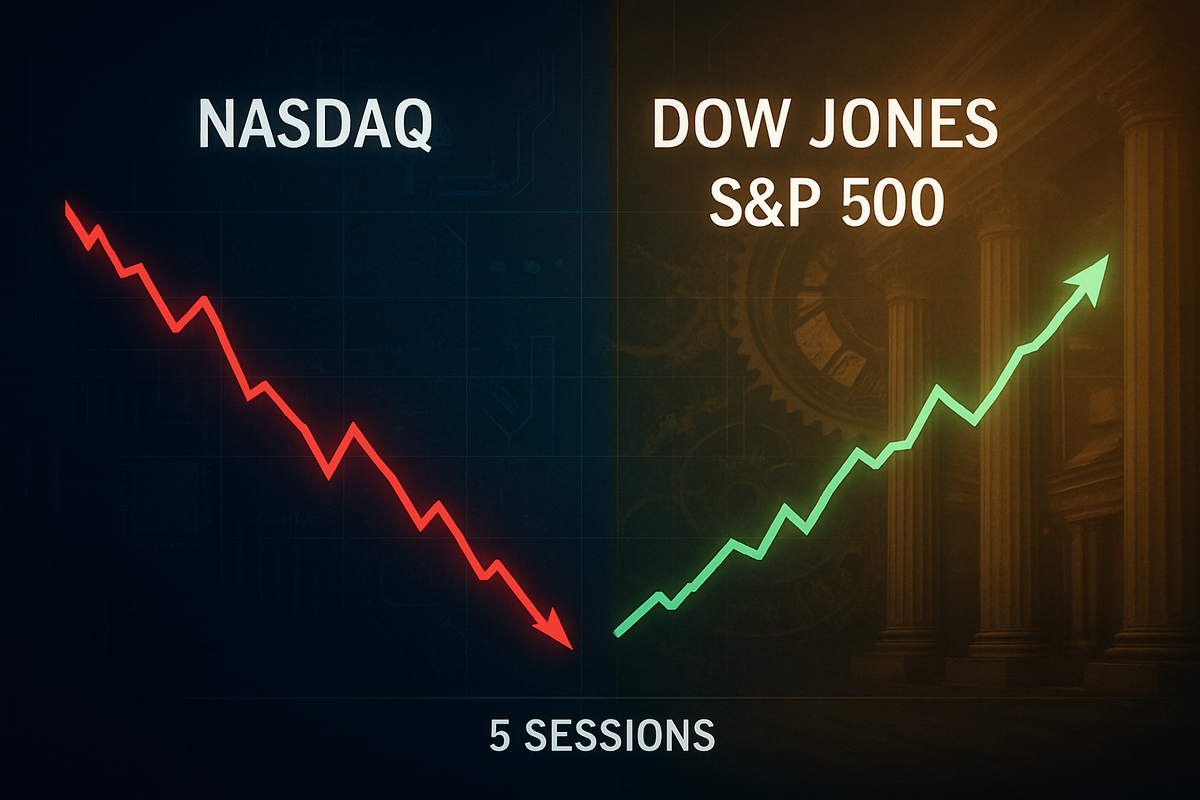
The tech-heavy Nasdaq Composite (NASDAQ: IXIC) began the new year on a somber note, extending its losing streak to five consecutive sessions on January 2, 2026. This marks the index's longest skid in over a year, a stark reversal from the bullish momentum that characterized much of 2025. While the Nasdaq struggled to find its footing, the broader market showed signs of resilience, with the Dow Jones Industrial Average (INDEXDJX: .DJI) and the S&P 500 (INDEXSP: .INX) both snapping their own year-end losing streaks to finish the day in positive territory.
The divergence highlights a growing rift in market sentiment as investors rotate out of high-growth technology stocks and into "Old Economy" cyclicals and value-oriented sectors. The Nasdaq’s 0.5% slide on Friday was fueled by a combination of disappointing electric vehicle delivery data, a shifting narrative around artificial intelligence (AI) monetization, and technical selling as institutional players locked in gains from the previous year.
A New Year's Hangover for Big Tech
The current five-session slump began on December 26, 2025, effectively neutralizing the traditional "Santa Claus rally" that investors typically expect during the final week of the year. The decline was exacerbated by a series of fundamental headwinds that hit the tech sector simultaneously. First, Tesla Inc. (NASDAQ: TSLA) reported that its 2025 annual sales fell for the second consecutive year, delivering 1.63 million vehicles compared to 1.79 million in 2024. This news sent shares of the EV giant tumbling 1.4% on the first trading day of 2026, acting as a significant weight on the consumer discretionary portion of the Nasdaq.
Furthermore, the "AI at any price" narrative that drove the markets for the past two years is facing a reality check. Recent reports from Oracle Corp. (NYSE: ORCL) regarding data center delays and a cautious outlook from Broadcom Inc. (NASDAQ: AVGO) on annual AI revenue guidance have fueled fears of an "AI bubble." This sentiment was compounded by the emergence of lower-cost AI models from international competitors like DeepSeek, which have begun to challenge the high-margin dominance of established U.S. software giants. Additionally, many institutional investors deferred selling their 2025 winners until January 2 to push capital gains tax liabilities into the 2026 tax year, creating a wave of programmed selling at the opening bell.
Winners and Losers: The Great Rotation
The primary beneficiaries of the tech exodus have been industrial and financial heavyweights. On January 2, the Dow Jones Industrial Average rose 0.7%, powered by strong performances from Boeing Co. (NYSE: BA), which gained 4.7%, and Caterpillar Inc. (NYSE: CAT), up 4.5%. These "quality value" stocks are seeing renewed interest following the implementation of the "One Big Beautiful Bill" Act (OBBBA) on January 1, 2026, which promises significant deregulation and tax relief for domestic manufacturing and infrastructure sectors.
In contrast, the "Magnificent Seven" and other high-beta tech names have faced a "show me the money" phase. Microsoft Corp. (NASDAQ: MSFT) saw its shares dip 0.9% as investors questioned the timeline for significant returns on its massive AI infrastructure investments. However, not all tech was treated equally; NVIDIA Corp. (NASDAQ: NVDA) managed to stabilize with a 1.3% gain on Friday, suggesting that investors are still willing to hold hardware providers with proven cash flows even as they trim exposure to experimental software and services.
Analyzing the Wider Significance
This shift in market leadership reflects a broader industry trend toward fundamental valuation over speculative growth. The Nasdaq's underperformance is a signal that the "AI euphoria" is maturing into a more discerning investment environment. Historically, such streaks often precede a shift in the Federal Reserve's policy focus. While the Fed implemented three rate cuts in late 2025, minutes from the December meeting revealed a committee divided over "sticky" inflation projections of 2.4% to 2.7% for 2026. This uncertainty has made the high-valuation tech sector particularly vulnerable to interest rate jitters.
The divergence also carries geopolitical weight. A "tariff truce" on consumer goods announced on New Year's Eve provided a tailwind for Dow-listed retailers and manufacturers but did little to alleviate the trade-sensitive pressures on the semiconductor and hardware sectors. This environment mirrors the market dynamics of early 2024, where a similar January slump eventually gave way to a broader recovery, though the current technical damage to the Nasdaq suggests a more cautious path forward in the first quarter of 2026.
Technical Support and the Path Ahead
From a technical perspective, the Nasdaq Composite is currently in a precarious position. The index ended the session testing a critical long-term uptrend line at 23,100. A sustained break below this level could signal a deeper correction toward the 200-day moving average, which currently sits near the 20,829 to 23,247 range depending on the weighting model used. However, there is a silver lining for bulls: the 14-day Relative Strength Index (RSI) for the Nasdaq has dropped to 28, indicating that the index is technically "oversold."
Short-term, the market may be due for a "relief bounce" as the RSI levels suggest the selling has been overextended. Long-term, the Nasdaq's recovery will likely depend on the upcoming Q4 2025 earnings season. Investors will be looking for concrete evidence that AI investments are translating into bottom-line growth. If software giants fail to provide clear monetization paths, the rotation into the Dow's industrial and financial sectors could become a defining theme for the first half of 2026.
Market Wrap-Up and Investor Outlook
The Nasdaq's five-session losing streak is a sobering reminder that even the most powerful bull markets require periods of consolidation and revaluation. While the Dow and S&P 500 have found early support in 2026, the tech sector remains under pressure from a combination of cooling AI sentiment, disappointing EV growth, and shifting fiscal policies. The key takeaway for investors is the clear move toward "quality" and "value"—a trend that has been bolstered by the recent passage of the OBBBA and a more cautious Federal Reserve.
Moving forward, the 23,100 level on the Nasdaq Composite is the most important number for traders to watch. A successful defense of this support could lead to a healthy recovery, while a failure could open the door for a more significant market reset. In the coming months, the focus will remain squarely on earnings transparency and the impact of new trade policies on the global tech supply chain.
This content is intended for informational purposes only and is not financial advice.