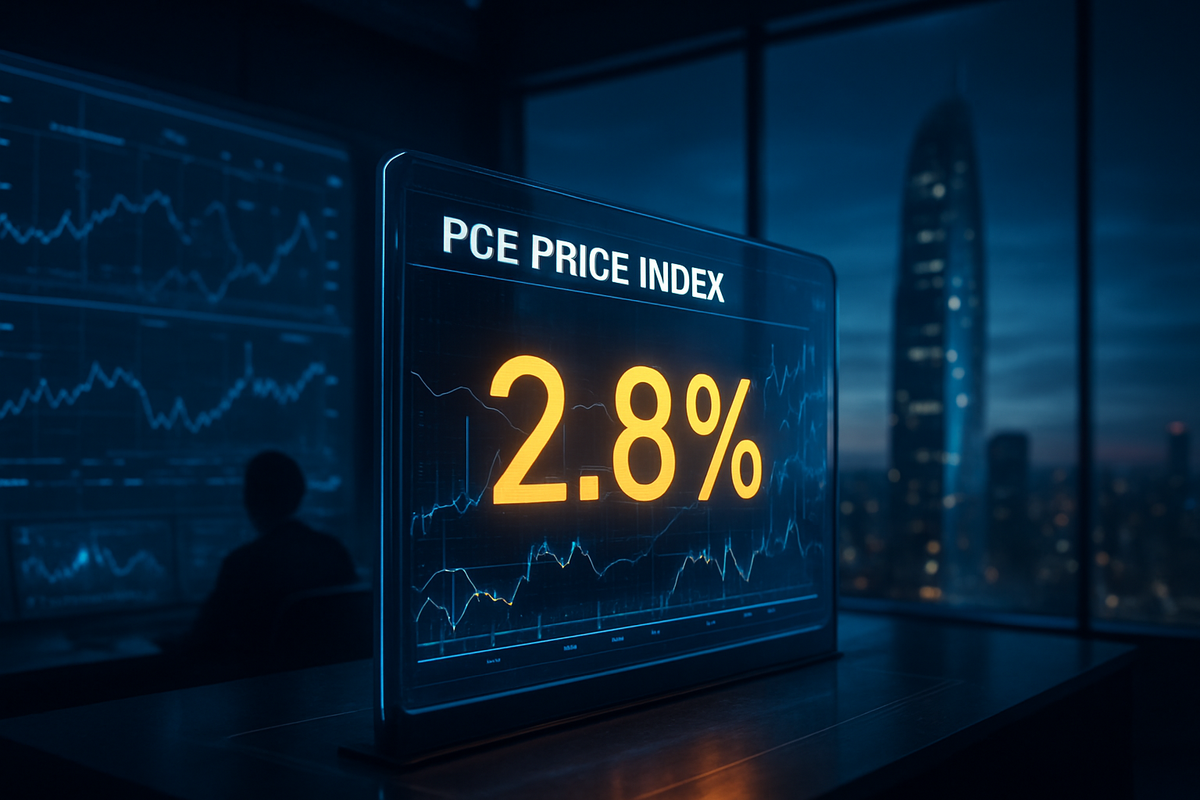
As the clock ticks toward the end of January 2026, Wall Street is laser-focused on a single number: the Personal Consumption Expenditures (PCE) price index. With the current date of January 20, 2026, the financial world is bracing for a critical update that has been complicated by recent government administrative delays. Economists are signaling that a 2.8% year-over-year print for core PCE could be the "make-or-break" moment for interest rate expectations in the first half of the year.
The release is particularly significant this month. A government shutdown in late 2025 disrupted the standard reporting cycle of the Bureau of Economic Analysis (BEA), leading to a high-stakes "catch-up" report scheduled for January 22, 2026, covering October and November data, followed by the December 2025 figures in February. For investors, a 2.8% reading would confirm fears that inflation is no longer cooling but has instead hit a "sticky" plateau, potentially forcing the Federal Reserve to maintain its restrictive stance far longer than the market had hoped.
Persistent Pressures and Data Delays
The road to this week’s data release has been anything but smooth. Throughout the final quarter of 2025, the U.S. economy faced a "perfect storm" of inflationary pressures, including a resurgence in goods prices driven by new trade tariffs and a resilient labor market that has kept service-sector wages high. These factors have pushed the PCE index back into the spotlight as the definitive measure of whether the Fed’s "last mile" of disinflation has turned into a dead end.
Originally, markets expected a steady glide path toward the 2% target, but a 2.8% print would represent a stalled progress narrative. This figure is not just a statistical data point; it is a psychological barrier. In the early weeks of 2026, Federal Reserve officials, led by Chair Jerome Powell, have repeatedly signaled that "substantial progress" is required before any further easing of the federal funds rate, which currently sits in the 3.50% to 3.75% range.
The timeline of events leading to this moment is defined by the late-2025 government shutdown, which created a "data blackout." During this period, market participants were left to speculate on the impact of holiday spending and the initial waves of tariff-related price hikes. As the BEA finally prepares to release its delayed findings, the 2.8% forecast has become the consensus "line in the sand." If the data comes in at or above this level, it would solidify a "hawkish hold" from the Federal Open Market Committee (FOMC), effectively erasing any remaining hopes for a rate cut in the first quarter of 2026.
Initial reactions from institutional bond desks suggest that the "higher for longer" narrative is already being priced back in. Yields on the 2-year Treasury note have climbed in anticipation, as investors move to hedge against a scenario where the Fed remains sidelined until at least June. The tension is palpable: after nearly two years of battling inflation, the 2.8% figure suggests that the final victory remains elusive.
Winners and Losers in a High-Rate World
The implications of a 2.8% PCE print are far from uniform across the equity markets. For large-cap financial institutions like JPMorgan Chase & Co. (NYSE: JPM), a "higher for longer" environment can be a double-edged sword but often leans toward a benefit. JPMorgan’s "fortress balance sheet" allows it to capitalize on higher net interest margins (NIM), as the rates it charges on loans remain high while its cost of funding remains relatively stable compared to smaller, more fragile peers.
Conversely, the regional banking sector remains on high alert. Companies like Regions Financial Corp. (NYSE: RF) are particularly sensitive to sustained high rates, which can increase the risk of defaults in commercial real estate portfolios and squeeze margins as deposit costs rise. A 2.8% inflation reading would likely trigger a sell-off in regional bank stocks, as it signals that the relief of lower interest rates is still months, if not quarters, away.
In the technology and growth sectors, the impact is equally bifurcated. While NVIDIA Corp. (NASDAQ: NVDA) has shown remarkable resilience due to the ongoing AI infrastructure supercycle, other growth-dependent giants like Amazon.com, Inc. (NASDAQ: AMZN) could face headwinds. Higher interest rates dampen the discretionary spending power of the middle-class consumer, and for a company like Amazon, a 2.8% PCE print suggests that the cost of living—and the cost of capital for its massive logistical expansions—will remain stubbornly high.
Real Estate Investment Trusts (REITs) are perhaps the most exposed. Office-focused firms like Kilroy Realty Corp. (NYSE: KRC) are already struggling with secular shifts in workplace demand; a 2.8% PCE reading would mean higher refinancing costs for their substantial debt loads, with little hope for the "cap rate compression" that usually drives property values higher. On the other hand, exchange operators like CME Group Inc. (NASDAQ: CME) tend to thrive in these conditions, as rate uncertainty drives massive spikes in trading volume for interest rate derivatives.
Analyzing the Macro Significance
To understand why this specific data point carries such weight, one must look at why the Federal Reserve prefers the PCE index over the more commonly cited Consumer Price Index (CPI). The PCE is a broader, more dynamic gauge. It utilizes a "substitution" formula, which accounts for the fact that if the price of beef skyrockets, consumers will likely switch to chicken. This makes it a more accurate reflection of actual consumer behavior compared to the CPI’s relatively fixed basket of goods.
Furthermore, the PCE includes expenditures made on behalf of households, such as employer-paid healthcare and Medicare. In early 2026, with healthcare costs representing a growing slice of the economic pie, the Fed views this weighting as more representative of the total economy. While the CPI is heavily influenced by shelter and housing (roughly 34%), the PCE gives it a more modest 15% weight, allowing the Fed to look past some of the "laggy" data associated with rental agreements and focus on broader inflationary trends.
A 2.8% print would fit into a broader industry trend of "reshoring" and trade regionalization. As companies move supply chains closer to home or navigate new tariff landscapes, the cost of goods is finding a higher floor. This structural shift suggests that the 2% target, once considered an easy baseline, may be harder to achieve in the post-globalization era. Historical precedents, such as the "stop-go" inflation of the 1970s, haunt the current FOMC, making them terrified of cutting rates too early only to see inflation reignite.
The Road Ahead: Strategic Pivots
What comes next depends entirely on the "supercore" components of the report—services excluding energy and housing. If a 2.8% headline figure is driven by these sticky service costs, the Fed is likely to pivot its communication from "when will we cut" to "how long must we hold." In the short term, this will likely lead to increased market volatility as "soft landing" bulls are forced to recalibrate their models for a "no landing" or "forced slowing" scenario.
Strategically, companies will need to adapt to a high-cost-of-capital environment as a permanent fixture rather than a temporary hurdle. We may see a "dealmaking renaissance" where firms like JPMorgan Chase (NYSE: JPM) lead a wave of M&A as weaker competitors are forced to sell to more capitalized players. Additionally, the focus on AI and automation—led by firms like NVIDIA (NASDAQ: NVDA)—will likely accelerate as businesses seek to offset high labor and borrowing costs with massive gains in productivity.
Potential scenarios range from a "Goldilocks" stabilization, where 2.8% is the peak of a plateau before a slow drift down, to a "re-acceleration" scenario where new geopolitical tensions push the figure back toward 3.5%. Investors should be prepared for a year where the "fed-speak" remains remarkably consistent: cautious, data-dependent, and decidedly un-dovish.
Market Outlook and Final Thoughts
In summary, the 2.8% PCE threshold is the definitive marker for the 2026 economic landscape. It represents the point where inflation is no longer a "crisis" but remains a persistent "nuisance" that prevents the Federal Reserve from returning to the low-rate environment that characterized the previous decade. For the market, the key takeaway is that the "last mile" of the inflation fight is proving to be the most grueling.
Moving forward, the market will likely be defined by a sharp divide between the "winners" who possess fortress balance sheets and pricing power, and the "losers" who are overly reliant on cheap debt and discretionary consumer spending. Investors should keep a close eye on the February 20, 2026, release of the full December data, as that will confirm whether the 2.8% trend is a one-off anomaly or the new reality.
The coming months will require a disciplined approach. While the AI-driven tech rally has provided a cushion for the major indices, a 2.8% PCE print serves as a reminder that the macro-economic gravity of interest rates still applies. For now, the "wait-and-see" approach of the Fed has become the "wait-and-worry" approach for Wall Street.
This content is intended for informational purposes only and is not financial advice.