As the financial world looks toward January 28, 2026, the upcoming quarterly earnings report for Tesla (NASDAQ: TSLA) marks a definitive turning point in the company’s history. For over a decade, Wall Street analysts obsessed over "deliveries"—the raw number of electric vehicles (EVs) rolling off assembly lines. However, as the 2025 fiscal year concludes, a profound decoupling has occurred. While traditional automotive metrics show a company in retreat, with annual deliveries dipping to 1.636 million units from their 2024 peaks, Tesla’s market valuation remains anchored not in the steel of its chassis, but in the silicon of its AI.
This week’s earnings report is expected to be a "tale of two Teslas." On one hand, the core manufacturing business is grappling with its second consecutive year of volume decline and an adjusted EPS projected to fall by nearly 40% year-over-year to roughly $0.46. On the other hand, the burgeoning "Tesla Network" and the promise of autonomous software margins have created a speculative floor that traditional car manufacturers like Ford or General Motors could only dream of. Investors are no longer buying a car company; they are pricing a global robotics and sovereign AI utility.
The Road to the Robotaxi: A Pivot Years in the Making
The transition to an "AI-first" enterprise has been characterized by aggressive strategic shifts throughout 2025. Following the high-profile unveiling of the "Cybercab" in late 2024, Tesla (NASDAQ: TSLA) has spent the last twelve months retooling its Gigafactory in Texas for a radical new manufacturing process. Unlike the Model 3 or Model Y, the Cybercab is designed without a steering wheel or pedals, representing a "bet-the-company" move that Elon Musk has compared to the original Model 3 production ramp.
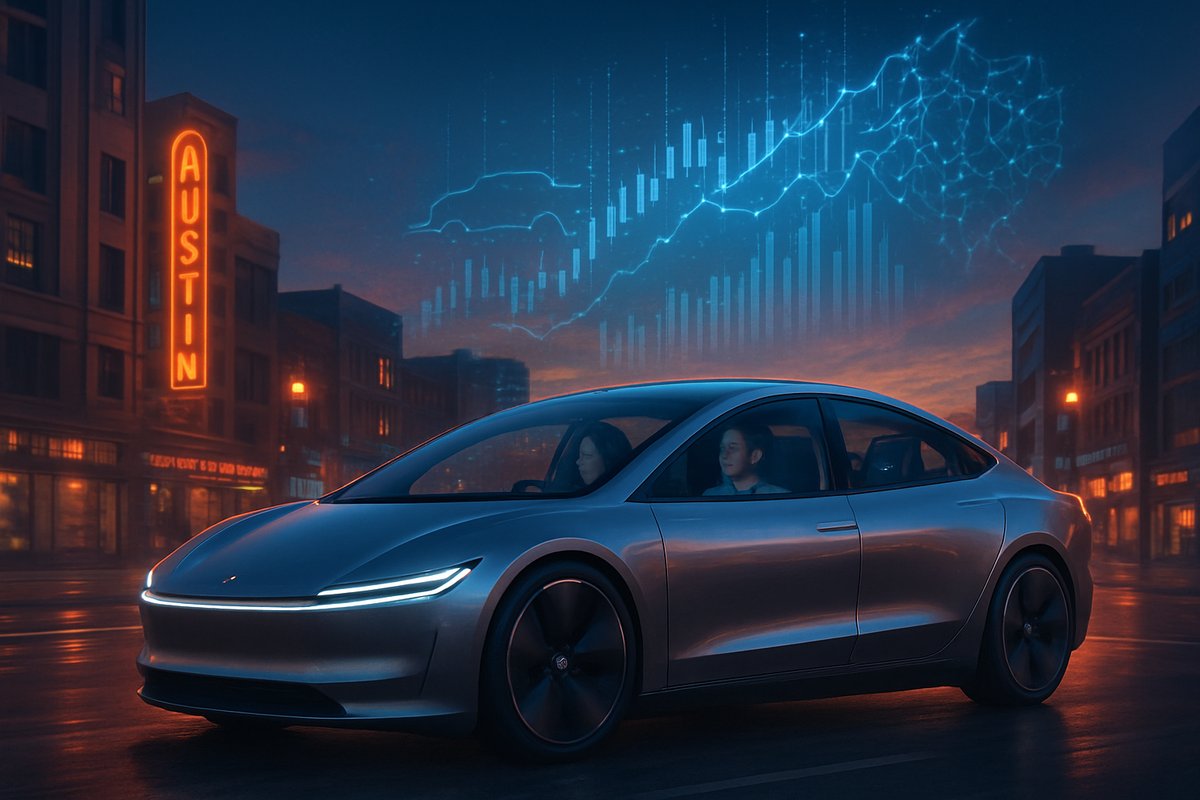
The timeline leading to this week's earnings has been punctuated by a major milestone: the late-January 2026 launch of "unsupervised" robotaxi rides in Austin, Texas. This pilot program, though limited in geography, serves as the first real-world proof of Tesla’s vision-only autonomous stack operating without a safety driver. Simultaneously, Tesla has moved to finalize its shift toward a recurring revenue model. By announcing the end of the $8,000 one-time Full Self-Driving (FSD) purchase option effective February 14, 2026, the company is forcing users into a $99-per-month subscription, aiming to transform its low-margin automotive hardware into high-margin software-as-a-service (SaaS) units.
Initial market reactions to these moves have been polarized. Institutional investors have largely applauded the growth in the Energy division, which deployed a staggering 14.2 GWh of storage in Q4 2025 alone, helping to offset the revenue bleed from the automotive side. However, retail sentiment remains jittery. The "Cybercab" is not slated for mass production until April 2026, and Musk’s recent warnings about an "agonizingly slow" initial ramp-up have kept a lid on short-term stock gains despite the AI hype.
Winners and Losers in the Autonomous Transition
The primary winner in this shift, at least in terms of technological validation, appears to be Alphabet Inc. (NASDAQ: GOOGL), the parent company of Waymo. While Tesla is just starting unsupervised trials in Austin, Waymo has already achieved "the gold standard," completing over 14 million driverless trips in 2025 and operating over a million weekly rides across major U.S. hubs. Waymo’s reliance on lidar and radar—sensors Tesla famously eschews—currently gives it a perceived safety edge that has allowed it to scale more rapidly in the eyes of regulators.
Conversely, the "losers" in this new paradigm appear to be traditional mass-market EV manufacturers who lack a credible software play. BYD Company Limited (OTC: BYDDF) has officially surpassed Tesla as the world’s largest manufacturer of battery electric vehicles, delivering 2.26 million units in 2025. However, BYD lacks the high-margin autonomous software ecosystem that Tesla is building, leaving them vulnerable to the low-margin "commodity trap" of basic vehicle manufacturing. Tesla is essentially surrendering the volume crown to BYD to chase the much more lucrative robotaxi market.
Another complex player is Uber Technologies, Inc. (NYSE: UBER). Initially feared as a casualty of the robotaxi revolution, Uber has positioned itself as the "interface for all." By partnering with Waymo and other autonomous developers, Uber has turned itself into a marketplace for robotaxis rather than a competitor. Tesla’s decision to build its own "Tesla Network" app instead of partnering with Uber creates a "walled garden" strategy that could either result in total dominance or isolation, depending on how quickly Tesla can scale its fleet.
Industry Trends and the Regulatory Gauntlet
Tesla’s pivot reflects a wider industry trend where hardware is becoming secondary to data and intelligence. Much like the smartphone industry shifted from selling handsets to selling services and apps, the automotive sector is moving toward "Mobility-as-a-Service" (MaaS). This evolution has significant ripple effects on competitors like Rivian Automotive (NASDAQ: RIVN) and Lucid Group (NASDAQ: LCID), who are now under immense pressure to prove their own AI credentials to justify their valuations in a world where "just being an EV" is no longer enough.
However, the path is fraught with regulatory landmines. While Tesla’s vision-only approach is cheaper to manufacture, it faces a skeptical eye from international regulators. Just this month, Chinese state media debunked Musk's optimistic claims that FSD would be approved in China by February 2026, citing unresolved concerns over data security and cross-border information flows. Historically, this mirrors the early days of the ride-sharing industry, which faced years of litigation and local bans before becoming mainstream. The difference now is that the stakes involve life-and-death safety metrics on a global scale.
The precedent for this shift can be found in the early 2000s transition of companies like IBM, which pivoted from hardware (PCs) to high-margin consulting and software. If Tesla succeeds, it will be the first time a capital-intensive heavy manufacturer has successfully transitioned into a pure-play tech giant. If it fails, it risks becoming a niche player in an industry dominated by low-margin Chinese manufacturers and high-tech autonomous platforms like Waymo.
Looking Ahead: The April Ramp and Beyond
In the short term, the market will likely react more to Tesla’s "FSD take rate" and "Energy gross margins" than its car delivery numbers. Analysts will be listening closely during the Q4 call for any updates on the "April 2026" production target for the Cybercab. Any hint of a delay could trigger a massive sell-off, as the stock is currently "priced for perfection" regarding its autonomous future.
The long-term scenario for Tesla depends on its ability to solve the "last 1%" of autonomy—handling edge cases like heavy snow or erratic human behavior—using only cameras. If Tesla can prove its vision-only system is as safe as Waymo’s sensor-fusion approach, its cost advantage will be insurmountable. This would allow Tesla to undercut every competitor on ride-hailing prices, potentially making car ownership obsolete for a large segment of the urban population.
Final Assessment for Investors
The takeaway from the upcoming earnings report is clear: the Tesla of old is gone. The "car company" that grew at 50% year-over-year has been replaced by a "robotics venture" with fluctuating hardware revenue and massive capital expenditures. Investors should brace for volatility; the 40% drop in EPS is a bitter pill to swallow, but it is the cost of building the AI infrastructure (Dojo and Optimus) that Tesla believes will define the next decade.
Moving forward, the key metrics to watch are not just vehicle deliveries, but the expansion of the Tesla Network pilot programs and the regulatory progress of FSD in Europe and China. As we approach the Cybercab's production start in April, the "execution risk" is at an all-time high. Tesla is effectively attempting to reinvent the wheel, the driver, and the business model all at once. For the patient investor, the potential for SaaS-like margins remains the ultimate prize; for the skeptic, the declining vehicle sales are a warning of a company losing its grip on reality.
This content is intended for informational purposes only and is not financial advice.